The 14 Best LLM Visibility Tools in 2026 (LLM SEO & ChatGPT SEO)
Sightivo
The 14 Best LLM Visibility Tools in 2026 (LLM SEO & ChatGPT SEO)
14 LLM visibility and LLM SEO tools compared on engines, prompt limits, API access and price — prices verified August 2026 — with free and under-$50 picks.

An LLM visibility tool tells you whether large language models — ChatGPT, Claude, Gemini, Perplexity, Google's AI Mode and AI Overviews — name your brand when someone asks a question in your category, which competitors they name instead, and which pages they cite while doing it. "LLM SEO tools" and "ChatGPT SEO tools" are the same category under a different search term; the tools below are what you find whichever phrase you type.
This guide compares fourteen of them, from a $20 credit-based tracker to enterprise platforms sold on a call, on the things that actually differ: engines covered, prompts at the entry price, whether you get an API, and what the tool does with a gap once it finds one. It is written for the founder or small team deciding what to pay for, so cheap and free options get real attention rather than a footnote.
The Best LLM Visibility Tools at a Glance
| Tool | Best for | Engines tracked | Starting price | Free tier / trial | Acts on the data? |
|---|---|---|---|---|---|
| Sightivo | Turning LLM gaps into pages and earned mentions | ChatGPT, Claude, Google AI Overviews | $99/mo | 3-day trial (card) + free checker | Yes — pages, sources, outreach |
| Otterly.AI | Cheapest paid monitor | ChatGPT, AI Overviews, Perplexity, Copilot (+ add-ons) | $29/mo | Free trial | No |
| Nightwatch | LLM tracking beside classic rank tracking | ChatGPT, AI Overviews and more, with citation sentiment | ~$32–39/mo | 14-day trial | No |
| Rankscale | Most engines for the least money | ChatGPT, Perplexity, AI Mode, AI Overviews, Gemini, Claude, Copilot, Grok, DeepSeek, Mistral | From $20/mo | 7-day trial on Pro | Partly — page audits |
| LLMrefs | 500 prompts and an API on one flat plan | ChatGPT, AI Overviews, AI Mode, Gemini, Perplexity, Claude, Copilot, Meta AI | $79/mo | 7-day trial, no card | No |
| AIclicks | AI Overviews tracking | ChatGPT, Gemini, Perplexity default; AI Overviews, Claude, Copilot, AI Mode, Grok, Meta, DeepSeek, Mistral on tiers | $59/mo | 3-day trial, no card | No |
| Peec AI | Clean daily tracking for mid-market brands | 3 of 6 per plan | $80/mo (annual) | 7-day trial, no card | No |
| Profound | Enterprise research and prompt volumes | ChatGPT (Starter); +Perplexity, AI Overviews (Growth); up to 9 | $99/mo | Trial via signup | Partly |
| Scrunch AI | Persona-based prompt sets, every engine | ChatGPT, Claude, Gemini, Perplexity, AI Mode/Overviews, Meta | $250/mo (annual) | 7-day trial, no card | Partly — audits |
| Semrush AI Visibility Toolkit | Semrush customers | ChatGPT, Gemini, Perplexity, AI Overviews | $99/mo per domain | Free checker | Partly |
| Ahrefs Brand Radar | Prompt-volume research on a 414M-prompt index | AI Overviews/AI Mode, ChatGPT, Perplexity, Copilot, Gemini, Grok | $199/mo per platform (+ Ahrefs) | Free checker | No |
| HubSpot AEO | Cheapest entry for HubSpot customers | ChatGPT, Gemini, Perplexity | $50/mo add-on | Free AI Search Grader | Partly |
| SE Visible | Standalone tracking from the SE Ranking engine | ChatGPT, AI Overviews, AI Mode, Gemini, Perplexity | From $79/mo | 14-day trial | Partly |
| Athena HQ | Most generous free tier | 5 engines free; 9 on Starter | Free → $295/mo | Free tier (~300 credits) | Partly |
Prices verified August 2026 against each vendor's published plans; annual-billing prices are marked.
What LLM Visibility Actually Measures
Before the tools, the numbers — because the dashboards all look alike and the definitions do not.
- Mention rate. The share of tracked prompts where the model names your brand at all. Most brands start near zero. That is not a verdict; it is the baseline almost everyone shares.
- Citation rate. The share of prompts where a page on your domain is cited as a source. A model can recommend you from what it learned in training and never link to you; it can also cite a page of yours while recommending someone else. Mention and citation are different signals and good tools report both.
- Share of voice. Your mentions as a share of all brands named across the prompt set, against the competitors you specify.
- Sentiment and framing. Whether you are named as the default, the budget option, the alternative, or a caution. Position in a list matters more than most dashboards admit; Evertune's review of 40,000 heavily cited URLs found half of ChatGPT's citations are listicles and 58% of those are ranked.
- Cited sources. The third-party pages the engines lean on for your category. This is the most useful output in the category and the least-used: it is the list of places to get mentioned.
- Sampling. The same prompt returns different answers on different runs. A tool that reports one sample per prompt is reporting noise; look for how many samples per prompt per engine, and for a stated cadence.
Two external numbers frame why the category exists. Ahrefs' study of 75,000 brands found branded web mentions correlate with AI visibility at 0.664 against 0.218 for backlinks — roughly three to one — so what an LLM says about you is driven by what other pages say about you. And Seer Interactive's client data put ChatGPT referral conversion at 15.9% versus 1.76% for Google organic: small traffic, unusually high intent.
How to Build a Prompt Set Worth Tracking
Every tool on this list is only as useful as the prompts you give it, and the default prompt sets most of them generate are generic. Ten minutes on the set is worth more than any feature comparison.
Write prompts the way buyers ask, not the way SEOs search. "best CRM for a 10-person startup" and "what should a small SaaS use instead of HubSpot" are prompts; "crm software" is a keyword. Models answer the first two with a list of names, which is the answer you are trying to be in.
Cover four intents. Category discovery ("best [category] for [situation]"), comparison ("[incumbent] alternatives", "[A] vs [B]"), problem-first ("how do I [job your product does]"), and branded ("is [your brand] any good", "[your brand] pricing"). The branded prompts tell you what the model believes about you; the other three tell you whether it thinks of you at all.
Match the count to the tool. Fifteen prompts (Otterly Lite) covers one category thinly; 50 (Peec, Profound Starter) covers one category properly; 200–500 (SE Visible, LLMrefs) covers several products or markets. Buying 500 prompts for a single-product startup buys noise.
Keep the set stable. Mention rate is only meaningful as a trend, and a trend needs the same prompts run the same way month after month. Add prompts; do not rewrite them. Most tools version prompts badly, so keep your own copy of the set.
Read the fan-out queries. ChatGPT, Gemini and AI Mode expand a prompt into several searches before answering. Tools that show those sub-queries (Profound, LLMrefs, Otterly, Sightivo) are showing you the keywords the model actually used — which are frequently not the ones you would have guessed, and are the cheapest content brief you will get.
How Often Should You Run It?
Weekly is the sensible default for a small team: often enough to see a new listicle or a competitor launch land, rare enough that the noise between runs does not look like a trend. Daily tracking (Peec, Nightwatch, Rankscale on higher tiers) matters for agencies reporting to clients and for launches; monthly is enough for a brand that is not yet doing anything about the results. Whatever the cadence, insist on at least three samples per prompt per engine — a single run of a non-deterministic system is an anecdote.
How We Chose
Four criteria, weighted in this order: what the tool does with a gap (a number, an export, an on-page audit, or an off-page action); engine coverage relative to the engines your buyers use, not the vendor's logo count; prompt control — do you write them, how many, and can you see the fan-out queries the engine actually ran; and entry price after the base plans and per-engine add-ons that headline prices hide.
This comparison is based on published plans, documentation and user reviews as of August 2026, plus the free tiers and trials we had access to. We have not run a controlled accuracy test across fourteen tools; LLM answers vary by session, region and model version, and any vendor publishing a precise accuracy ranking should be asked how they controlled for that.
The 14 Best LLM Visibility Tools
Our tool
1. Sightivo
Disclosure: Sightivo is our product. The facts below are the same ones we hold competitors to.
Sightivo tracks the buyer prompts in your category across ChatGPT, Claude and Google AI Overviews, records which brands are named, in what position and framing, and which sources are cited — then does the part the rest of the list stops at. It drafts the comparison, list and answer pages your site is missing, finds the third-party pages the models already cite and that are open to adding you, surfaces the authors and contacts behind them, and drafts the outreach.
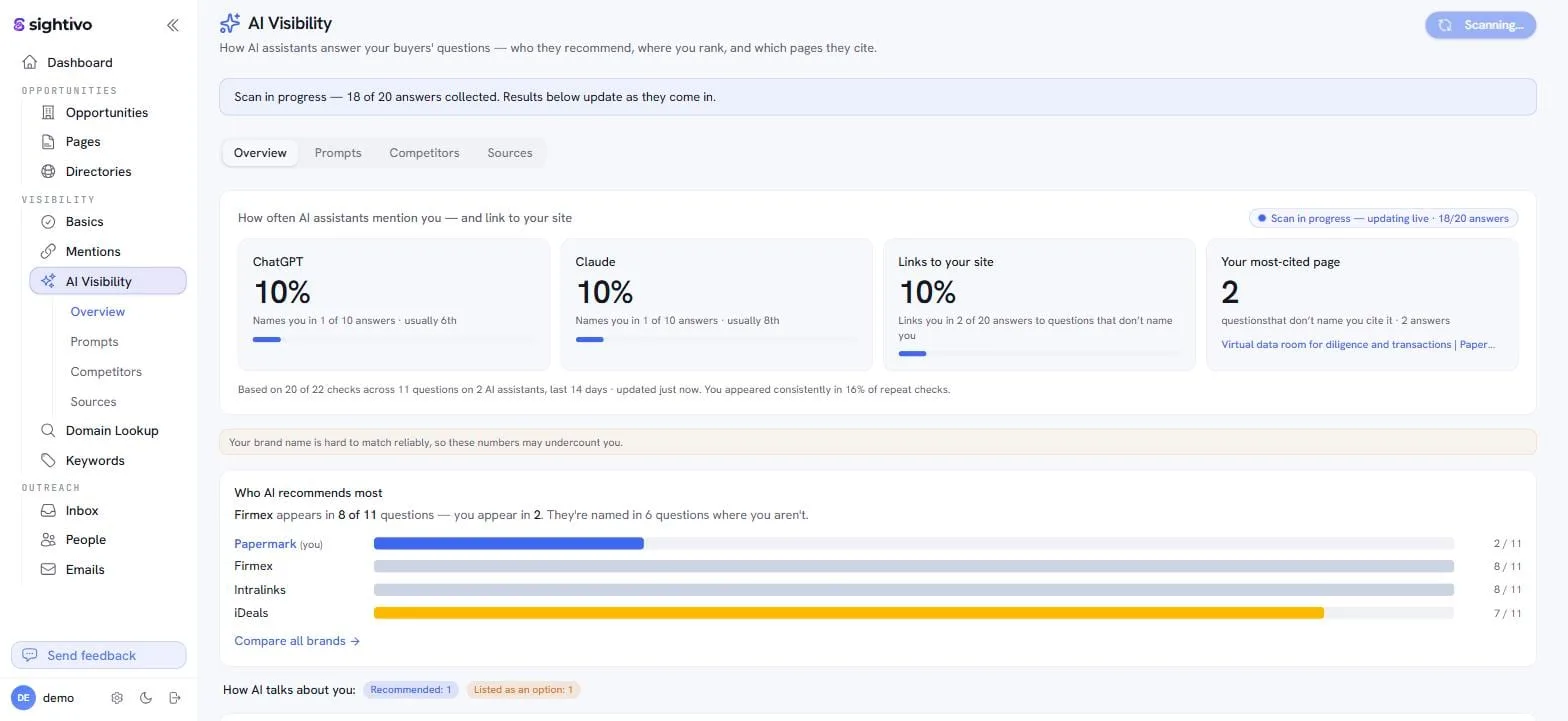
Engines: ChatGPT, Claude, Google AI Overviews.
Pricing: Solo $99/mo (2 projects), Indie $199/mo (4), Studio $399/mo (10); unlimited seats on every plan. 3-day trial with a card; no long-term free plan. The free AI visibility checker runs five ChatGPT prompts on any domain with no signup for the first check.
Best for: Startups and small teams that want the next action, not the next number.
One honest con: Three engines rather than nine; prompt volumes sized for one brand; no white-label reporting.
2. Otterly.AI
The cheapest paid LLM monitor and a sensible first purchase. Otterly turns your existing keywords and URLs into prompts, tracks them across the base engines, audits pages for GEO readiness, and on Standard and above exposes an API and an MCP endpoint.
Engines: ChatGPT, Google AI Overviews, Perplexity, Copilot on all plans; Claude, Gemini and AI Mode are paid add-ons.
Pricing: Lite $29/mo — 15 prompts, 1,000 URL audits. Standard $189/mo — 100 prompts, API/MCP. Premium $489/mo — 400 prompts. Annual −15%. Free trial.
Best for: Confirming the problem exists for under $30.
One honest con: 15 prompts is too few for most categories, and the engine add-ons erode the price advantage.
3. Nightwatch
Nightwatch is a rank tracker that added LLM tracking, AI Overviews tracking and citation sentiment without abandoning the thing it was good at. If you want ChatGPT answers next to your Google positions in one report, with no per-seat pricing, it is the pragmatic choice.
Engines: ChatGPT and Google AI Overviews with citation sentiment; further LLMs on the AI tracking product.
Pricing: From roughly $32–39/mo; 14-day trial; no per-seat charge.
Best for: Small teams that already track rankings and want LLM answers beside them.
One honest con: The LLM layer is a feature of a rank tracker, not a platform — no source-level outreach, no content workflow.
4. Rankscale
Rankscale covers more engines than anything else on the list at the lowest starting price, bills by AI answers rather than prompt caps, and adds page audits and brand dashboards on Pro.
Engines: ChatGPT, Perplexity, Google AI Mode, AI Overviews, Gemini, Claude, Copilot, Grok, DeepSeek, Mistral and more.
Pricing: Essentials from $20/mo. Pro $99/mo — up to 4,800 answers, ten dashboards, 50 audits, 7-day trial. Growth $385/mo. Enterprise $780/mo.
Best for: Engine breadth on a small budget.
One honest con: Credit billing makes "how many prompts" a maths problem, and the action layer stops at your own pages.
5. LLMrefs
LLMrefs sells one flat plan with what most vendors spread across three: 500 tracked prompts, eight engines, fan-out query tracking, geo-targeting across 50-plus countries, unlimited team members and projects, CSV export and API access — plus a bundle of free SEO tools (crawlability checker, Reddit thread finder, llms.txt generator).
Engines: ChatGPT, Google AI Overviews, AI Mode, Gemini, Perplexity, Claude, Copilot, Meta AI.
Pricing: All-in-One $79/mo (advertised as a limited-time price). 7-day trial, no card.
Best for: Volume and an API without an enterprise conversation.
One honest con: Monitoring only, and a one-plan pricing structure that may not stay at $79.
6. AIclicks
AIclicks is best known for its AI Overviews tracker — it ranks first for the term — and sells the same tracking across the other engines in tiers. Three engines are on by default; the rest are enabled by plan.
Engines: ChatGPT, Gemini, Perplexity by default; Google AI Overviews, Claude, Copilot, AI Mode, Grok, Meta, DeepSeek, Mistral by tier.
Pricing: Starter $59/mo — 30 prompts. Pro $189/mo — 150 prompts. Business $499/mo — 300 prompts. 3-day trial, no card, on Starter and Pro.
Best for: Teams whose main question is "are we in the AI Overview".
One honest con: 30 prompts at $59 is thinner than Otterly or LLMrefs per dollar, and there is no action layer.
7. Peec AI
Peec is the clean, daily-tracking option for mid-market brands and the agencies that serve them: source and citation views, competitor benchmarking, and an interface clients understand. Every self-serve plan lets you pick three of six engines.
Engines: Three per plan from ChatGPT, AI Mode, AI Overviews, Copilot, Perplexity and Gemini; up to eleven on Enterprise.
Pricing: Starter $80/mo billed annually — 50 prompts, one project. Pro $205/mo — 150 prompts. Advanced $420/mo — 350 prompts, multi-country, Looker Studio. 7-day trial, no card.
Best for: Daily tracking you can put in front of a client.
One honest con: Monitoring only; the three-engine cap applies to every tier without a sales call.
8. Profound
The enterprise reference point: real prompt volumes from a dataset Profound puts at 1.9 billion prompts, citation analysis, AI crawler analytics, and a content workflow that drafts a few articles a month. More than a thousand G2 reviews at around 4.5 stars.
Engines: ChatGPT only on Starter; ChatGPT, Perplexity, AI Overviews on Growth; up to nine on Enterprise.
Pricing: Starter $99/mo (annual) — ChatGPT only, 50 prompts. Growth $399/mo — three engines, 100 prompts. Enterprise custom.
Best for: Enterprise research depth.
One honest con: The $99 tier is one engine; three engines start at $399.
9. Scrunch AI
Persona-first: define your buyers, generate prompt sets from an industry library, track every engine, audit pages for AI readability. All engines on every plan.
Engines: ChatGPT, Claude, Gemini, Perplexity, AI Mode/AI Overviews, Meta.
Pricing: Starter $250/mo annual ($300 monthly) — three seats, 350 custom + 1,000 industry prompts. Growth $417/$500. Enterprise custom. 7-day trial, no card.
Best for: Enterprise teams that think in personas.
One honest con: No small plan; multi-brand is Enterprise-only.
10. Semrush AI Visibility Toolkit
A $99/month per-domain add-on with 25 prompts included and about $60 per additional 50; mentions, sentiment and share of voice across four engines, inside the Semrush suite.
Engines: ChatGPT, Gemini, Perplexity, AI Overviews.
Pricing: $99/mo per domain on top of a Semrush plan; free AI Search Visibility Checker.
Best for: Semrush customers who want one login.
One honest con: The least generous prompt allocation per dollar on this list.
11. Ahrefs Brand Radar
A research index more than a monitor: a prompt pool Ahrefs puts at 414 million-plus, used to measure how often a brand or topic appears in AI answers across platforms.
Engines: AI Overviews and AI Mode, ChatGPT, Perplexity, Copilot, Gemini, Grok.
Pricing: $199/mo per platform or $699/mo for all, plus an Ahrefs plan — realistically around $828/mo all-in. Free AI visibility checker.
Best for: Share-of-voice research at scale.
One honest con: The all-in price, and no action layer.
12. HubSpot AEO
A $50/month add-on ($45 annual) that tracks visibility and sentiment across three engines, reports competitor share of voice and citations, and gives prioritised recommendations — 25 prompts included. The free AI Search Grader is a one-off snapshot.
Engines: ChatGPT, Gemini, Perplexity.
Pricing: $50/mo add-on; free AI Search Grader.
Best for: HubSpot customers.
One honest con: 25 prompts, and recommendations that are mostly on-page.
13. SE Visible
SE Ranking's AI visibility engine sold standalone: 200 prompts, five engines, three projects, source and citation reporting, content suggestions.
Engines: ChatGPT, AI Overviews, AI Mode, Gemini, Perplexity.
Pricing: From $79–99/mo; 14-day trial. (Inside SE Ranking it is an $89/mo add-on on the $129 Core plan.)
Best for: 200 prompts across five engines without an enterprise contract.
One honest con: The action layer is content suggestions; nothing off-site.
14. Athena HQ
The most generous free tier in the category — five engines and roughly 300 credits — then a jump to $295 for a platform with competitor insights, content recommendations and an agent that proposes on- and off-page actions.
Engines: ChatGPT, Perplexity, AI Overviews, Gemini, Claude free; nine on Starter.
Pricing: Essential free (about 300 credits). Starter $295/mo (annual −17%) — 3,600 credits, CSV export. Enterprise custom.
Best for: A free multi-engine baseline.
One honest con: The free-to-$295 cliff, and credit billing that is hard to forecast.
API vs UI: Which Do You Need?
Most teams need a dashboard. A few need the data somewhere else — a warehouse, a Looker report, a Slack alert, an internal tool — and for them the API question decides the shortlist.
- API on an affordable plan: LLMrefs ($79, API included), Otterly Standard ($189, API and MCP), Profound (Enterprise), Peec (Enterprise), Athena (paid add-on on Starter).
- Reporting connectors instead of an API: Peec Advanced (Looker Studio), SE Ranking (its own reporting), Nightwatch (white-label reports).
- No API: HubSpot AEO, Semrush's toolkit (beyond the suite's own API), Rankscale's lower tiers.
If your question is "which of my pages does ChatGPT cite and where are the gaps", a UI is enough. If your question is "alert me when a competitor's share of voice moves five points on any prompt", you want an API, and LLMrefs is the cheapest honest answer.
Picks by Situation
Free. Athena HQ's Essential tier; AirOps' free ChatGPT tracking (100 prompts, not in the table because its multi-engine plans are quoted); the one-off checkers from HubSpot, Semrush, Ahrefs and ours. Full list: free AI visibility tools.
Under $50/mo. Rankscale Essentials ($20) for engine breadth, Otterly Lite ($29) for simplicity, Nightwatch (~$32) for LLMs beside rankings, HubSpot AEO ($50) if you are on HubSpot.
Under $100/mo. LLMrefs ($79) for volume and an API, Peec Starter ($80 annual) for daily tracking, Sightivo Solo ($99) once you want the gap worked rather than reported. The wider comparison is in the best AI visibility tools list.
Enterprise. Profound, Scrunch, Ahrefs Brand Radar.
Common Questions
What is an LLM visibility tool?
Software that runs a defined set of prompts through large language models on a schedule, records whether and how your brand is mentioned and which pages are cited, and reports mention rate, citation rate and share of voice against competitors. The better tools also show the fan-out queries the model searched and turn the cited-source list into things to do.
What is LLM SEO?
LLM SEO — also called generative engine optimization or answer engine optimization — is the practice of getting your brand named and cited in LLM-generated answers. It overlaps heavily with classic SEO (models retrieve from search indexes; Search Engine Land's analysis found 72% of ChatGPT-cited pages open with a short answer capsule, which is also snippet best practice) but leans much harder on third-party mentions, because that is what the models learn brands from.
Can ChatGPT do SEO?
ChatGPT can help with SEO tasks — keyword grouping, outlines, schema drafts, title variants — but it cannot tell you whether ChatGPT recommends your brand, because a single chat is one sample of a non-deterministic system. That is what the tools above exist for: repeated sampling across a fixed prompt set, on a schedule, with competitors alongside.
Which LLM visibility tool is free?
Athena HQ's Essential tier (five engines, about 300 credits) is the most complete free option. AirOps tracks 100 ChatGPT prompts free. HubSpot's AI Search Grader, Semrush's AI Search Visibility Checker, Ahrefs' AI Visibility Checker and our AI visibility checker give one-off snapshots.
How do I track my brand in ChatGPT?
By hand: write 10–20 buyer prompts ("best [category] for [use case]", "alternatives to [incumbent]"), run each three times in a fresh chat, and log whether you are named, in what position, and which sources are cited. With a tool: any of the fourteen above will automate that on a schedule — start with the cheapest that covers the engines your buyers use. Our ChatGPT brand monitoring guide walks through both.
Do I need to worry about crawlers?
Yes, before you buy anything. Otterly's report on more than a million AI citations found 73% of sites had a technical barrier blocking at least one AI crawler — a robots rule written for training bots, a firewall challenge, a JavaScript-only page. A visibility tool will faithfully report zero for a site the model cannot read.
Key Takeaways
- LLM visibility, LLM SEO and ChatGPT SEO tools are one category; pick for the job, not the label.
- Mention rate and citation rate are different numbers; insist on both, and on multiple samples per prompt.
- Under $100 there is real choice: Rankscale, Otterly, Nightwatch, LLMrefs, Peec, HubSpot.
- Almost everything measures; weight the "acts on the data" column, because the gap is usually off your site.
- Fix crawler access first — a fifth of what looks like invisibility is a robots.txt line.
If you'd rather your LLM visibility tool named the next action than the next number, see how AI search visibility works or start free.
Topics covered
Related articles
Written by
Product leader who's launched 8 B2B SaaS products over the past 6 years. Experienced in taking products from 0 to 1 and scaling them. Built Sightivo out of frustration while doing backlink outreach for another startup—spent hours juggling spreadsheets and tools just to send a few emails. Decided to build something better and share it with others facing the same pain.
Ready to grow your search & AI visibility?
Sign up for Sightivo to track rankings, backlinks, and how often AI engines cite your brand.
Start free