Key takeaways
- ChatGPT only cites when it searches. Search runs on Bing's index through OAI-SearchBot — so Bing indexation and crawler access are the entry fee, not Google rankings.
- Cited pages share a shape: a short direct answer up top (72.4% of cited posts in Search Engine Land's audit), around 900–1,000 words, a few H2s, images, and a visible author and date.
- ChatGPT cites other people's pages about you far more than your own: community threads, "best of" roundups, reference and review pages. Reddit is its single most-cited domain.
- Blocking GPTBot to stay out of training is fine; blocking OAI-SearchBot with it removes you from search answers entirely. Allow the search crawler explicitly.
- Measure with a fixed set of buyer prompts, monthly, and read the sources panel. One check is noise; a trend is a measurement.
What "cited by ChatGPT" means
A ChatGPT citation is a link ChatGPT shows under an answer as one of the sources it read while writing it. It is distinct from a mention: a mention is your brand named in the answer text; a citation is your URL listed as evidence. You can have either without the other — and getting cited is a page-level problem, while getting mentioned is mostly a reputation problem.
One disambiguation, because the search results mix the two up: this page is about being cited by ChatGPT as a source. It is not about how to cite ChatGPT in an essay or paper — for that, see the APA or MLA guidance.
Citations only appear when ChatGPT searches. With search on (the default for anything current or factual), it retrieves live pages, writes an answer and links some of them. With search off, it answers from what the model learned in training and cites nothing. So the first question is always: was this answer retrieved, or remembered?
The two problems need different work. Being mentioned is about reputation across the web — we cover that in how to get your brand mentioned in ChatGPT. Being cited is about specific pages being retrievable and quotable, which is what the rest of this guide is about.
How ChatGPT picks sources
There are three ways ChatGPT can know about a page, each with its own crawler, and only one of them produces citations. OpenAI documents the three user agents on its bots page; the table is what each means for you.
| Path | Crawler | How it works | What that means for you |
|---|---|---|---|
| Search retrieval (default for current or factual questions) | OAI-SearchBot | ChatGPT runs one or more searches against Bing's index, fetches the top candidates, reads them and writes an answer with some of them linked as sources. | This is where citations come from. You need to be indexed by Bing, fetchable by OAI-SearchBot, and ranked well enough for the sub-queries to be a candidate. |
| Model memory (search off, or the model decides it knows) | GPTBot (training) | The answer is generated from what the model learned in training — a snapshot of the public web, months old. No sources are shown. | You can be named here without ever being cited. What the model "knows" is the consensus of pages that mentioned you before its cutoff; it changes only with model updates. |
| User-directed fetch | ChatGPT-User | A user pastes your URL or asks about your site; ChatGPT fetches that page on demand and answers from it. | Rare as a discovery path, but the page must render as plain HTML. Blocking ChatGPT-User makes your own site unreadable to your own prospects. |
This is why a brand can be "known" and never cited. Memory answers name whoever the training snapshot associated with the category — usually the incumbents — and show no sources. Retrieved answers cite whatever Bing returned for the sub-queries ChatGPT generated, ranked by the same authority and relevance signals search uses. A new company has no route into the first and a very direct route into the second: be the page Bing returns for the question, or be named on it.
Two details matter more than they look. First, ChatGPT rewrites the user's question into several search queries — Google's AI Overviews call this query fan-out — so the page that gets cited is often the one answering a narrower sub-question ("X pricing", "X vs Y"), not the broad one. Second, it reads a handful of results, not a page of them: Qwairy's Q3 2025 analysis of 118,101 answers put the average at 7.92 citations per ChatGPT answer (Perplexity 21.87, AI Overviews 17.93). There is no page two.
What ChatGPT-cited pages look like
Several teams have now measured the pages ChatGPT cites at scale. The findings agree more than they differ: cited pages are direct, medium-length, structured, recent, and often not the pages Google ranks first.
| Trait | The number | Source |
|---|---|---|
| Opens with an "answer capsule" — a direct 120–150-character answer before any context | 72.4% of ChatGPT-cited posts; ~91% of those capsules contain no link | Search Engine Land, Huntress audit of 15 domains / ~2M sessions, Nov 2025 |
| Length and structure of cited pages | median 941 words, ~4 H2s, ~10 images, ~28 internal and ~15 external links | Evertune analysis of ~40,000 cited URLs, May 2026 |
| Share of citations that are "best of" / comparison pages | ~44% (Ahrefs) · ~50% (Evertune) | Ahrefs 75,000-brand study, 2025; Evertune dataset, 2026 |
| Freshness | ChatGPT-cited content is on average ~393 days newer than Google's top results | Ahrefs, 2025 |
| Overlap with Google's top ten | 67.82% of AI-cited sources are not in Google's top 10 for the query | Surfer, LLM citations study, Feb 2026 |
| Citations per answer | 7.92 per ChatGPT answer; Perplexity 21.87, AI Overviews 17.93 (118,101 answers) | Qwairy, Q3 2025 |
Read together: a page of roughly a thousand words that answers the question in its first two sentences, breaks into a few clearly-labelled sections, shows its author and date, and carries specifics — prices, counts, named examples — is the shape that gets cited. Length beyond that adds little; a 6,000-word guide with the answer in paragraph nine is a worse candidate than a 900-word page that opens with it. And because two-thirds of cited sources sit outside Google's top ten, a page can be cited long before it ranks.
The source types ChatGPT cites
For a category question — "best X for a small team" — the cited pages are mostly not the vendors'. They are the pages that compare vendors. Which is the whole strategy in one sentence: get onto the pages ChatGPT reads instead of waiting for it to read yours.
| Source type | Evidence | What to do |
|---|---|---|
| Community threads (Reddit, forums, Quora) | Reddit is the most-cited domain in Ahrefs' 75,000-brand study (847,338 citations vs Wikipedia's 431,710). | Answer the threads that already rank for your buyer questions, as a real person, with disclosure. A thread naming you is a thread ChatGPT will read. |
| "Best X" roundups and comparison articles | ~44–50% of citations across the Ahrefs and Evertune datasets. | Get listed in the roundups ChatGPT already cites for your category — this is the highest-leverage placement and the one most teams skip. |
| Reference pages (Wikipedia, glossaries, docs) | Second-most-cited domain class; product documentation is cited for "how do I" questions. | Publish definitions and documentation that answer in the first sentence. Keep a consistent one-line description of what you are everywhere. |
| Review and directory sites (G2, Capterra, Product Hunt) | Yext reported 86% of AI citations come from brand-controlled or brand-managed sources — profiles you can edit. | Complete every profile with the same description, category and pricing. Wrong or thin profiles get cited as-is. |
| Recent editorial and news | Cited content skews recent (Ahrefs: ~393 days newer than Google's top results). | Founder commentary, data and launches in publications that cover your category; refresh your own pages with real changes and visible dates. |
| Your own pages | Cited mostly for questions about you, or when they carry original numbers no one else has. | Answer-first structure, original data, author and date. Do not expect a homepage to be cited for a category question. |
The Ahrefs numbers come from its 75,000-brand study, which also found that how often a brand is mentioned across the web predicts its AI visibility far more strongly than how many backlinks it has. Mentions are the input; citations are the output.
Crawler and index checklist
Most sites that never get cited fail one of these, and most of them do not know it. Ten minutes, once.
- robots.txt allows OAI-SearchBot (and ChatGPT-User). Check for a blanket "User-agent: *" disallow, a CDN bot rule, or a GPTBot block written as a wildcard. Otterly found 73% of sites block at least one AI crawler; most did not mean to block search.
- Indexed by Bing, not just Google. Verify the site in Bing Webmaster Tools, check the URL is indexed, and submit new or changed URLs through IndexNow. A page Google ranks and Bing has never seen cannot be cited.
- Renders as HTML without JavaScript. Fetch the page with curl or a text browser. If the answer only appears after client-side rendering, the crawler reads an empty shell.
- No login, cookie wall or interstitial in front of the answer. Crawlers do not dismiss modals. The answer must be in the initial HTML.
- Canonical, title and H1 agree on what the page answers. Retrieval matches sub-queries to pages; a page whose title promises one thing and body another is a weak candidate for both.
- llms.txt: optional. No evidence OpenAI reads it. Harmless to publish; not a lever. Spend the hour on Bing indexation instead.
One first-party report exists: Bing Webmaster Tools' AI Performance report lists the URLs Microsoft's AI surfaces (Copilot, and by extension the Bing index ChatGPT draws on) have cited. It is the closest thing to a Search Console for this, and it is free.
Eight tactics that get pages cited
Four are about your pages; four are about everyone else's. Teams that only do the first four publish a great deal and stay uncited, because the sources were being chosen elsewhere.
- 01
Question-shaped headings with a 40–60-word direct answer under each
Retrieval matches sub-queries to passages, not to pages. A heading that is the question, followed by two or three sentences that answer it before any nuance, is the passage ChatGPT can lift cleanly. Search Engine Land's audit put the cited answer capsule at 120–150 characters and link-free — write it that way and let the supporting detail follow.
- 02
Carry numbers nobody else has
Pages get cited when they support a claim. A page that says "pricing varies" supports nothing; a page with a dated price table, a benchmark, or a count from your own data supports a sentence in the answer. Every number should carry a source and a date so it survives being quoted.
- 03
Be present in the source types ChatGPT cites
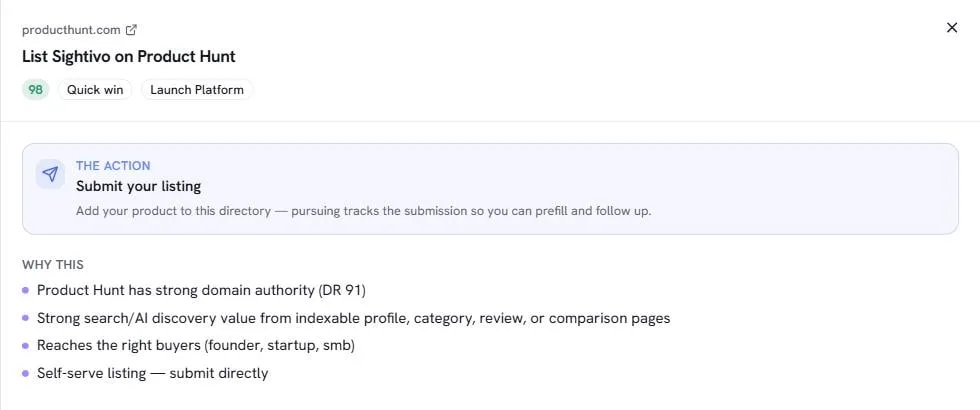
Ask ChatGPT your category's buying questions, open the sources, and list the domains. For most B2B categories they are a small set of roundups, comparison pages, directories and community threads. If you are not in them, no on-site change puts you in the answer — the engine is reading them, not you. Earn an accurate mention there: a listing, an inclusion, a review, a quote. This is the work Sightivo automates.
- 04
Get the entity right, everywhere
What ChatGPT says about you is a consensus of what it has read. Decide the one-line answer to "what is X, who is it for, what does it cost" and make your site, G2, Crunchbase, LinkedIn, Product Hunt and press boilerplate agree. Inconsistent descriptions produce vague or wrong answers — and a wrong-but-cited answer is a real failure mode.
- 05
Schema as housekeeping, not as a lever
Article, FAQPage and Organization markup remove ambiguity about which text is the question, which is the answer and who wrote it. There is no evidence it makes a page more likely to be cited on its own. Add it where it is honest, then move on.
- 06
Visible dates, and a refresh cadence that changes the content
Cited content is on average more than a year fresher than Google's top results. Show a published and an updated date, and earn the updated one: re-check prices, replace stale screenshots, add what changed. Cosmetic date bumps are discounted; real refreshes on a 30–90-day cadence are not.
- 07
Show up where the community answers already are
Reddit, YouTube and the forums in your niche take a large share of citations because they are where real comparisons happen. A disclosed founder answer in a thread that already ranks for your buyer question — with a screenshot, not a pitch — is cheaper than any article and is read by the engine on its next pass.
- 08
Pitch the "best of" pages directly
Because roughly half of citations go to roundups and comparisons, the list of pages that cite for your category is your outreach list. Ask to be added, not reordered; offer the author your pricing, a screenshot and an honest positioning line. Every inclusion is a citation candidate on every future answer that reads that page.
How to check whether ChatGPT cites you
Write down 15–20 questions a buyer in your category would ask an assistant — several phrasings per intent, buying questions and informational ones, category questions rather than "what is [my brand]". Ask them with search on. For each answer, note whether you are named, whether any source is yours, and which domains are cited instead. Repeat monthly on the same set.
Two rules keep it honest. Answers vary between runs, so treat one check as a spot check and a trend as a measurement. And record the cited domains — that list is your outreach list for tactic 03, and it changes slowly, which is what makes it actionable.
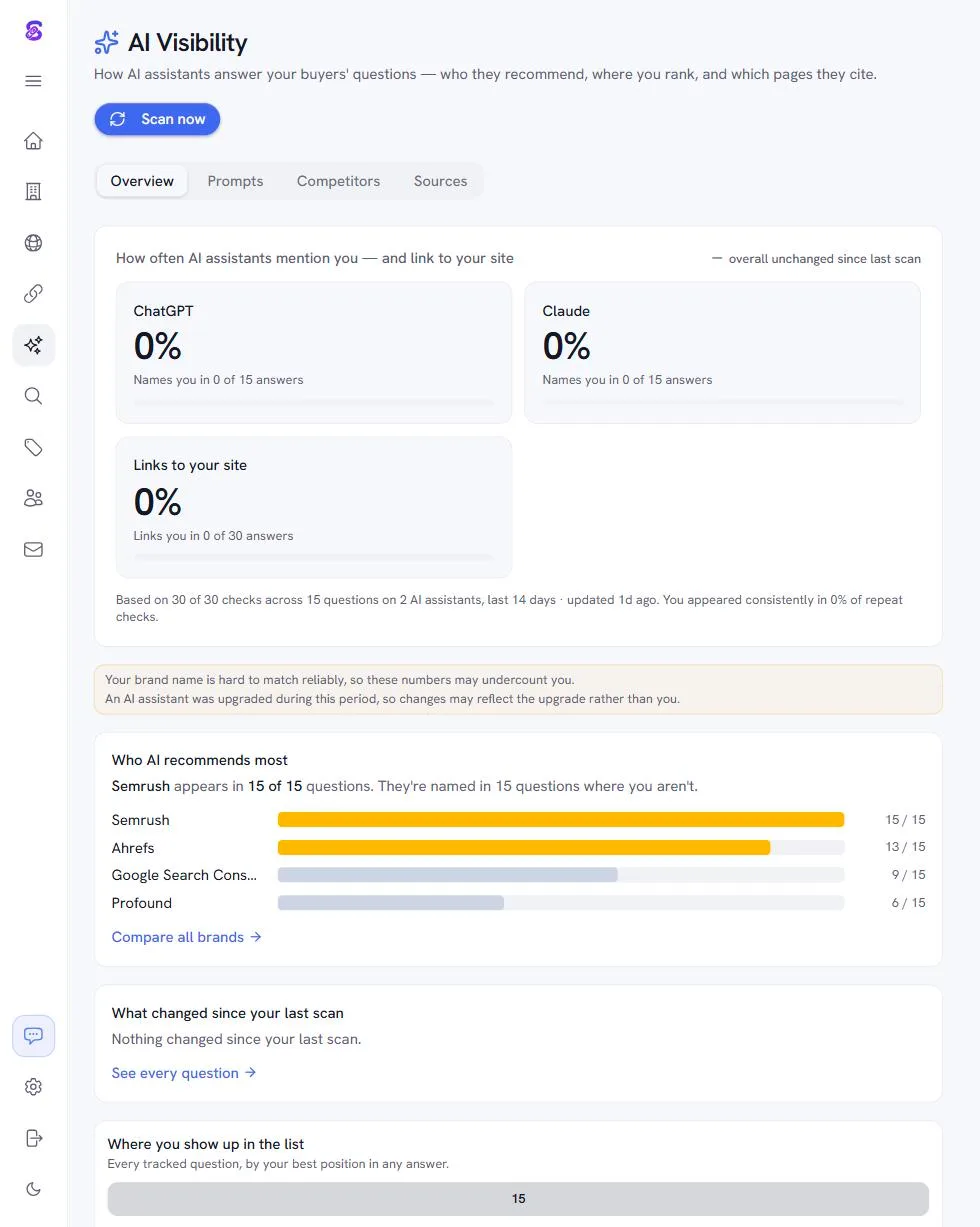
For a first pass without setting anything up, the free AI visibility checker asks ChatGPT your category's buying questions and reports who was named. Pew Research found people click a result on about 8% of searches that show an AI summary versus 15% without one — so being the cited source matters less than being the named brand, and the checker measures the latter.
Where Sightivo fits
Sightivo is an SEO and AI visibility platform for startups. It runs the measurement loop above across ChatGPT, Claude and Google AI Overviews, then does the part that decides citations: it reads the sources behind the answers you are missing from and turns them into a ranked list of places to get mentioned — each with the author, their contact details and a drafted pitch. Plans start at $89/mo with unlimited seats; the honest limits are on the AI search visibility page.
Getting cited by ChatGPT: FAQ
How do I get my website cited by ChatGPT?
Make the page retrievable and quotable. Retrievable: indexed by Bing (ChatGPT search runs on Bing's index), not blocking OAI-SearchBot, rendered as HTML without JavaScript. Quotable: a direct one-to-three-sentence answer under a question-shaped heading, a named author and visible date, original numbers or specifics, and a format ChatGPT already favours — comparison, list, definition or step-by-step. Then get the page linked or mentioned from the source types ChatGPT cites most (community threads, category roundups, reference pages), because retrieval still ranks candidates by authority.
How can I check ChatGPT citations?
Ask ChatGPT with search enabled the 15–20 questions a buyer in your category would ask, and open the sources panel under each answer — the cited URLs are listed there. Record whether any are yours, and which domains are cited instead. Repeat monthly; answers vary run to run, so a single check is a spot check. Sightivo's free AI visibility checker automates the first pass, and Bing Webmaster Tools' AI Performance report shows which of your URLs Microsoft's AI surfaces cite.
Does ChatGPT use Bing?
Yes. ChatGPT search retrieves from Bing's index (OpenAI documents its search crawler, OAI-SearchBot, and its Bing partnership). Practically, that means a page Google indexes but Bing does not is invisible to ChatGPT search. Verify indexation in Bing Webmaster Tools and submit new or changed URLs through IndexNow.
Do backlinks help you get cited by ChatGPT?
Indirectly. Backlinks drive the search rankings that decide which pages ChatGPT retrieves as candidates, so they still gate entry. But Ahrefs' study of 75,000 brands found brand mentions across the web correlate with AI visibility far more strongly than backlinks do, and Surfer found 67.82% of cited sources are not in Google's top ten. A mention on a page ChatGPT already cites does more than a link from a page it never reads.
How long does it take to get cited by ChatGPT?
For retrieved answers, days: once Bing has indexed the page and OAI-SearchBot can fetch it, it is a candidate on the next relevant question. Whether it wins the slot depends on the page and on competing sources. Changing what ChatGPT says from memory — training-data answers — lags by months, since it depends on the next model update. Most teams see first citations within two to eight weeks of fixing crawler access and publishing answer-first pages.
What kind of pages does ChatGPT cite most?
Community threads (Reddit is the single most-cited domain in Ahrefs' 75,000-brand study), "best of" and comparison articles (about 44% of citations in the same study; around half of cited pages in Evertune's 40,000-URL dataset are listicles), reference pages such as Wikipedia, product documentation, review sites and recent editorial. Vendor homepages are cited rarely unless the question is about that vendor.
Should I allow GPTBot or OAI-SearchBot?
They do different jobs. OAI-SearchBot is the crawler behind ChatGPT search citations — block it and you cannot be cited. GPTBot collects training data — blocking it keeps your content out of future model training but does not affect search citations. ChatGPT-User fetches a page when a user asks about it. Many sites block GPTBot and accidentally block OAI-SearchBot with it; Otterly reported 73% of sites block at least one AI crawler. Allow OAI-SearchBot explicitly.
Does llms.txt help you get cited by ChatGPT?
There is no evidence OpenAI reads llms.txt, and it is a proposal rather than an adopted standard. It costs little to publish and does no harm, but it is not a citation lever. Bing indexation, crawler access, answer-first structure and third-party mentions are.
Go deeper
Find out whether ChatGPT cites you
Run the free checker to see which sources ChatGPT reaches for in your category, then let Sightivo show you where to get mentioned and who to pitch.
Or run the free checker first
Product leader who's launched 8 B2B SaaS products over the past 6 years. Experienced in taking products from 0 to 1 and scaling them. Built Sightivo out of frustration while doing backlink outreach for another startup—spent hours juggling spreadsheets and tools just to send a few emails. Decided to build something better and share it with others facing the same pain.