The 10 Best AI Visibility Tools in 2026 (AI Search Visibility Tools Compared)
Sightivo
The 10 Best AI Visibility Tools in 2026 (AI Search Visibility Tools Compared)
We compared 10 AI search visibility tools on engine coverage, prompt limits, pricing and whether they tell you what to do next—so you can pick the one that fits your team and budget.

A year ago, "are we visible in AI answers?" was a question you answered by opening ChatGPT and typing a few prompts yourself. Now there's a whole category of software built to answer it properly—tracking how often assistants mention your brand, which sources they cite, and how you stack up against competitors.
The stakes moved quickly. When Ahrefs re-ran its AI Overviews study on 300,000 keywords using December 2025 data, the top-ranking page was getting 58% fewer clicks when an AI Overview was present—up from 34.5% eight months earlier. Meanwhile the traffic that does arrive from AI converts unusually well: Semrush puts the average AI search visitor at 4.4x the value of a traditional organic one.
The category is young enough that the tools disagree about what to even measure. This guide compares ten AI search visibility tools—the ones that track ChatGPT, Perplexity, Gemini and Google AI Overviews through 2025 and into 2026—on the things that actually differ: which engines they cover, whether you can track your own prompts, what they charge, and whether they tell you what to do about a gap.
Full disclosure: we build Sightivo, the first tool listed. Prices were checked in August 2026 and move often—confirm on each vendor's page.
The short answer: if you just need to start tracking cheaply, Otterly.AI at $29/mo is the floor. If you're an enterprise team, Profound. If you already pay for Semrush or Ahrefs, use the AI features you're already entitled to. And if you want one tool that both measures your AI visibility and earns the mentions that change it, that's what we built Sightivo to do—starting free. The rest of this guide is the evidence for those four sentences.
The Best AI Visibility Tools at a Glance
| Tool | Best for | Engines tracked | Entry price |
|---|---|---|---|
| Sightivo | Measuring visibility and earning the mentions | ChatGPT, Perplexity, Gemini, AI Overviews | Free checker, free plan, then $79/mo |
| Otterly.AI | The cheapest real way to start tracking | ChatGPT, Perplexity, AI Overviews, Copilot | $29/mo |
| Profound | Enterprise depth and executive reporting | ChatGPT on entry tier, more above | $99/mo (billed yearly) |
| Peec AI | Clean daily tracking for marketing teams | ChatGPT, AI Mode, AI Overviews, Copilot, Perplexity, Gemini | Starter tier, quoted on site |
| ZipTie | Analysis plus on-page fixes | AI Overviews, ChatGPT, Perplexity | $69/mo |
| Semrush AI Toolkit | Teams already paying for Semrush | ChatGPT, Perplexity, Gemini, AI Mode | Add-on to a Semrush plan |
| Ahrefs Brand Radar | Benchmarking beside backlink data | AI Overviews, ChatGPT, Perplexity | Included on higher Ahrefs tiers |
| SE Ranking | Bundling GEO with classic SEO | Major assistants plus AI Overviews | $129/mo (Core) |
| Frase | Content teams closing the gap they find | Major assistants | $39/mo (billed yearly) |
| Scrunch AI | How AI crawlers read a large site | Agent-side rather than answer-side | Enterprise, sales-led |
Feature Comparison
Where the tools genuinely differ, rather than where their marketing pages differ:
| Tool | Own prompts | Competitor tracking | Citation sources | Sentiment | Off-page actions |
|---|---|---|---|---|---|
| Sightivo | Yes | Yes | Yes | Yes | Yes |
| Otterly.AI | Yes | Yes | Yes | Limited | No |
| Profound | Yes | Yes | Yes | Yes | Partial |
| Peec AI | Yes | Yes | Yes | Limited | No |
| ZipTie | Yes | Yes | Yes | No | On-page only |
| Semrush AI Toolkit | Yes | Yes | Yes | Yes | On-page only |
| Ahrefs Brand Radar | Limited | Yes | Yes | Limited | No |
| SE Ranking | Yes | Yes | Yes | Limited | On-page only |
| Frase | Yes | Limited | Yes | No | On-page only |
| Scrunch AI | N/A | Limited | N/A | No | Technical only |
Pricing Compared
Entry tier, the tier most teams actually end up on, and what the step up buys:
| Tool | Entry | Realistic working tier | What the jump buys |
|---|---|---|---|
| Sightivo | Free | $79/mo Starter | Unlimited-cadence scans, full opportunity flow, drafts |
| Otterly.AI | $29/mo Lite | $189/mo Standard | More prompts and engines beyond 15 |
| Profound | $99/mo Starter | $399/mo Growth | Engines beyond ChatGPT |
| ZipTie | $69/mo Basic | $99/mo Standard | Double the checks, more optimizations |
| SE Ranking | $129/mo Core | $129/mo Core | Core is already the working tier |
| Frase | $39/mo | $39/mo | Entry is the working tier for most |
| Semrush | $139/mo + add-on | $139/mo + add-on | AI toolkit sits on top of the suite |
| Ahrefs Brand Radar | From $199/mo | From $199/mo | On top of an Ahrefs plan |
| Peec AI | Quoted | Quoted | Projects and countries |
| Scrunch AI | Quoted | Quoted | Enterprise only |
The honest read: below $50/mo you're buying a trend line. Between $69 and $129 you're buying enough prompts and engines to make decisions from. Above that you're buying reporting, seats, or enterprise procurement comfort.
How We Evaluated These Tools
Four criteria, weighted in this order:
Does it connect measurement to action? Nearly every tool reports a mention rate. Far fewer tell you what to do about it. This is the biggest real difference in the category and it's weighted heaviest.
Engine coverage that matches your buyers. More engines is better, but relevance beats count. Weekly ChatGPT data is worth more than shallow coverage of six assistants if ChatGPT is where your buyers are.
Prompt control and volume. Every tool caps tracked prompts. We checked both the cap and whether you can write your own—templated prompt sets rarely match how customers actually ask.
Price relative to who's paying. A founder tracking one product and an enterprise brand team need different products. We noted the entry tier rather than the headline plan.
We have not run a controlled head-to-head of accuracy across every tool. Anyone claiming they have should be asked how, given AI answers are non-deterministic and vary by session, region and model version.
What AI Visibility Tools Actually Measure
Before comparing, it helps to know the handful of metrics they're all circling:
Mention rate. Out of a set of prompts your buyers would plausibly ask, what percentage of answers include your brand? The headline number in most tools.
Share of voice. Of all brands mentioned across those answers, what share is yours? More actionable than your raw mention rate, because it gives you a target.
Citations and sources. Which URLs did the assistant reference? The most direct route to a to-do list—those pages are where you need to appear.
Sentiment and framing. Being described as "a cheaper option" versus "the tool most teams start with" is a meaningful difference.
Coverage across engines. ChatGPT, Perplexity, Gemini, AI Overviews and Copilot don't agree with each other. A tool checking one engine tells you a fraction of the story.
For background on why any of this matters, see AI search visibility and GEO vs. SEO.
The 10 Best AI Visibility Tools
Our tool
1. Sightivo — best for measuring visibility and earning the mentions
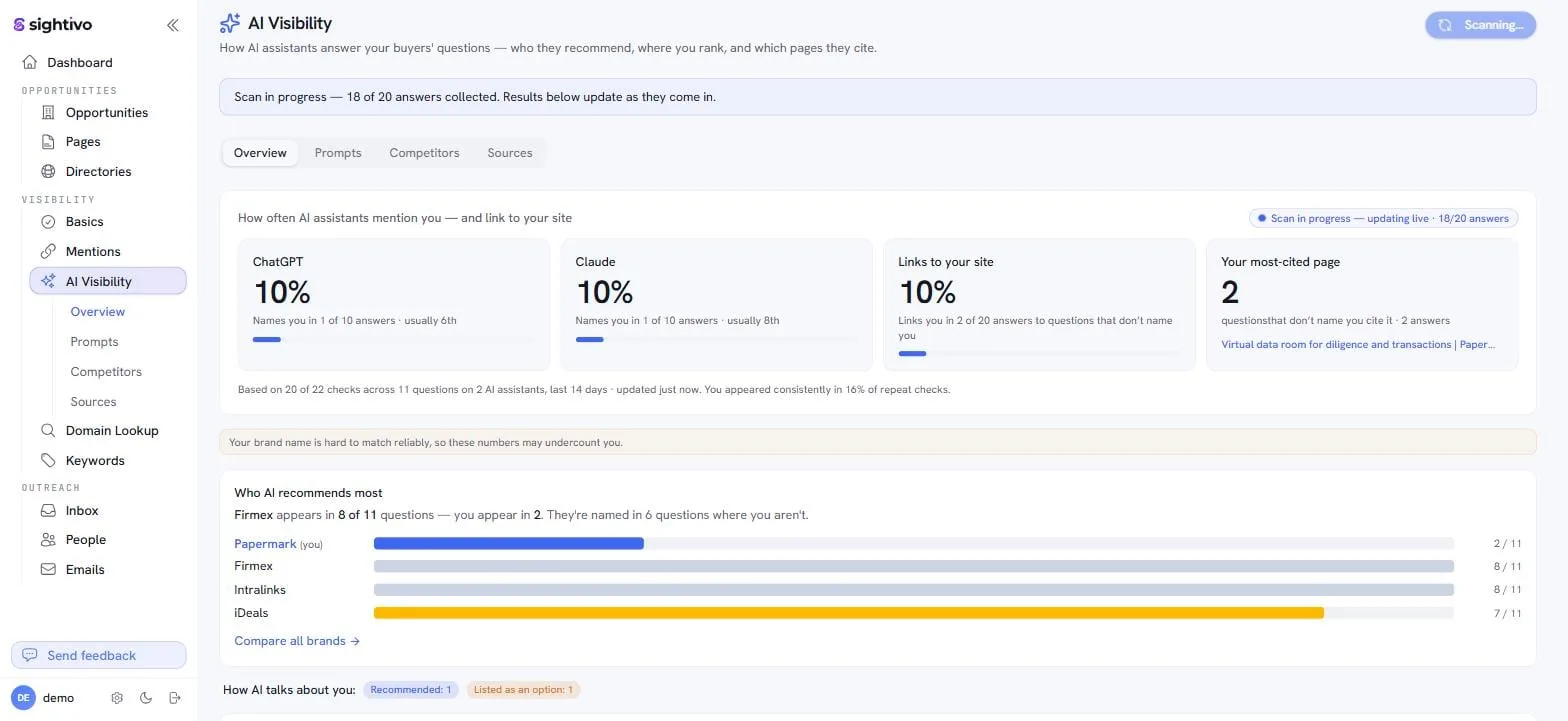
Sightivo tracks how often ChatGPT, Perplexity, Gemini and AI Overviews mention your brand—then works backward from that number to the mentions you'd need to change it.
Strengths:
- Per-engine mention rates plus a competitor share-of-mention view
- Tracked prompts you write yourself, so the questions match your buyers
- Connects each visibility gap to a prioritized list of places to get mentioned
- Finds the authors behind those pages, with contact details, and drafts the outreach
- Backlink and rank tracking in the same workspace, so both surfaces sit together
Limitations:
- Newer platform than the incumbent SEO suites
- Built for startups and small teams rather than enterprise brand monitoring
- Not an Ahrefs-scale backlink index
Pricing: Free AI Visibility Checker with no account at all — a domain in, a ChatGPT hit rate out. Then a free plan with a visibility snapshot, 10 tracked prompts and 2 competitors, no credit card. Starter $79/mo. Growth $169/mo for 3 companies and 3 seats.
Best for: Founders and small teams who want the number and the work that moves it. (If that is you, we wrote a dedicated guide: the best AI visibility tools for founders and small teams.)
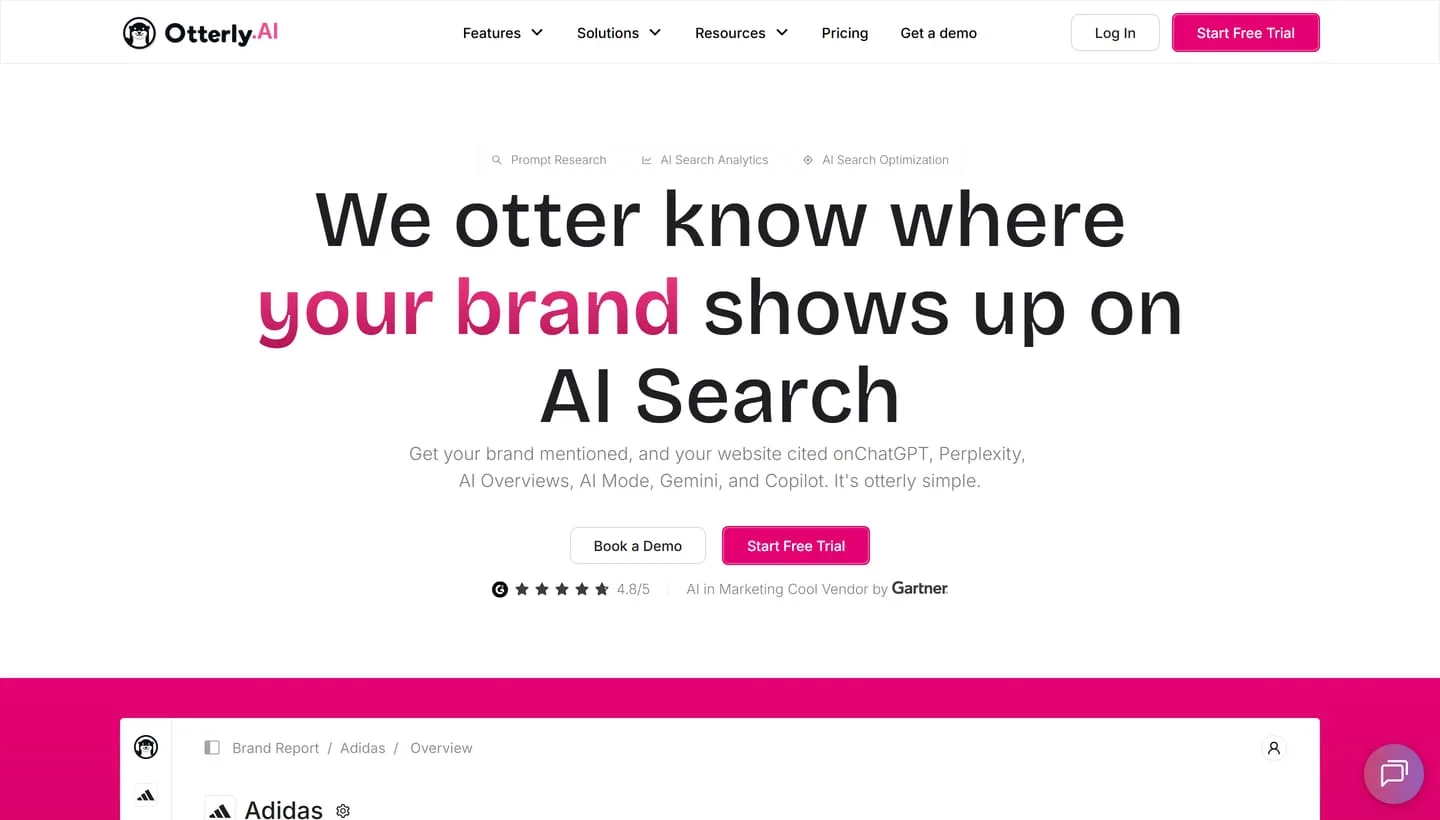
2. Otterly.AI — best cheap entry point
The most affordable way to find out whether this matters for you at all.
Strengths:
- Lite plan is genuinely small-team priced
- Tracks both mentions and the links assistants cite
- Unlimited team members even on the entry plan
- Set up in an afternoon
Limitations:
- 15 prompts on Lite goes quickly
- Lighter feature set than enterprise platforms
- Reporting is functional rather than boardroom-ready
Pricing: Lite $29/mo ($25 billed annually), Standard $189/mo, Premium $489/mo.
Best for: Small teams testing whether AI visibility is worth tracking
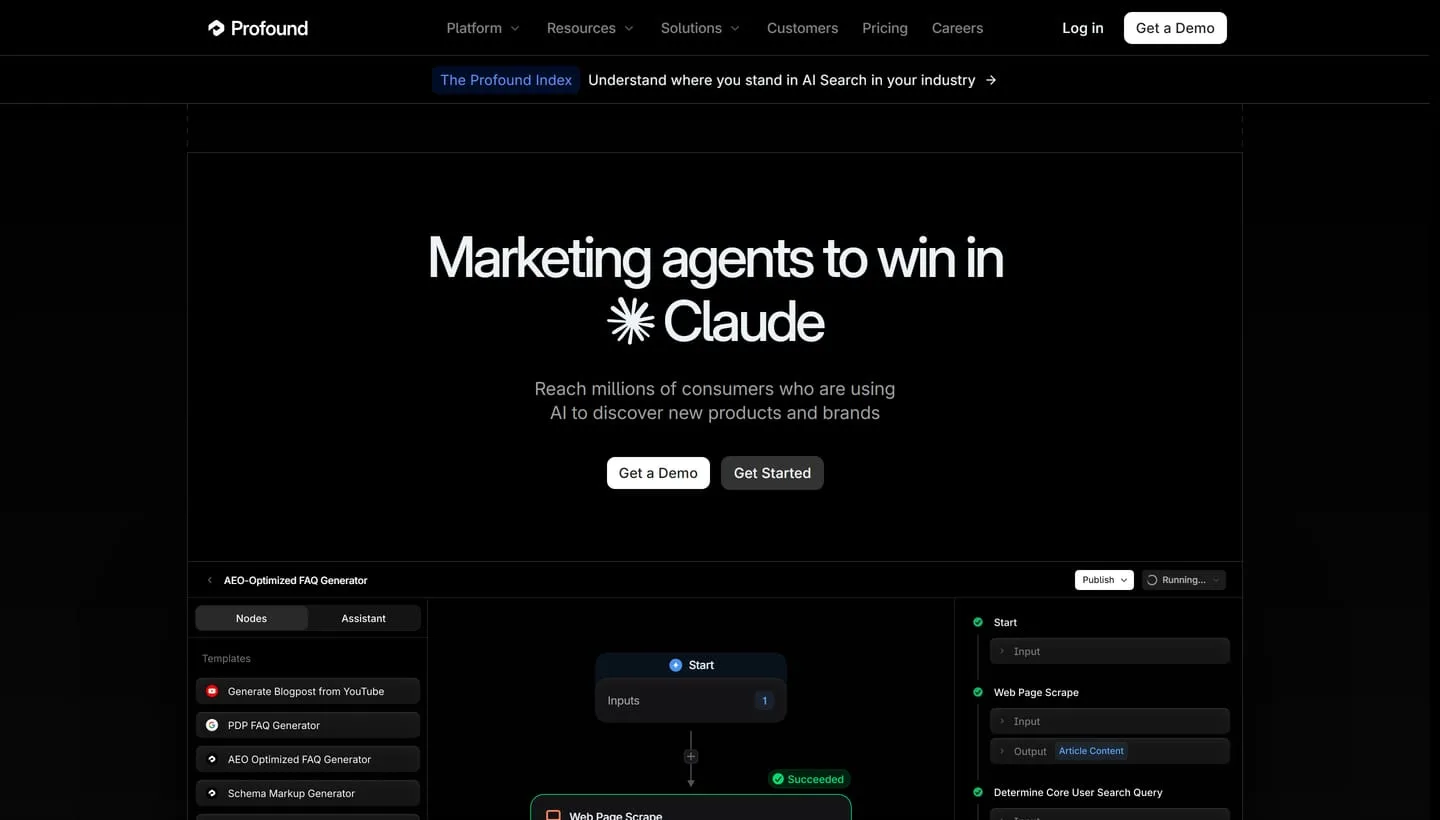
3. Profound — best for enterprise depth
One of the more established names at the enterprise end, focused on answer-engine analytics at scale.
Strengths:
- Deep analytics across assistants, with conversation-level category insight
- Reporting built for showing executives a trend line
- Agent-oriented features beyond simple mention counting
Limitations:
- The $99 Starter tier covers ChatGPT only—real coverage starts higher
- Priced and packaged for teams with budget
- Measurement-heavy: you still need people to act on it
Pricing: Starter $99/mo and Growth $399/mo (both billed yearly), Enterprise custom.
Best for: Larger brands with a dedicated marketing team
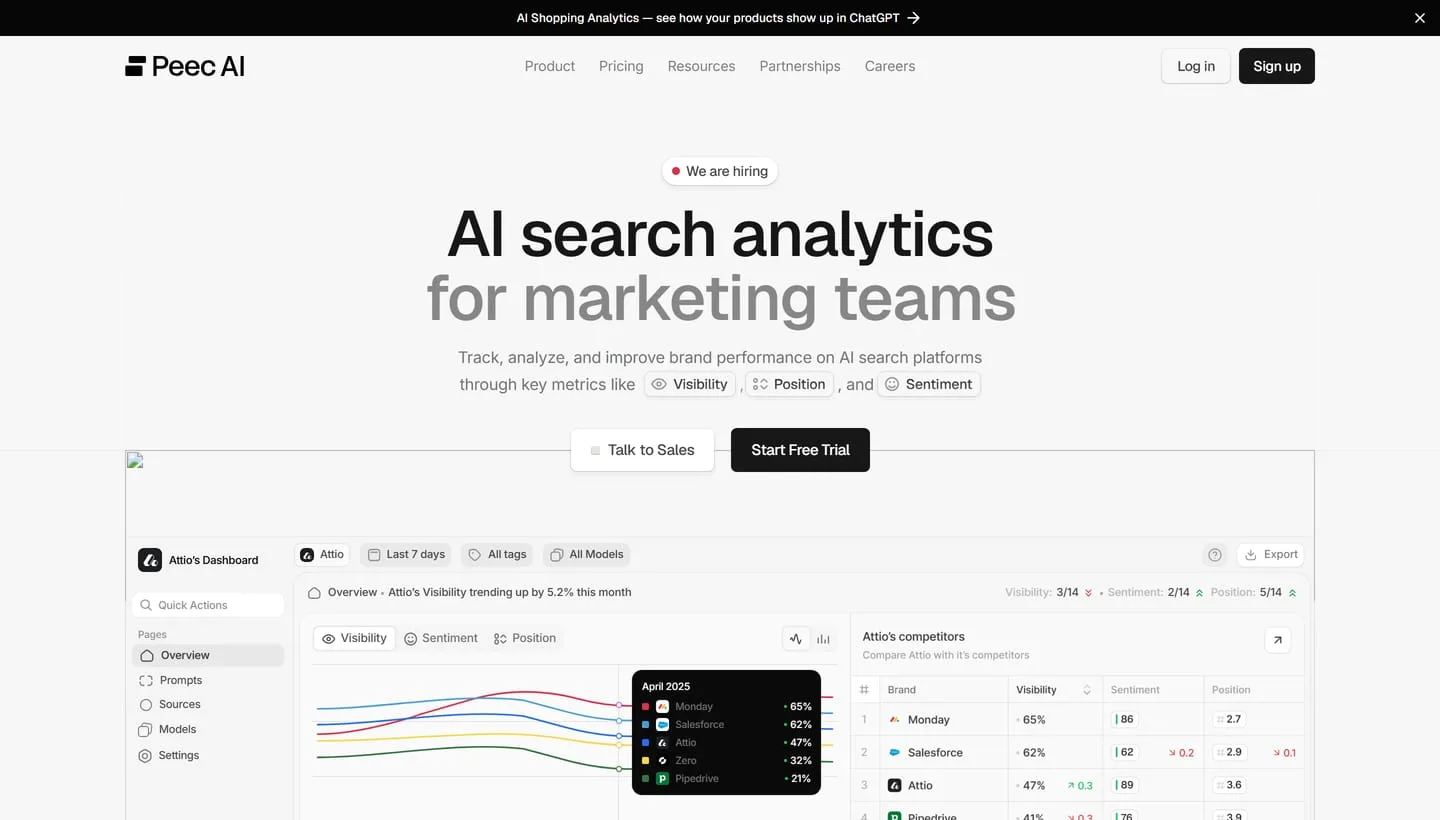
4. Peec AI — best for marketing teams who want a clean dashboard
Focused, fast-moving, and popular with European SaaS and agency teams.
Strengths:
- Broad engine coverage from the entry tier, including Copilot and Gemini
- Daily tracking and readable competitor comparisons
- Straightforward setup
Limitations:
- Analytics-first—acting on findings happens elsewhere
- Project and country limits bite on lower tiers
- Pricing isn't published as plainly as some rivals
Pricing: Starter through Enterprise tiers; current numbers are on their pricing page.
Best for: Marketing teams who want a focused dashboard, not a workflow
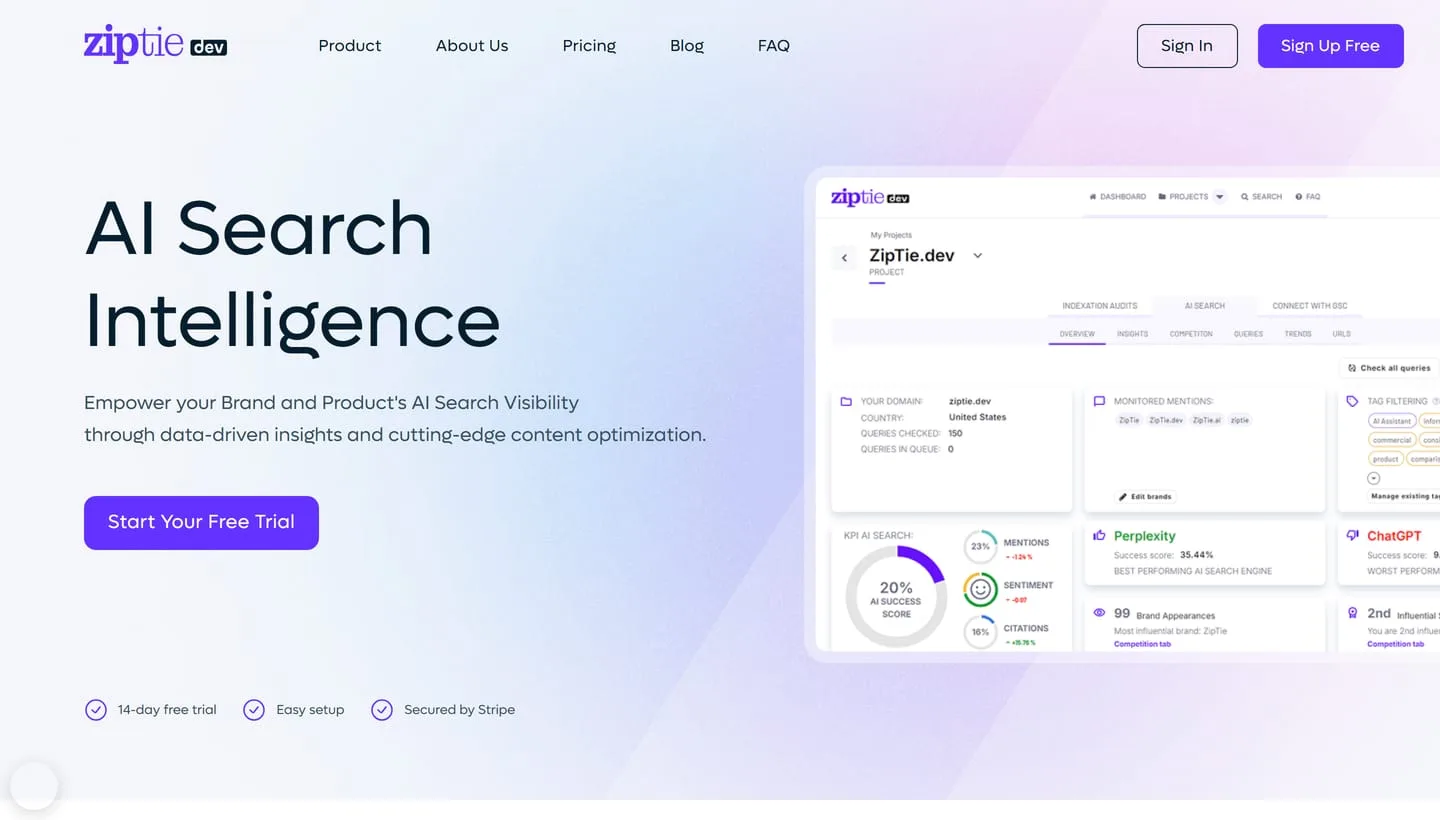
5. ZipTie — best for pairing analysis with fixes
Sits between pure monitoring and content optimization.
Strengths:
- Content optimization credits included alongside AI search checks
- 14-day free trial before you commit
- Coverage across 14 countries
Limitations:
- Check volumes on Basic are modest
- Fewer engines than the broadest trackers
- One seat on the entry plan
Pricing: Basic $69/mo, Standard $99/mo, Pro $159/mo.
Best for: Content-led teams who want the fix suggested, not just the gap named
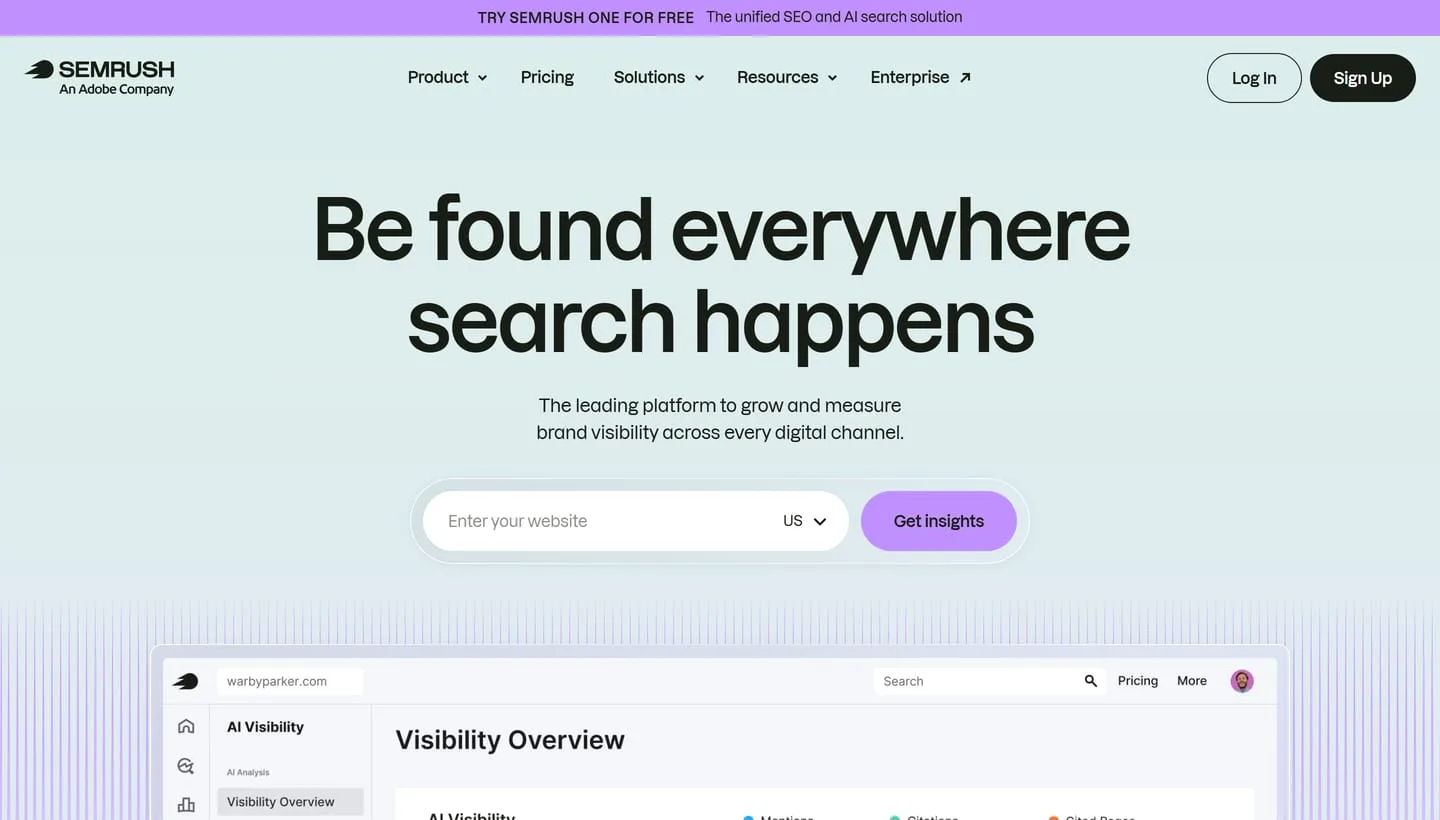
6. Semrush AI Toolkit — best if you already pay for Semrush
AI-answer tracking bolted onto the suite you may already have.
Strengths:
- No new vendor, and it sits beside your keyword and backlink data
- Correlating AI mentions with rankings is easy in one place
- Backed by large crawl infrastructure
Limitations:
- An add-on to a much larger product, so depth varies
- Usually gated behind higher tiers or extra cost
- Overkill if AI visibility is all you need
Pricing: Add-on to a Semrush subscription.
Best for: Teams already standardized on Semrush
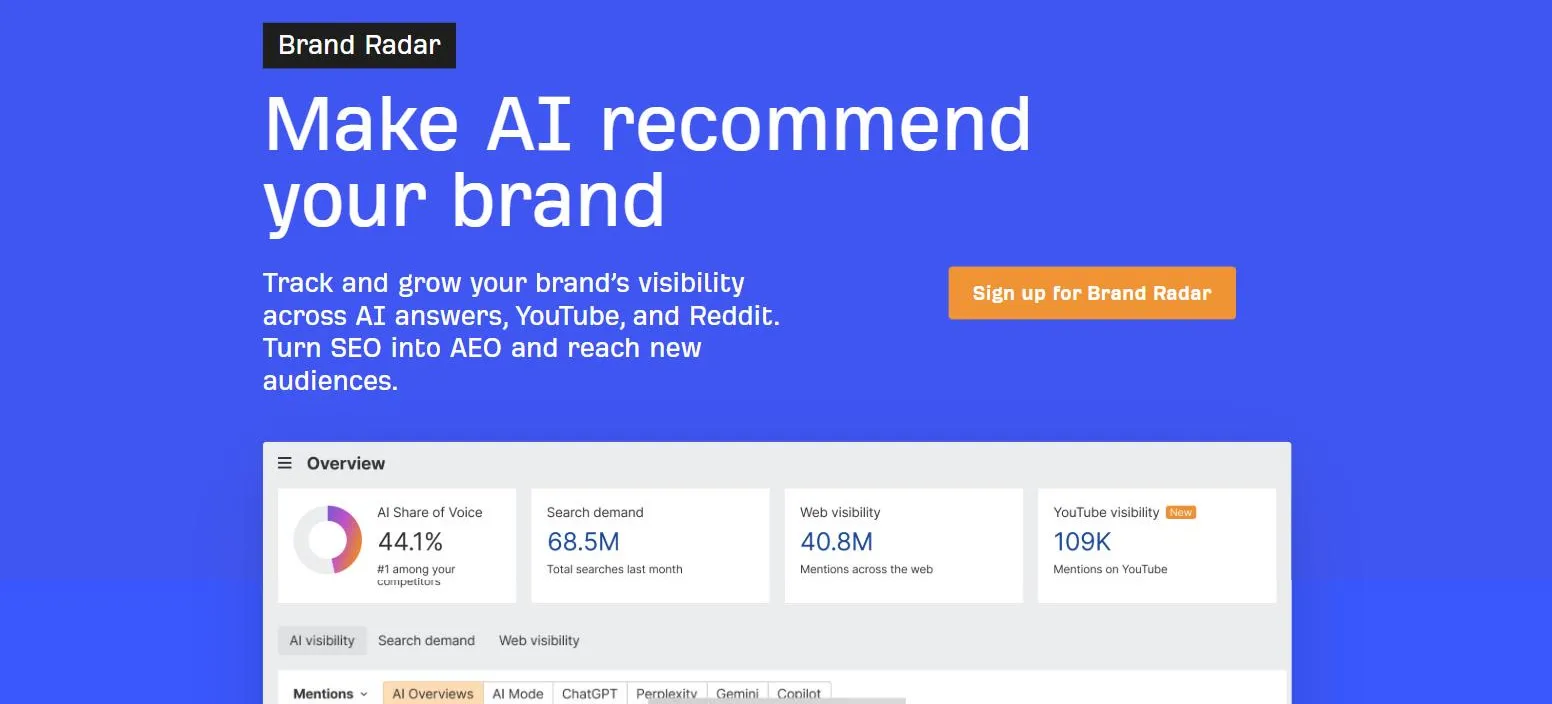
7. Ahrefs Brand Radar — best for benchmarking beside link data
Ahrefs' answer to the category, and the most useful if you're already deep in their ecosystem.
Strengths:
- Brand mentions tracked next to the backlink data that drives them
- Ahrefs' own research shows brand web mentions correlate with AI Overview visibility at 0.664 versus 0.218 for backlinks—Brand Radar is built around that insight
- Strong competitive benchmarking
Limitations:
- Requires an Ahrefs subscription, which is not cheap
- Less prompt-level granularity than dedicated trackers
- Reporting geared to SEO teams rather than brand teams
Pricing: Included on higher Ahrefs plans.
Best for: SEO teams already running Ahrefs
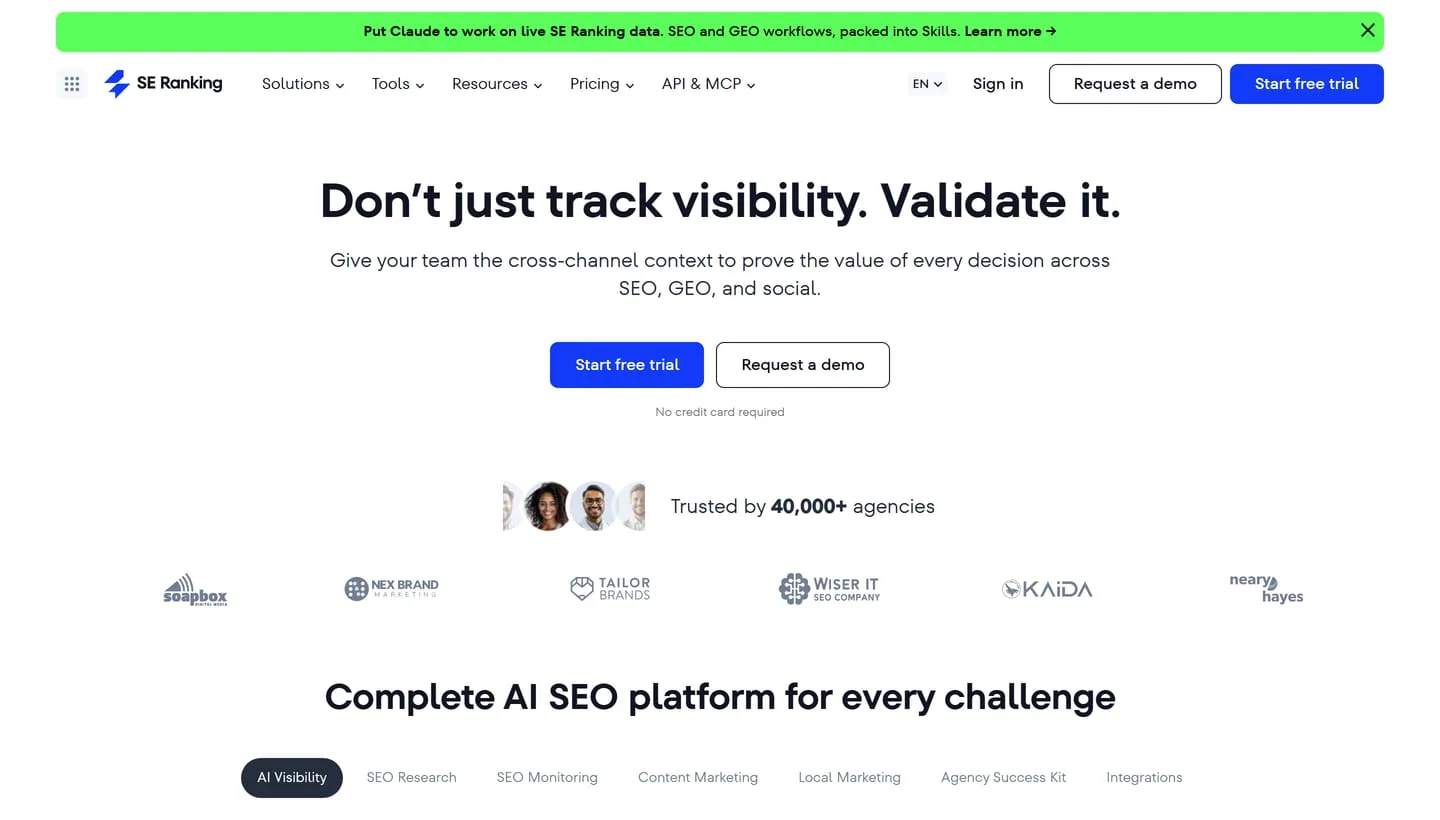
8. SE Ranking — best for bundling GEO with classic SEO
Rank tracking, audits and AI visibility in one subscription.
Strengths:
- One tool covering rankings, technical audit and AI answers
- 100 tracked prompts daily on Core is generous
- 14-day trial without a card
Limitations:
- Core is above $100/mo, so it's not an entry-level buy
- GEO features are newer than the core rank tracking
- Broad rather than deep on AI specifically
Pricing: Core $129/mo monthly, about $103/mo billed annually.
Best for: Teams consolidating SEO and GEO into one subscription
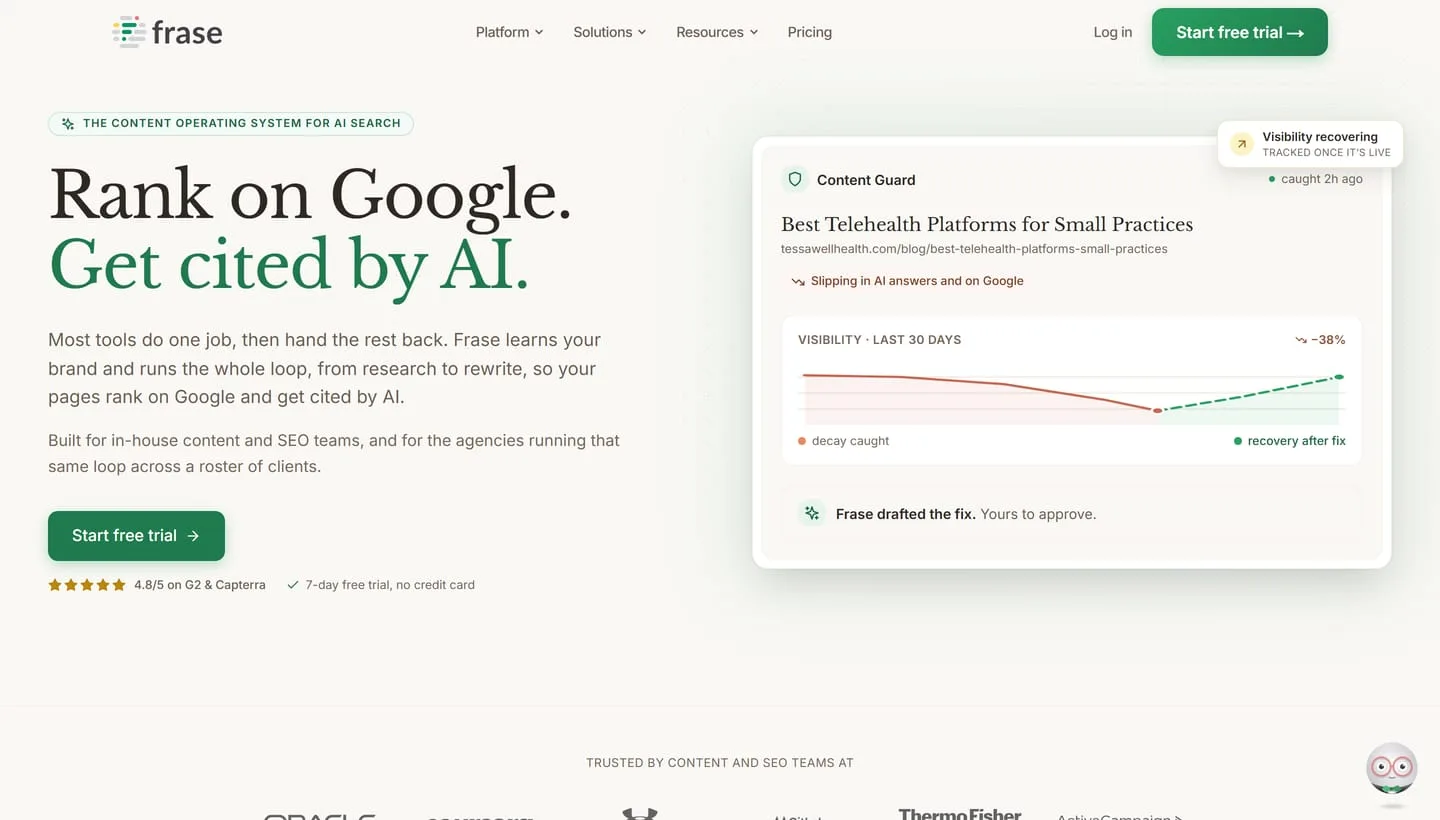
9. Frase — best for content teams
Pairs AI-engine tracking with the research and writing meant to close the gap.
Strengths:
- Cheapest entry point of the content-oriented tools
- Tracking sits next to briefs and optimization, so the fix is in the same tool
- Well suited to teams publishing on a cadence
Limitations:
- Content-first: weaker on competitor share-of-voice depth
- Optimizing your own pages only goes so far in a category where most citations are earned elsewhere
Pricing: From $39/mo billed yearly.
Best for: Content teams who want tracking and production in one place
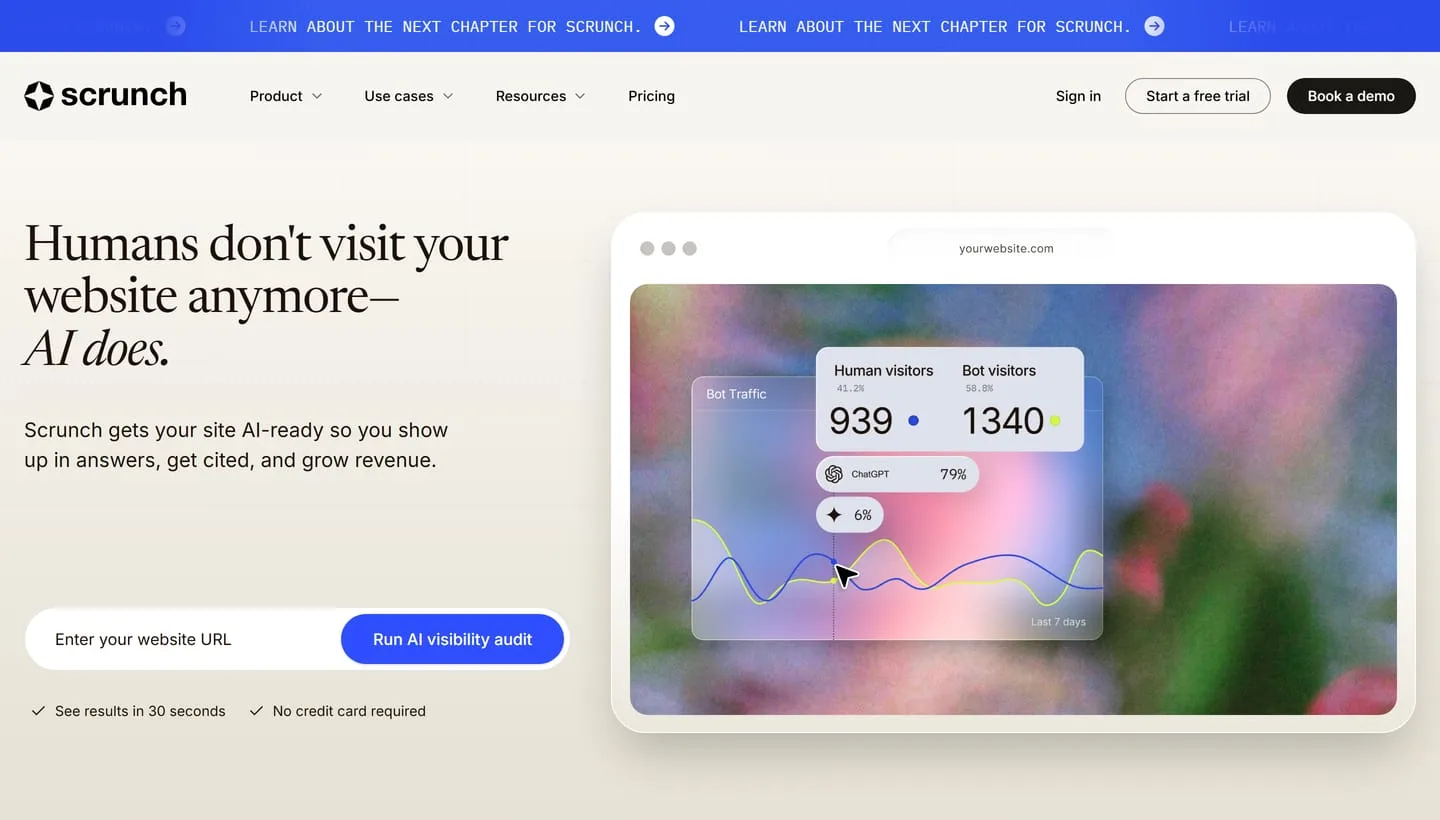
10. Scrunch AI — best for large sites with a crawler problem
Approaches the problem from the agent side: how AI systems encounter and represent your site.
Strengths:
- Focus on how your own site reads to AI crawlers and agents
- Useful when structure, not reputation, is the bottleneck
- Enterprise-grade reporting
Limitations:
- Overkill for a small site with a handful of pages
- Sales-led enterprise pricing
- Solves a different problem than answer-side trackers
Pricing: Enterprise, quoted.
Best for: Large sites where the technical surface is part of the problem
Who Each Tool Is Actually For
The same ten tools, sorted by who's asking rather than by what they do:
Solo founder, pre-revenue. Free checker for a baseline, then a free plan or Otterly's $29 Lite. Don't buy engine breadth you can't act on.
Seed-stage SaaS with one marketer. Something that produces actions, not just a number — you have no capacity to translate a dashboard into work. Budget $79–99/mo.
Content team at a Series A. Frase or ZipTie, where tracking sits beside the production you're already doing. $39–69/mo.
SEO team with an existing suite. Turn on Semrush's AI toolkit or Ahrefs Brand Radar before adding a vendor. Marginal cost beats marginal capability at this stage.
Marketing team reporting upward. Profound or Peec — you're buying the chart as much as the data, and that's a legitimate purchase.
Agency with a client roster. Per-client separation and seat economics dominate everything else. Covered properly in the 9 best AI visibility tools for agencies.
Enterprise with a large site. Scrunch for the crawler surface, plus an answer-side tracker. These solve different problems and you likely need both.
Also Worth Knowing
Tools we looked at that didn't make the ten, and who they suit:
- AthenaHQ and Rankscale — both credible newer trackers; worth a look if the ten above don't fit
- Writesonic — GEO tracking attached to an AI writing suite
- Similarweb — side-by-side SEO and GEO tracking, priced for larger teams
- Evertune and Conductor — enterprise brand-visibility platforms
- Manual prompt testing — a spreadsheet, twenty prompts and a monthly hour. Free, teaches you more than a number does, and doesn't scale past a handful of prompts
How to Run Your First AI Visibility Audit
Whichever tool you pick, the first two weeks look the same. Doing this properly is worth more than the choice of vendor.
1. Write the prompt list from customer language, not category language. Open your last twenty sales conversations, support tickets or demo recordings. How did those people describe the problem before they knew your category's jargon? "Tool to stop my team pasting screenshots into Slack" is a real prompt. "Best collaboration platform" is one you wrote.
2. Include the prompts you expect to lose. Comparison prompts naming a competitor, price-sensitive prompts, and prompts for adjacent use cases you'd like to own. A prompt set you win 90% of measures nothing.
3. Record who else is named, not just whether you are. The competitor set an assistant returns is the category consensus. If a brand you've never considered a rival appears in eight of twelve answers, that's a positioning finding before it's an SEO one.
4. Collect every cited URL into one list. This is the single most valuable artifact of the audit. Those pages are the working set — the roundups, comparisons, directories and threads currently shaping answers in your category.
5. Sort that list by whether you appear on it. Pages that cite you: protect and update. Pages that cite competitors but not you: your target list, ranked by how often they're cited.
6. Re-run monthly, same prompts, same wording. Changing the prompts resets your baseline. Keep a frozen set even if you add new ones alongside.
Most teams stop after step one and buy a dashboard. Steps four and five are where the work actually gets defined.
What to Do When You Find a Gap
The finding is always some version of "we're in 15% of answers and a competitor is in 60%." Four moves, in order of leverage:
Get into the cited roundups. Take the URLs from step four. For each, find the author, check whether the piece is actively maintained, and pitch a specific addition — not "please add us," but the row of the table you'd fill and why their readers benefit. This is slow, unglamorous, and the highest-leverage thing available.
Fix how you're described where you already appear. Being mentioned as "a cheaper alternative" trains the model to recommend you for a query you don't want. Ask for corrections where the description is stale or wrong. Editors update facts far more readily than they add new brands.
Claim the structured surfaces. G2, Capterra, Product Hunt, relevant directories, integration listings. They're free, they're heavily cited, and they're the fastest-moving part of this.
Make your own pages quotable. Clear definitional sentences, honest comparison tables, specific numbers. This is real but secondary — it helps a model that already reaches you, and does nothing for one that never does.
The ordering matters because the first three are off-page and the last is on-page. Most tools in this category can only help with the last one, which is why so many teams do it first and see nothing move.
Where This Category Goes Next
Three things look likely over the next year, worth factoring into a purchase you'll live with:
Consolidation. A dozen tools measuring nearly identical things is not a stable market. Expect acquisitions by the SEO suites and a shakeout among the thinnest trackers — a reason to prefer vendors with either real depth or real distribution.
Measurement standardisation. There's no agreed definition of "mention rate" today, which is why two tools give you different numbers for the same brand. That will settle, and early adopters will have to rebaseline when it does.
The recommendation gap closing — partially. More tools will move from reporting to recommending. The easy half (on-page) will come first because it's computable. The half that requires knowing who maintains a page and what they'd say yes to will stay rare, because it's a contact-data and workflow problem rather than a crawling one.
The Gap Every Tool in This Category Shares
Measurement is the easy half. Almost every tool here will tell you that you're mentioned in 12% of relevant answers and a competitor is at 40%. Very few tell you what to do on Monday.
The answer is nearly always the same: you need more credible sources talking about you, in the right context, in the places these engines pull from. Roundups. Comparison posts. Industry publications. Directories that matter in your category. Podcasts. That's the work—and it looks a lot like link building, because backlinks and brand mentions still drive AI visibility.
The data backs this from two directions. Ahrefs studied 75,000 brands and found brand web mentions correlate with AI Overview visibility at 0.664—far ahead of backlinks at 0.218, with the top three factors all off-site. And Muck Rack's analysis of more than 25 million cited links found earned media accounts for 84% of AI citations, while paid and advertorial content accounts for 0.3%.
You cannot buy your way into AI answers, and you cannot optimize your own pages into them either. Other people have to talk about you.
How to Choose
If you're testing whether this matters: start free or at $29. Get a baseline, then decide.
If you need to report to executives: Profound or Similarweb. You're buying the reporting layer as much as the data.
If you already pay for a suite: turn on what you have before adding a vendor.
If the gap is content: Frase or ZipTie put the fix next to the finding.
If the gap is reputation—which it usually is: pick something that hands you the places to get mentioned and the people to contact, or you'll be buying a thermometer and no treatment.
How to Start This Week
- Write 20 real prompts. The actual questions your buyers ask, in their words, including ones where you'd expect a competitor to win.
- Get a baseline. Run them through a tool or by hand, and record who gets mentioned. The quickest version costs nothing and takes about thirty seconds: the free AI Visibility Checker asks ChatGPT five category questions for your domain and shows who it named instead of you.
- Read the citations. Those URLs are your target list.
- Pick five sources to pursue. Roundups, comparisons and category pages you're missing from.
- Re-measure monthly. This moves slowly; monthly is a sane cadence.
Common Questions
Are AI visibility tools worth paying for yet?
If AI assistants already send you traffic or your buyers mention using them, yes. If neither is true, run a free snapshot and manual prompt testing first, then revisit in a quarter.
Why do the tools disagree with each other?
Because AI answers are non-deterministic and each tool samples them differently—different prompts, regions, frequencies and sometimes model versions. Treat the trend as the signal, not the exact percentage.
What is the cheapest AI visibility tool?
Sightivo's free plan covers a snapshot with 10 tracked prompts at no cost. Among paid-only tools, Otterly.AI's Lite plan at $29/mo is the lowest entry point. We ranked the no-cost options separately in free AI visibility tools.
Can I just check manually?
For a handful of prompts, yes, and you should—reading raw answers is instructive. It stops working once you want trends, competitor comparison, or coverage across five engines.
Do these replace my SEO tools?
No. They measure a different surface. The work that improves both numbers overlaps heavily, which is the good news.
How many prompts do I need to track?
Twenty to thirty real buyer questions per brand. Below fifteen you're sampling too thinly to distinguish a trend from model variance; above fifty you're usually paying for prompts you never read.
How long before AI visibility improves?
Months, not weeks. It moves when new content about you gets published and indexed, so the realistic cycle is: pitch in month one, placements land in month two, answers shift in month three. Anyone promising faster is selling something.
Should I track Perplexity and Gemini too, or just ChatGPT?
Start with wherever your buyers are, which is usually ChatGPT. Add others when you have budget — they cite differently, and Perplexity in particular is useful because it shows its sources plainly, which makes building a target list quick.
Do these tools work for local or ecommerce businesses?
Partly. The measurement works anywhere. The action half is weaker for local, where directory consistency and reviews matter more than editorial mentions, and for ecommerce, where product feeds and marketplace presence carry more weight.
Can I build this myself with the API?
You can, and some teams do — a script that runs prompts on a schedule and logs brand mentions is a weekend project. What you're buying from a vendor is the history, the competitor parsing, the citation extraction and someone else absorbing the API bill. Build it if you want to learn the shape of the problem; buy it if you want the trend line.
Are "LLM monitoring" and "AI brand monitoring" tools the same thing?
Yes—the category is young enough that vendors haven't settled on a name. AI visibility tools, LLM visibility tools, LLM monitoring, AI brand monitoring, AI search monitoring and answer engine tracking all describe the same job: recording how AI assistants talk about your brand. Pick tools by engine coverage and what they let you act on, not by which label the vendor chose.
What's the difference between AI visibility tools and GEO tools?
Mostly marketing. "AI visibility" usually emphasizes measurement, "GEO" emphasizes optimization, and most products now do some of both. We broke the discipline down in generative engine optimization, and compared the tools that lean optimization in best GEO tools and the ones focused on one engine in ChatGPT brand monitoring tools.
Key Takeaways
- Every tool measures roughly the same things: mention rate, share of voice, citations and sentiment
- Engine coverage and prompt control matter more than dashboard polish
- The dividing line is whether a tool connects the gap to an action or stops at the number
- Entry pricing ranges from free to $129/mo, so there's no reason not to have a baseline
- The fix for low AI visibility is almost always more credible mentions in the sources these engines read
If you want the measurement and the outreach in one place, see how Sightivo handles AI visibility or start free.
Topics covered
Related articles
Written by
Product leader who's launched 8 B2B SaaS products over the past 6 years. Experienced in taking products from 0 to 1 and scaling them. Built Sightivo out of frustration while doing backlink outreach for another startup—spent hours juggling spreadsheets and tools just to send a few emails. Decided to build something better and share it with others facing the same pain.
Ready to grow your search & AI visibility?
Sign up for Sightivo to track rankings, backlinks, and how often AI engines cite your brand.
Start free