The 24 Best SEO Tools in 2026 (Tested by Job — Research, Content, Technical, AI Visibility)
Sightivo
The 24 Best SEO Tools in 2026 (Tested by Job — Research, Content, Technical, AI Visibility)
The 24 SEO and SEO marketing tools worth using in 2026, organised by the job they do—measurement, research, keywords, content, technical, rank tracking, competitive intelligence, off-page and AI visibility—with tested notes, current pricing, four stacks that work, and the tools that didn't make the list.

There are hundreds of SEO tools and about eight jobs they do. Once you see which job each tool is actually built for, the buying decision gets much smaller — and you stop paying three subscriptions to do the same thing.
This guide covers 24 tools grouped by job: measurement, research suites, keyword and demand research, content, technical, rank tracking, competitive intelligence, and the off-page and AI visibility work that most stacks leave uncovered. Each entry says what it is best for, where it stops, and what it costs.
Full disclosure: we build Sightivo, which appears under off-page and AI visibility. Prices were checked on each vendor's own pricing page in August 2026 (a few, marked, are from recent third-party listings because the vendor hides pricing behind a trial). They change often — treat the numbers as the shape, not the invoice.
The Best SEO Tools at a Glance
| Tool | Job | Best for | Entry price | Free option |
|---|---|---|---|---|
| Google Search Console | Measurement | Everyone, day one | Free | Yes |
| Bing Webmaster Tools | Measurement | A second index and Copilot | Free | Yes |
| Google Analytics 4 | Measurement | Traffic and AI referrals | Free | Yes |
| Ahrefs | Research suite | Backlink and competitor research | $29/mo Starter, $129/mo Lite | Ahrefs Webmaster Tools |
| Semrush | Research suite | One vendor across channels | $139/mo | Free tools + trial |
| SE Ranking | Research suite | Value bundle with AI tracking | $129/mo | Trial |
| Moz Pro | Research suite | Beginners and DA reporting | ~$49/mo | Free tools |
| Mangools | Research suite | The easiest learning curve | Trial | |
| Ubersuggest | Research suite | The smallest budget | ~$29/mo or lifetime | Limited free |
| Google Keyword Planner + Trends | Keyword research | Volume ranges and seasonality | Free | Yes |
| Keywords Everywhere | Keyword research | Volume while you browse | $84/yr | No |
| AnswerThePublic | Keyword research | Question mapping | $20/mo | Limited free |
| Exploding Topics | Keyword research | Catching demand early | $39/mo | Trial |
| Surfer | Content | Repeatable on-page optimisation | $49/mo | No |
| Clearscope | Content | Editorial teams | $129/mo | Trial |
| Frase | Content | Briefs plus AI visibility on one bill | $39/mo (yearly) | Trial |
| BuzzSumo | Content / PR | Ideation and who covers what | $199/mo | Trial |
| ChatGPT / Claude | Content / analysis | The generalist assistant | Free–$20/mo | Yes |
| Screaming Frog | Technical | Crawls and audits | Free to 500 URLs | Yes |
| Rank Math / Yoast | Technical (WordPress) | On-page hygiene in the CMS | Free / ~$8–10/mo | Yes |
| AccuRanker | Rank tracking | Accuracy that is contractual | $224/mo | No |
| Similarweb | Competitive intelligence | Market-level traffic estimates | ~$199/mo | Free tools |
| Sightivo | Off-page + AI visibility | Earning the mentions that move rankings and AI answers | Free, $79/mo | Yes |
| Profound / Peec / Otterly | AI visibility tracking | Dedicated AI-answer tracking | $29–99/mo | Trials |
How We Tested
We use most of this list. Sightivo's own SEO runs on Search Console, Bing Webmaster Tools, GA4, Ahrefs, Screaming Frog and — obviously — Sightivo; the rest we ran on paid or trial accounts against the same three tasks in July and August 2026:
- Research a competitor. Pull the backlink profile and top keywords for one mid-sized SaaS domain and see how long it takes to get to a usable list of pages and sites.
- Plan and optimise one article. Take the keyword "backlink checker", get from seed to brief to a scored draft.
- Answer one hard question. "Which third-party page should we get mentioned on next, and who runs it?" — the question that decides whether a tool reduces work or generates it.
We scored each on the job it claims, not on the jobs it doesn't. A content optimiser is not marked down for lacking a backlink index. Screenshots are the vendors' current pages; where we show product output it is from our own account, and we say so.
How We Grouped Them
Buying by job rather than by brand avoids the most common stack mistake: three subscriptions that all do keyword research and nothing that covers off-page.
Measurement — what's actually happening on your site, from the source. Research suites — keywords, competitors, backlink data in one place. Keyword and demand research — narrower tools that do one part of research well or cheaply. Content — what to write and how to optimise it. Technical — crawlability, redirects, on-page hygiene. Rank tracking — position over time, at the accuracy you need. Competitive intelligence — traffic and channel estimates for domains you don't own. Off-page and AI visibility — earning mentions elsewhere, and measuring whether AI engines repeat them.
Most teams over-invest in research and under-invest in the last one. That's worth knowing before you spend, because Ahrefs' 14-billion-page study found 96.55% of pages get no search traffic from Google — and publishing without earning mentions is how you join them.
SEO Marketing Tools: What Marketers Actually Need
If you searched for "SEO marketing tools" rather than "SEO tools", you are probably a marketer running SEO as one channel among several, not a specialist. Two adjustments to the list below:
- You need fewer research tools and more measurement. Search Console, GA4 and one suite on its cheapest tier cover a marketing team's SEO research for a long time; the money is better spent on content and on off-page.
- You care about the AI answer surfaces now, not later. A growing share of buying research ends inside ChatGPT, Perplexity or an AI Overview, and the sources those answers draw on are the same roundups, comparison pages and directories that PR and partnerships teams already talk to. Tools that measure and act on that are marked below.
HubSpot's Marketing Hub, for the record, has SEO recommendations and topic clusters and now an AEO beta; it is a fine place to keep content if you already pay for it, but it is not where you would do research or off-page, so it is not in the ranked list.
Measurement (Free, Non-Negotiable)
1. Google Search Console — best for everyone, on day one
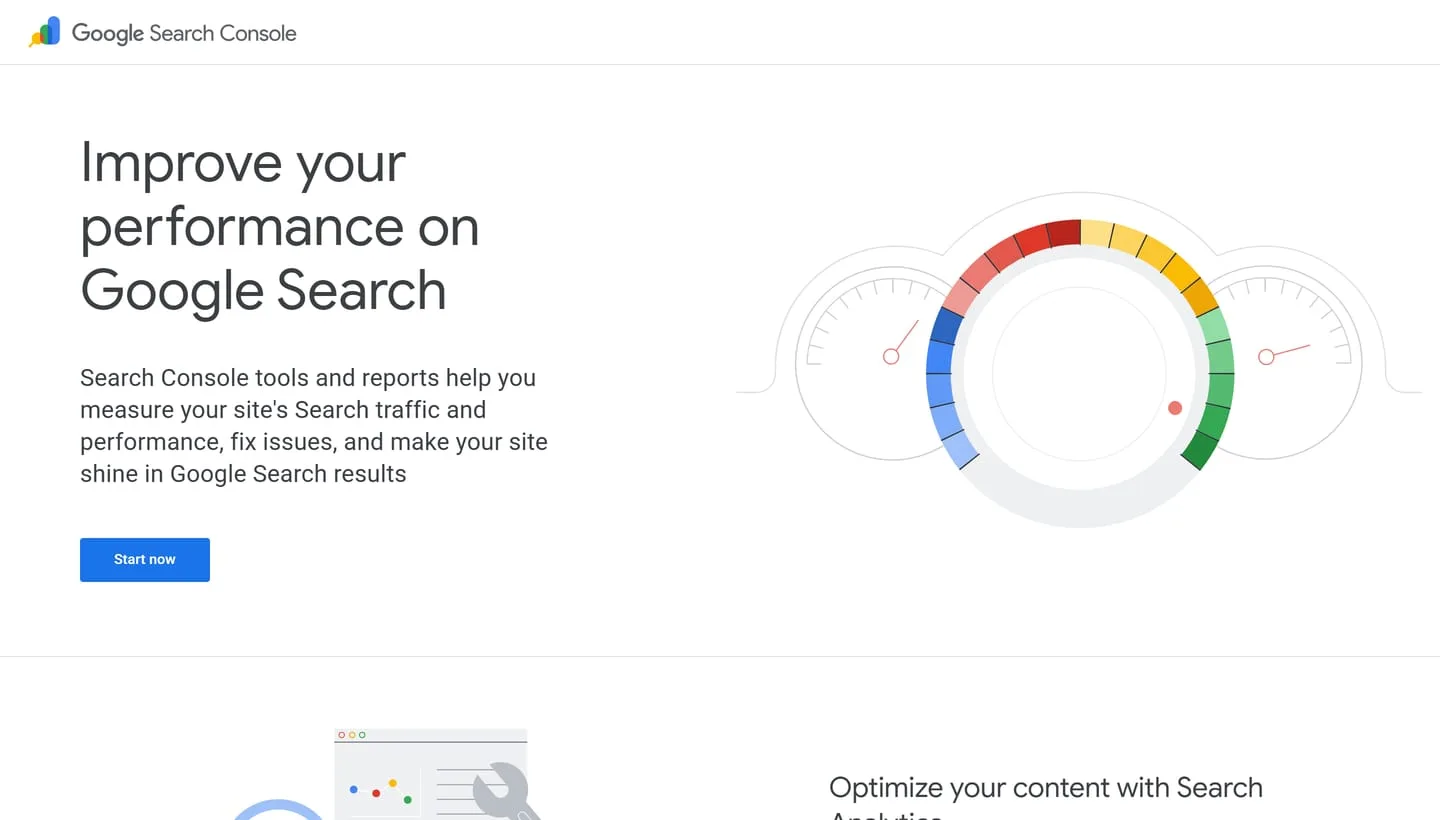
Google's own data on your queries, pages, clicks and links. No paid tool replaces it, and every paid tool is an approximation of it.
What we use it for: the Performance report filtered by regex to a keyword cluster (backlink check|ai visibilit), which is how we track whether a plan is working without paying for a rank tracker; the Links report as the free baseline for a backlink audit; URL Inspection when a page won't index.
Strengths: Free forever; the only first-party truth about your site; five-minute setup; 16 months of history. Limitations: Sampled and anonymised query data, no alerts, no competitor view, two-to-three-day lag. Best for: Everyone, on day one.
2. Bing Webmaster Tools — best free second index, and the Copilot report
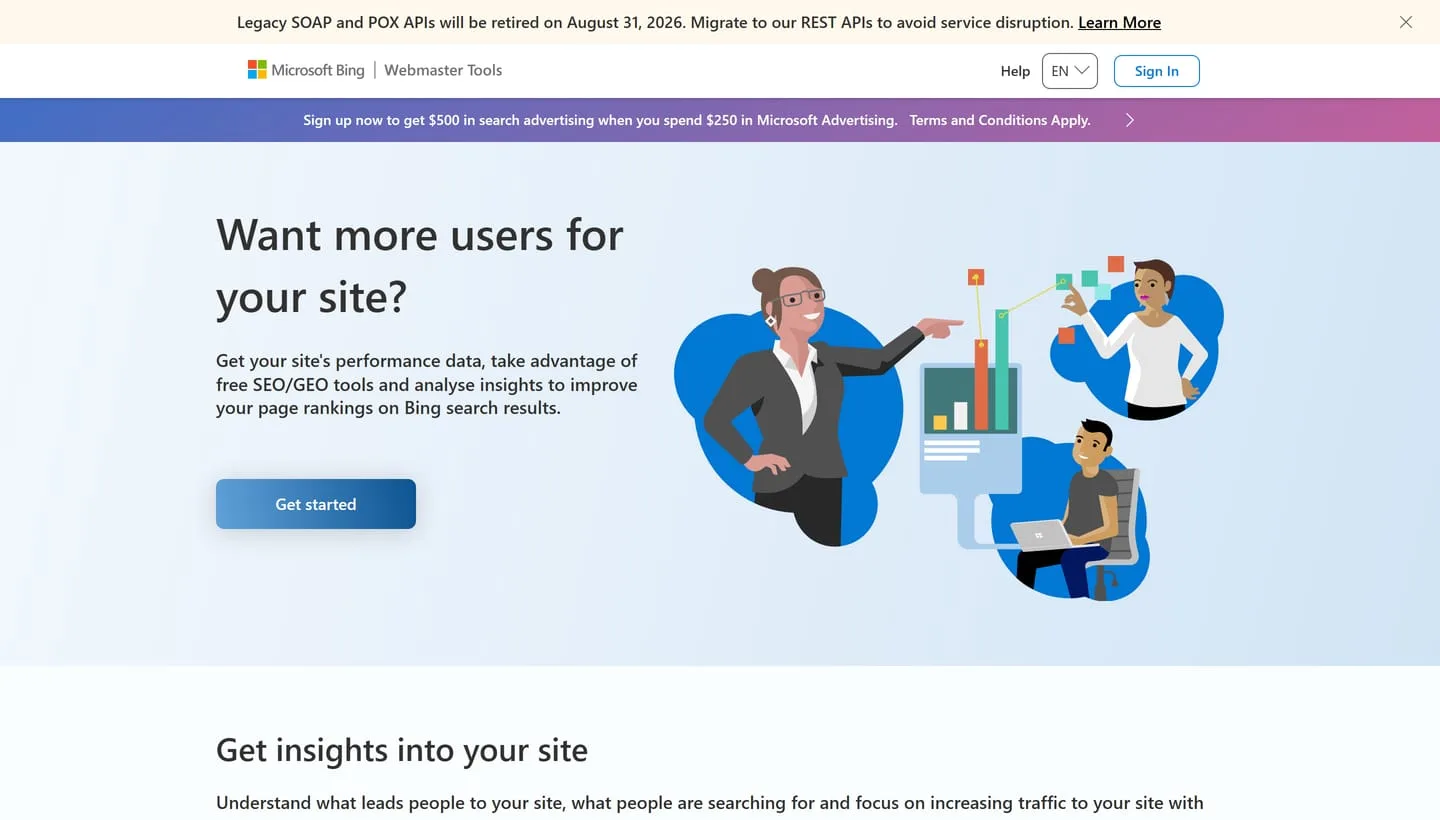
Underrated, and now strategically important: Bing's index is what ChatGPT search and Microsoft Copilot retrieve from. If your site is thin in Bing, you are thin in two AI engines.
What we use it for: confirming indexation after a deploy (IndexNow submits go here); the AI Performance report, which lists URLs cited across Microsoft's AI experiences — one of very few first-party citation reports that exist; the competitor keyword comparison Search Console has no equivalent of.
Strengths: Free; competitor glimpses; keyword research included; the AI citation report. Limitations: Bing's view of the web, not Google's. Best for: A free second opinion, and anyone who cares about ChatGPT search or Copilot.
3. Google Analytics 4 — best for traffic, conversion and AI referrals
Not an SEO tool, but the one every SEO tool's numbers eventually have to reconcile with. Two things make it belong on this list in 2026: it is where you tie organic sessions to signups, and it is where AI referral traffic shows up — sessions from chatgpt.com, perplexity.ai, gemini.google.com and copilot.microsoft.com, which you can group into a custom channel and watch as its own line.
Strengths: Free; conversion attribution; landing-page-level organic performance; the AI referral channel once you define it. Limitations: Steep interface; sampled at scale; nothing about rankings or competitors. Looker Studio (also free) is the usual fix for reporting. Best for: Proving that SEO work turned into customers.
Research Suites
4. Ahrefs — best for backlink and competitor research
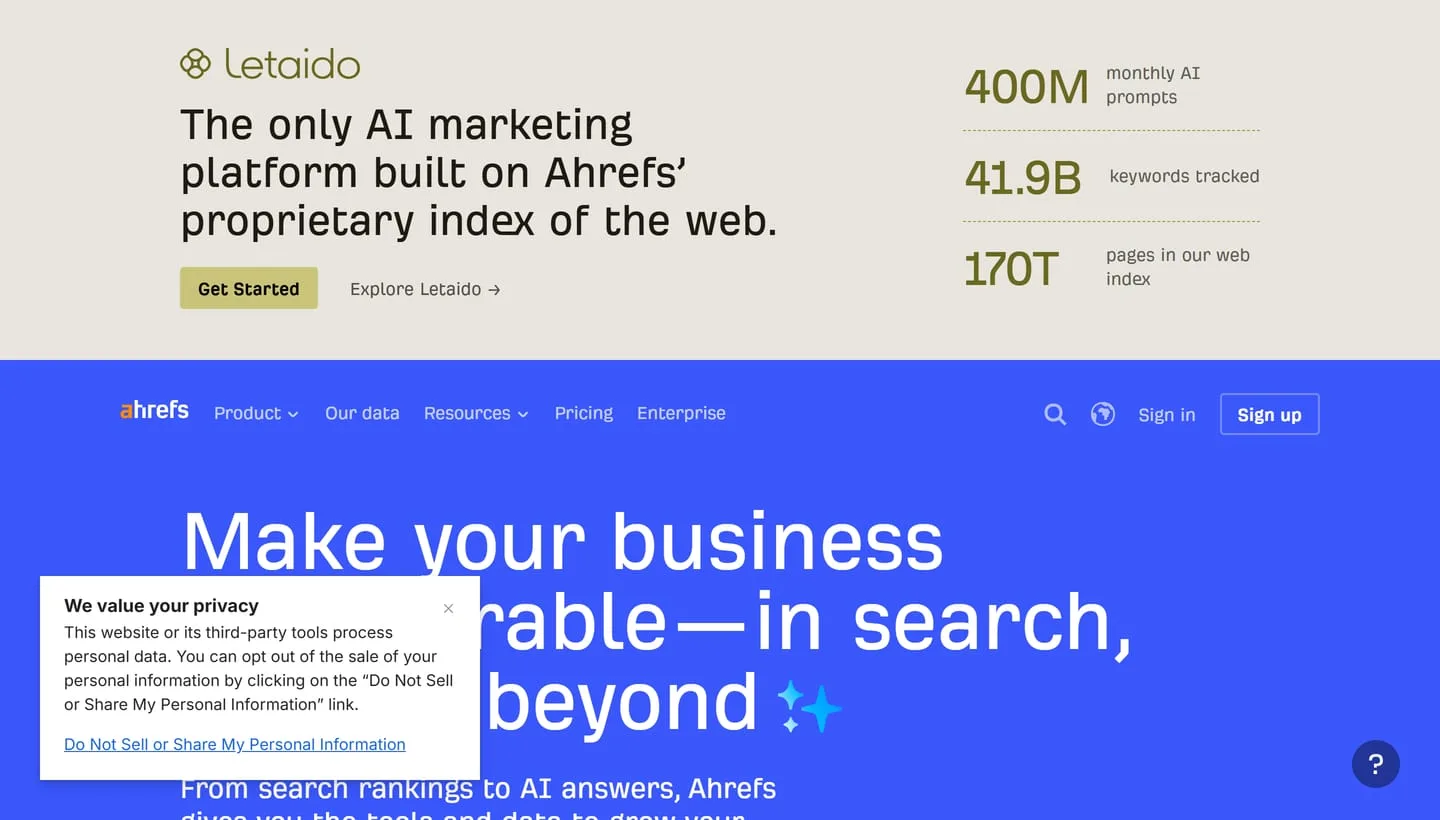
The reference standard for backlink data, and now the cheapest serious entry point in the category thanks to the Starter tier.
What we use it for: Site Explorer on competitors, Link Intersect for "who links to three rivals and not to us" (the fastest route to a prospect list anywhere), Content Gap for keywords. Ahrefs Webmaster Tools — free for your own verified site — is a genuinely good backlink monitor and audit tool, and it is why "we can't afford a backlink tool" stopped being true.
Strengths: Largest backlink index; best competitor analysis; Keywords Explorer's traffic-potential metric is the most honest volume number in the category; Brand Radar covers AI Overviews and assistants for the AI-visibility job. Limitations: Lite at $129/mo is the real working tier — Starter is capped hard; research, not action — no outreach, no contacts; Brand Radar is priced above the SEO tiers. Pricing: Starter $29/mo, Lite $129/mo, Standard $249/mo, Advanced $449/mo, Enterprise $1,499/mo. Brand Radar from $199/mo. Best for: Anyone doing systematic competitor backlink work.
5. Semrush — best for one vendor across several channels
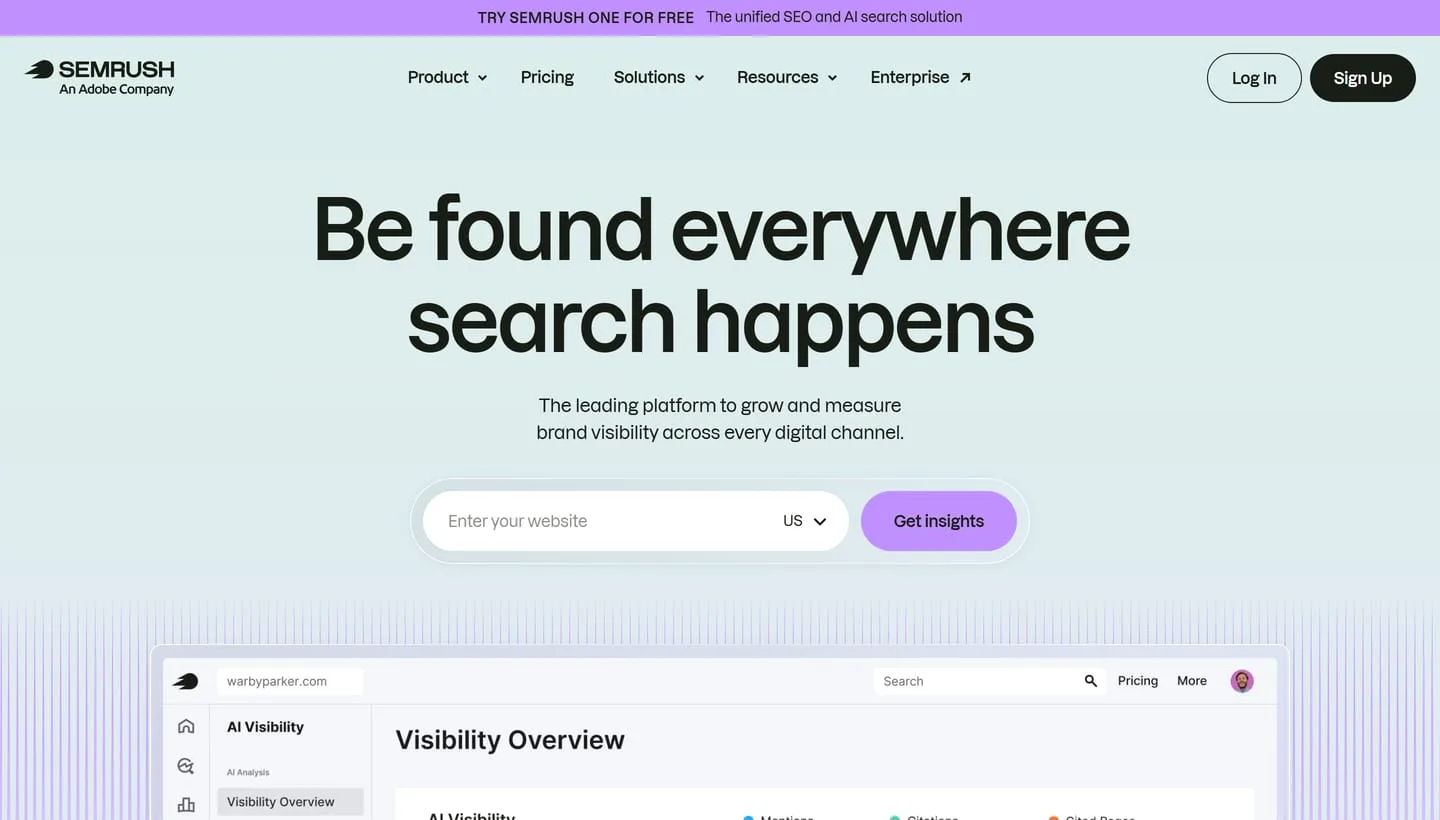
The broadest suite: keywords, ads, technical, content, local, social and an AI visibility toolkit, with a homepage that now literally says "SEO tools for the AI search era".
What we use it for: Keyword Magic Tool for expansion (its free tier is one of the better free keyword tools on the web), Position Tracking when a client wants daily numbers, Site Audit as a scheduled crawl. The AI Visibility Toolkit is competent and expensive.
Strengths: One subscription across many jobs; strong position tracking; the largest keyword database; AI visibility as an add-on rather than another vendor. Limitations: Backlink index smaller than Ahrefs; one seat on entry; you will pay for modules you don't use; add-ons stack up. Pricing: SEO $139/mo, Starter $199/mo, Pro+ $299/mo, Advanced $549/mo. Best for: Teams who want one vendor across several channels.
6. SE Ranking — best value bundle, with AI tracking included
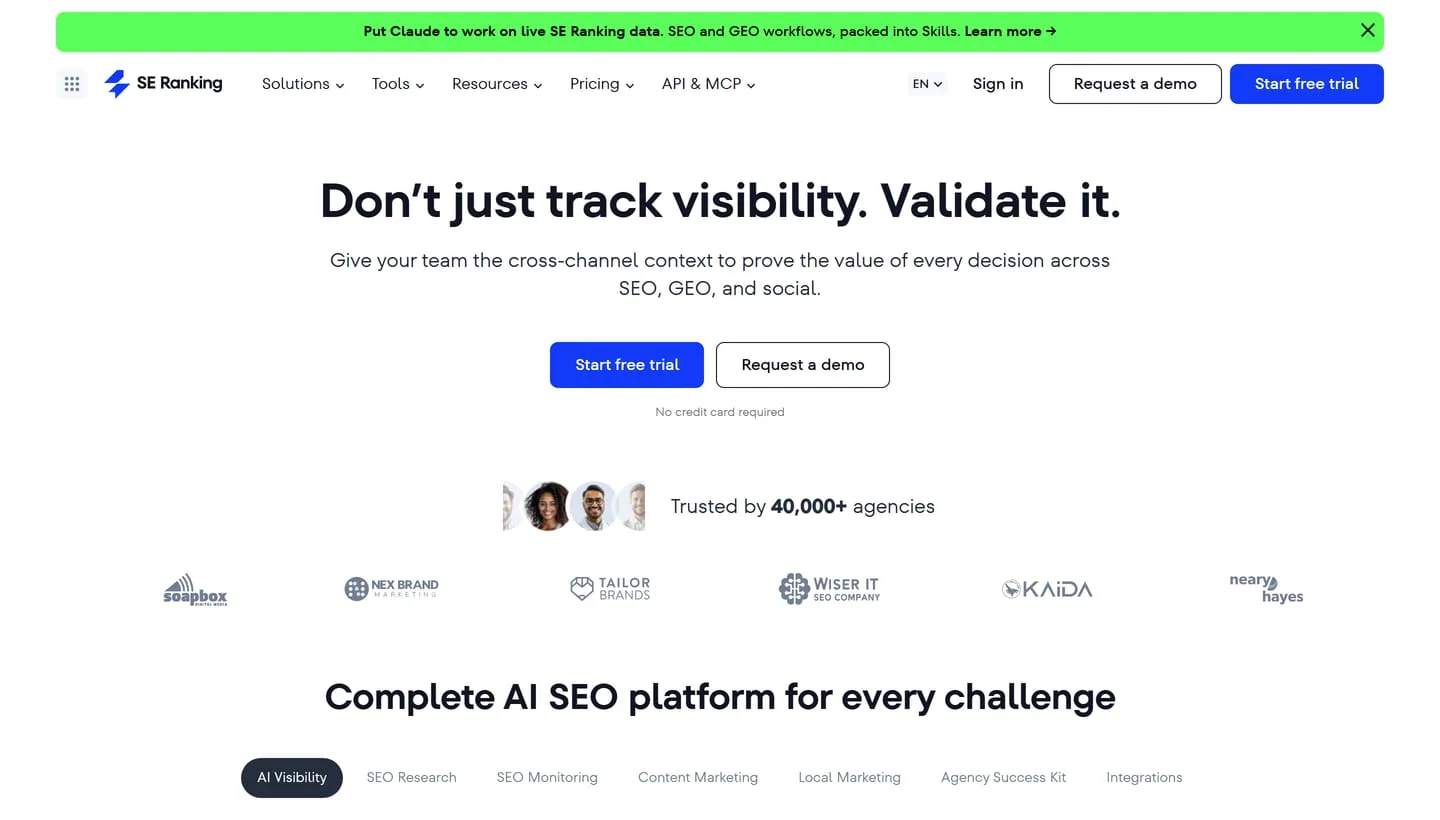
The suite people switch to when the two above start to feel like paying for a bank. Rank tracking, backlinks, keyword research, site audit and an AI visibility tracker on the same tier, at a price the big two charge for their entry level.
What we found: the backlink index is smaller than Ahrefs' but adequate for most competitor work; the rank tracker is the strongest part; the AI visibility module covers the major assistants and AI Overviews and is included rather than sold separately, which is unusual.
Strengths: Breadth for the price; AI tracking bundled; agency features (white label, client seats) on the higher tier. Limitations: Data depth trails Ahrefs and Semrush; fewer integrations; annual discount is where the real value is. Pricing: Core $129/mo, Growth $279/mo (about 20% less billed annually). 14-day trial, no card. Best for: Small agencies and in-house teams who want the whole SEO+GEO bundle on one line.
7. Moz Pro — best for beginners and DA-based reporting
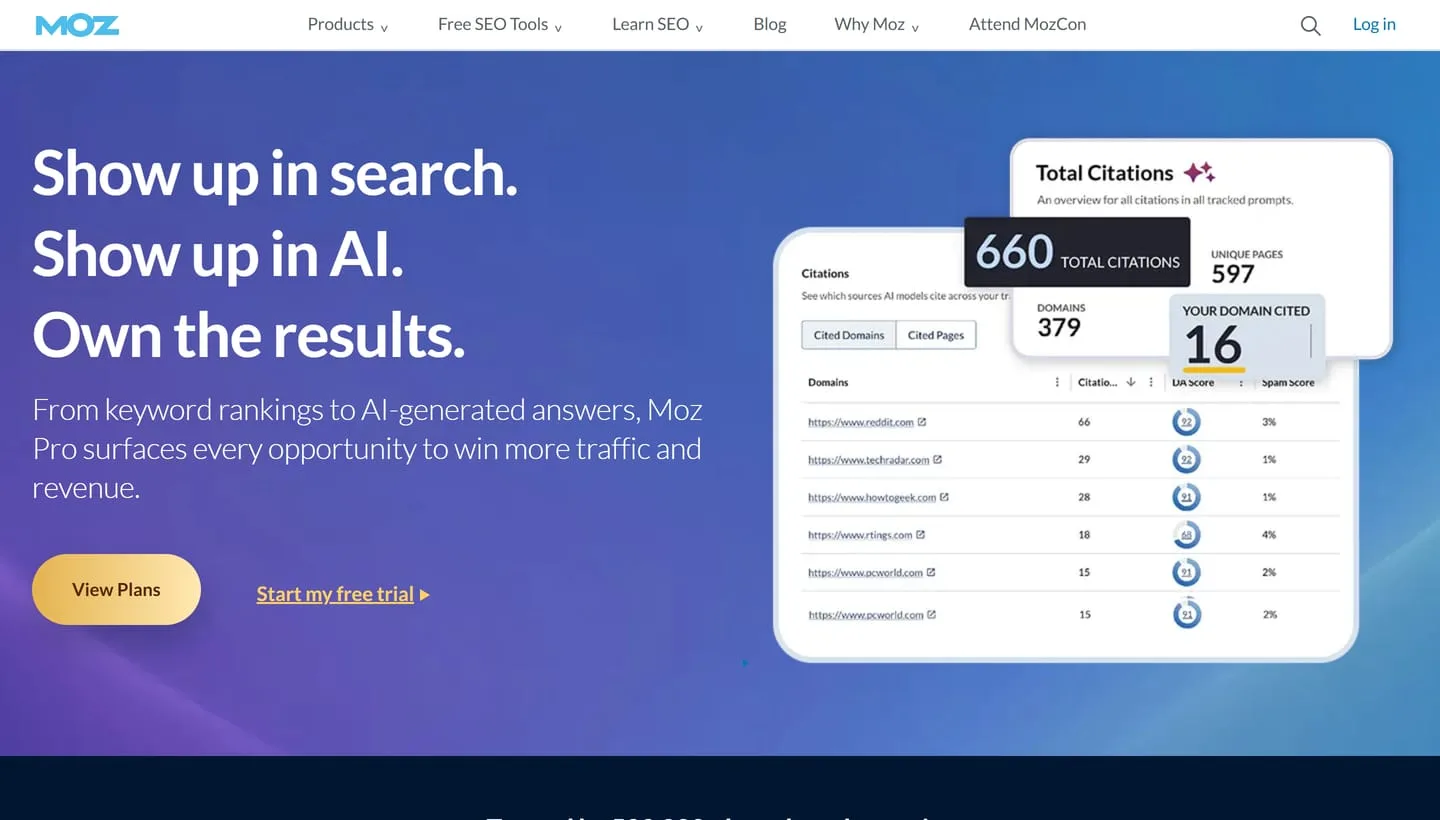
The friendliest on-ramp, and the origin of Domain Authority — still the metric most clients and executives recognise.
Strengths: Approachable interface; DA is widely understood; genuinely good free tools (Link Explorer, Keyword Explorer with limits, MozBar). Limitations: Smaller index than Ahrefs or Semrush; its recommendation features are on-page and technical — the link tools are research, not actions. Pricing: Starter around $49/mo, Standard around $99/mo (vendor page blocks fetching; figures from current listings). Best for: Teams new to SEO, or reporting to stakeholders who know DA.
8. Mangools — best for the easiest learning curve
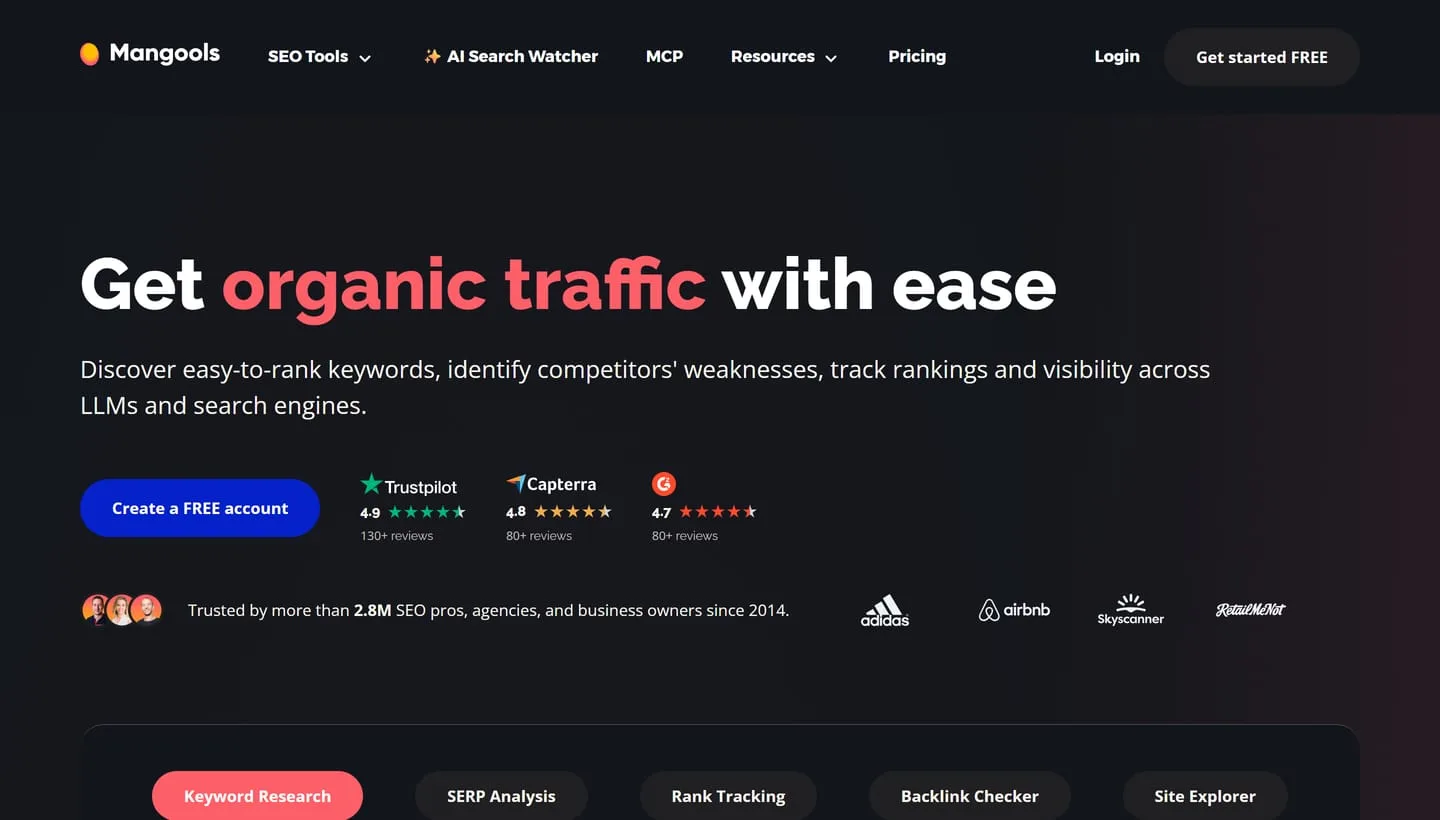
Five simple tools (KWFinder, SERPChecker, SERPWatcher, LinkMiner, SiteProfiler), a clean interface, and a price that doesn't frighten a small business.
Strengths: Easiest learning curve here; keyword difficulty that beginners can act on; good value on annual. Limitations: Shallower data than the big two; limited for enterprise or agency work. Pricing: Basic around $49/mo (about $30 billed annually), Premium around $69/mo (from current listings). Best for: Beginners and small sites.
9. Ubersuggest — best for the smallest budget
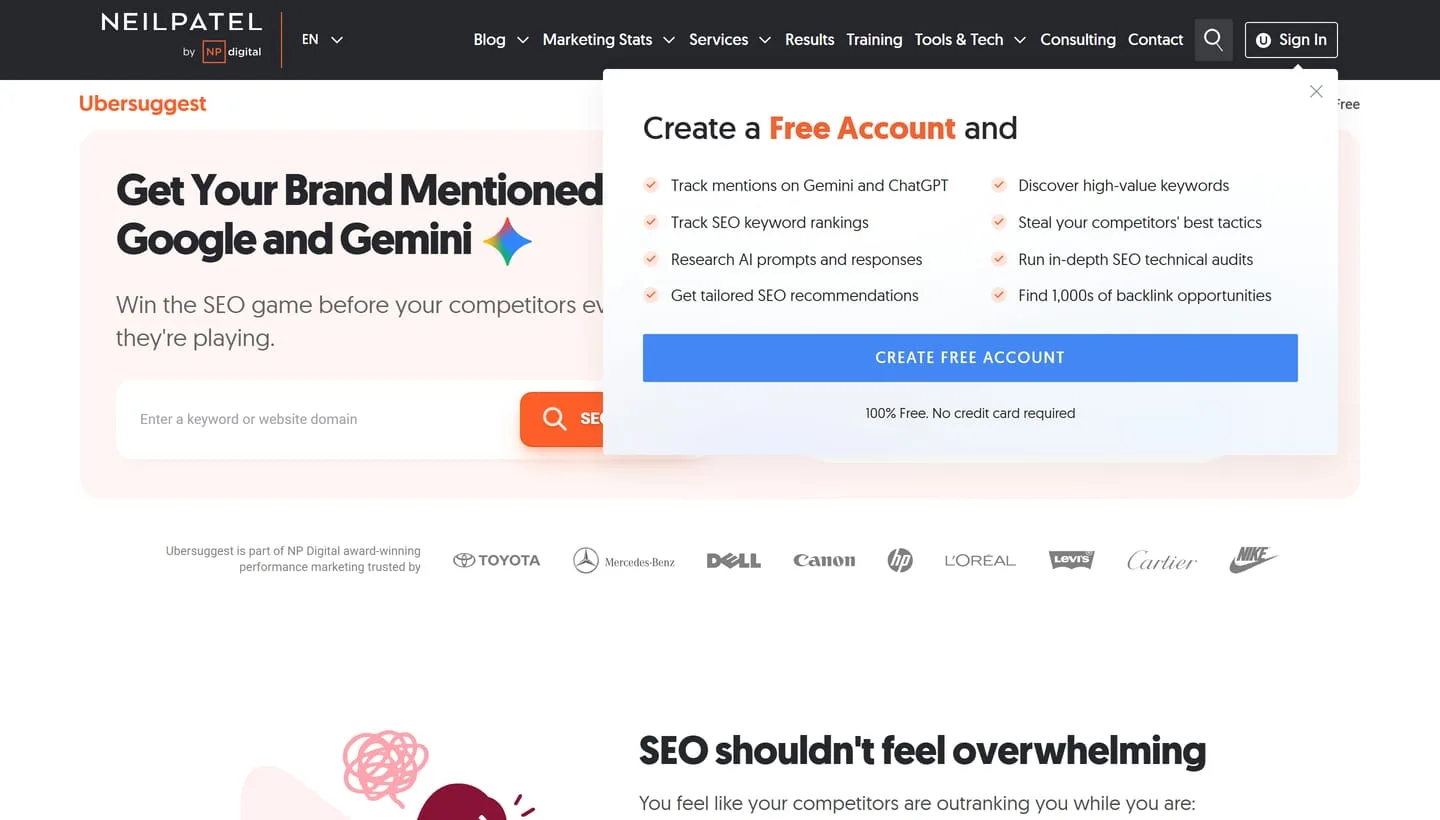
The budget option, including lifetime pricing that no competitor matches.
Strengths: Cheapest real research tool; lifetime deals; fine for keyword ideas and basic competitor checks; a decent free backlink checker with daily limits. Limitations: Data quality trails the leaders; limits are tight; not a stack you scale on. Pricing: Individual around $29/mo or $290 lifetime, Business around $49/mo (from current listings). Best for: Solo founders and side projects.
Keyword and Demand Research
10. Google Keyword Planner and Google Trends — best free volume and seasonality
Two free Google tools that most paid keyword tools quietly resell. Keyword Planner (inside a Google Ads account, no spend required, though exact volumes need an active campaign) gives volume ranges and related terms straight from the source. Trends gives relative demand over time and by region — the fastest way to see whether a keyword is seasonal or dying, and to compare two phrasings.
Strengths: Free; first-party; Trends' "rising" queries surface demand before it has volume. Limitations: Planner shows ranges without spend; neither gives difficulty; Trends is relative, not absolute. Best for: Validating a keyword idea before you pay anyone for it.
11. Keywords Everywhere — best for volume while you browse
A browser extension that overlays volume, CPC and competition on Google, YouTube, Amazon and a dozen other sites as you search, plus "people also search for" and related keywords in the sidebar. It replaced a lot of tab-switching for us.
Strengths: Cheap; the overlay makes keyword research a habit rather than a session; historical trend charts on hover. Limitations: Credit-based; the free mode shows keywords without metrics; no difficulty score of its own. Pricing: Bronze $84/yr (100k credits), Silver $168/yr; one-off credit packs from $80. Annual only. Best for: Marketers who want numbers in the browser without opening a suite.
12. AnswerThePublic — best for question mapping
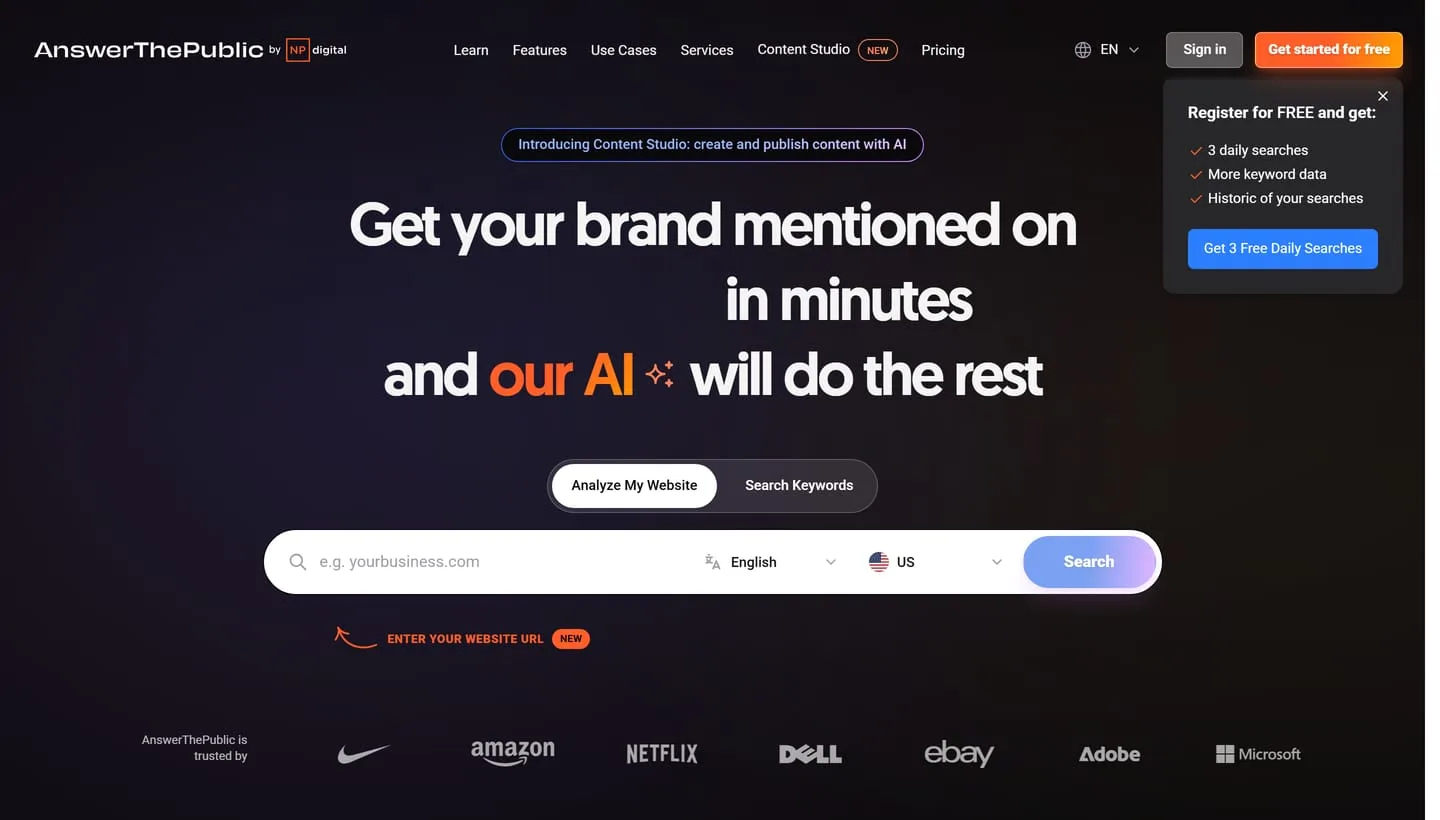
Question research, and unusually relevant now that people phrase queries conversationally to assistants.
Strengths: Fast question mapping; cheap; the output maps neatly onto prompts worth tracking in AI visibility tools. Limitations: One narrow job; limited free searches; volumes are second-hand. Pricing: Starter $20/mo ($99 lifetime), Growth $99/mo. Best for: Content planning and building your AI prompt list.
13. Exploding Topics — best for catching demand early
Trend discovery: topics and products whose search growth is accelerating, months before they show meaningful volume in a suite. We use it for the "what should we have a page about next year" question rather than "what should we write this week".
Strengths: Finds keywords before the volume exists; category filters; the Pro database is broad. Limitations: Not a keyword tool for the current month; hit rate on trends is uneven; you still need a suite for difficulty. Pricing: Entrepreneur $39/mo, Investor $99/mo. 7-day trial. Best for: Content strategists planning quarters ahead.
Content
14. Surfer — best for repeatable on-page optimisation
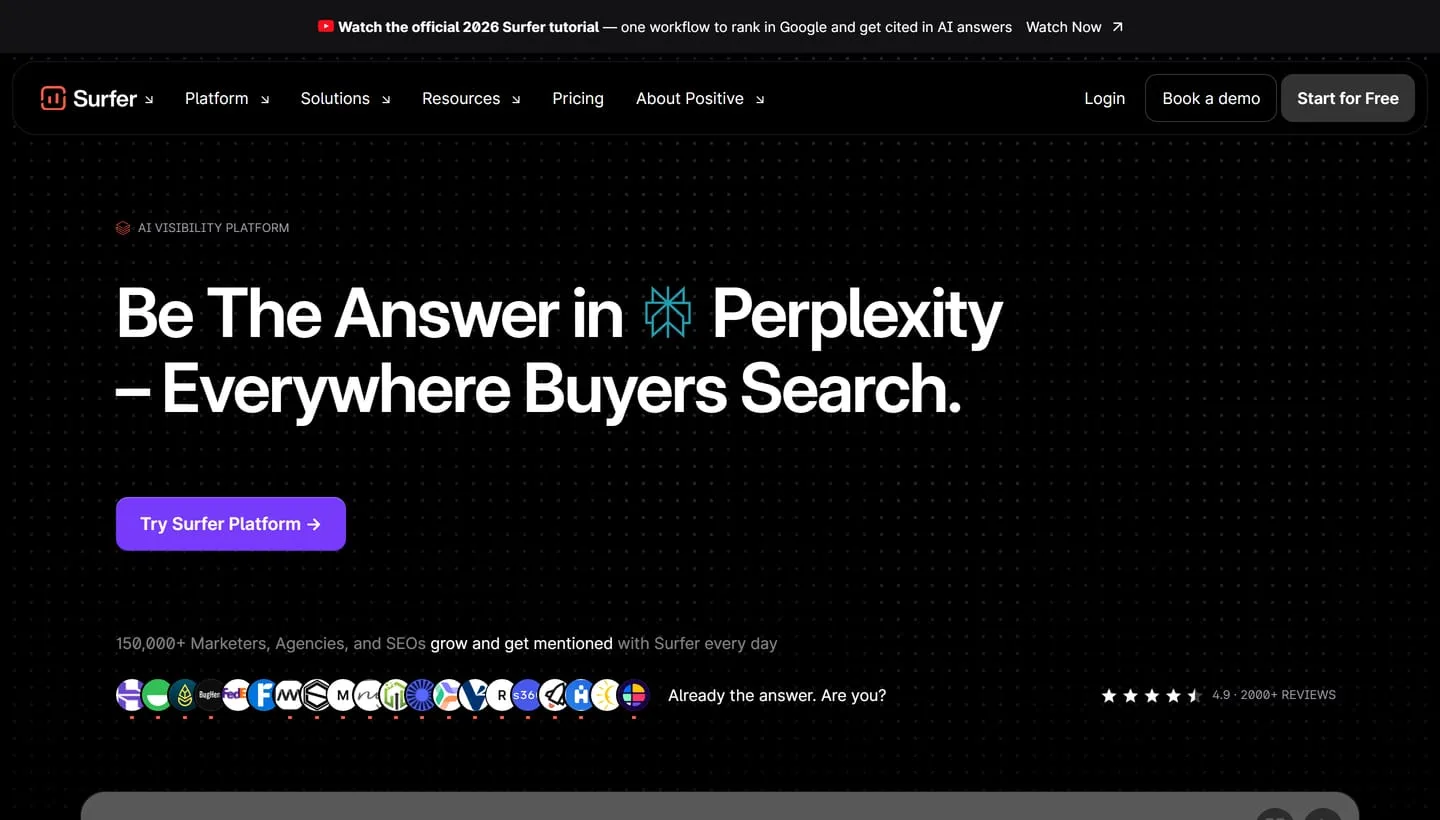
The default on-page content optimizer, now with an AI search analytics product alongside it.
Strengths: Clear, actionable on-page guidance; good editor integrations; AI Search Analytics available standalone. Limitations: On-page only by design; document limits on Discovery; another subscription beside your suite. Pricing: Discovery $49/mo, Standard $99/mo, Pro $182/mo, AI Search Analytics $158/mo standalone. Best for: Teams publishing regularly who want a repeatable optimisation process.
15. Clearscope — best for editorial teams
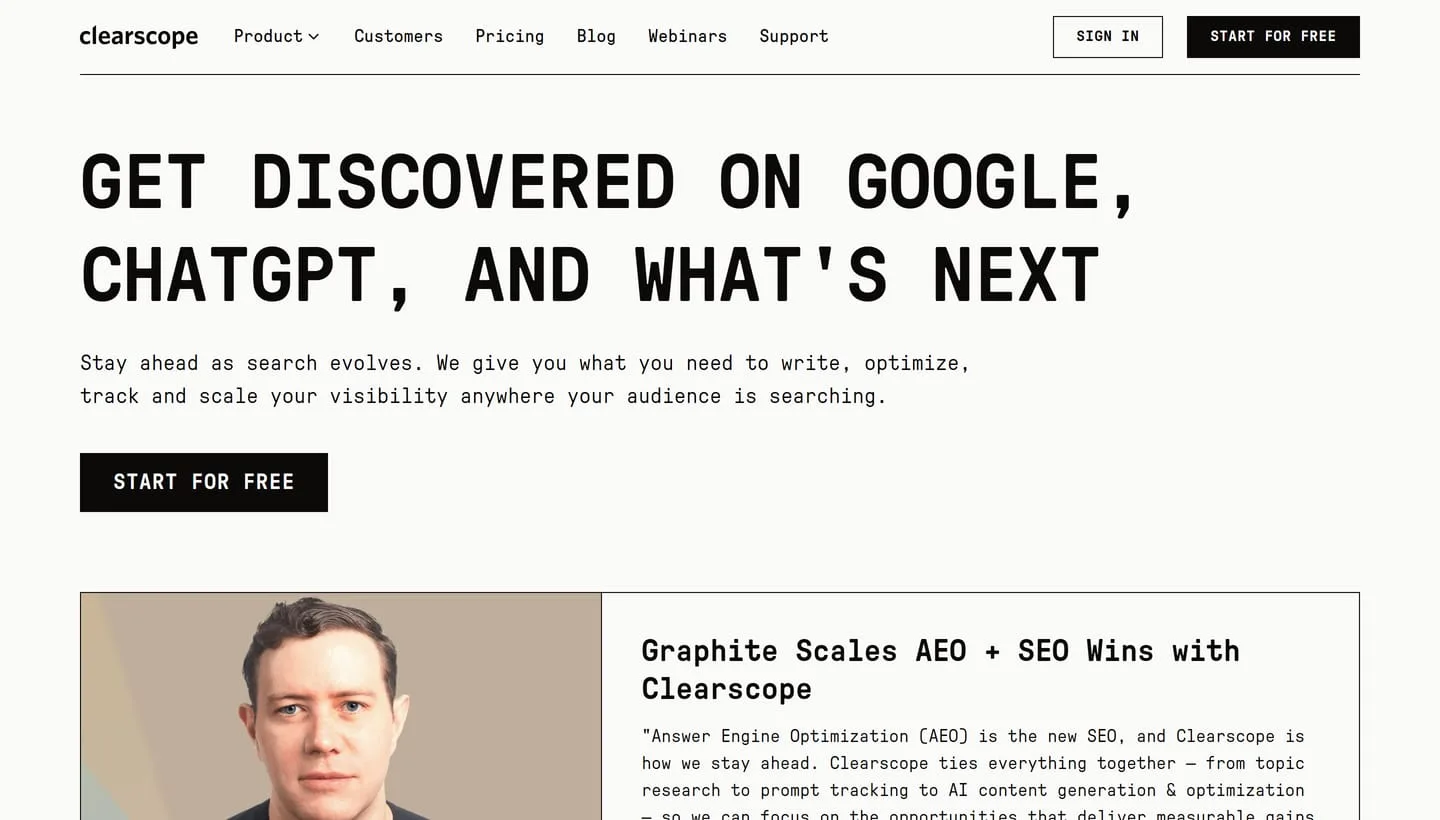
The premium content optimizer, favoured by editorial teams.
Strengths: Excellent report quality; strong with freelance writer workflows; trusted in content-heavy orgs. Limitations: Priced above Surfer for a narrower job; overkill for occasional publishing. Pricing: Essentials $129/mo, Business $399/mo. 14-day trial. Best for: Editorial teams with real content budgets.
16. Frase — best for briefs plus AI visibility on one bill
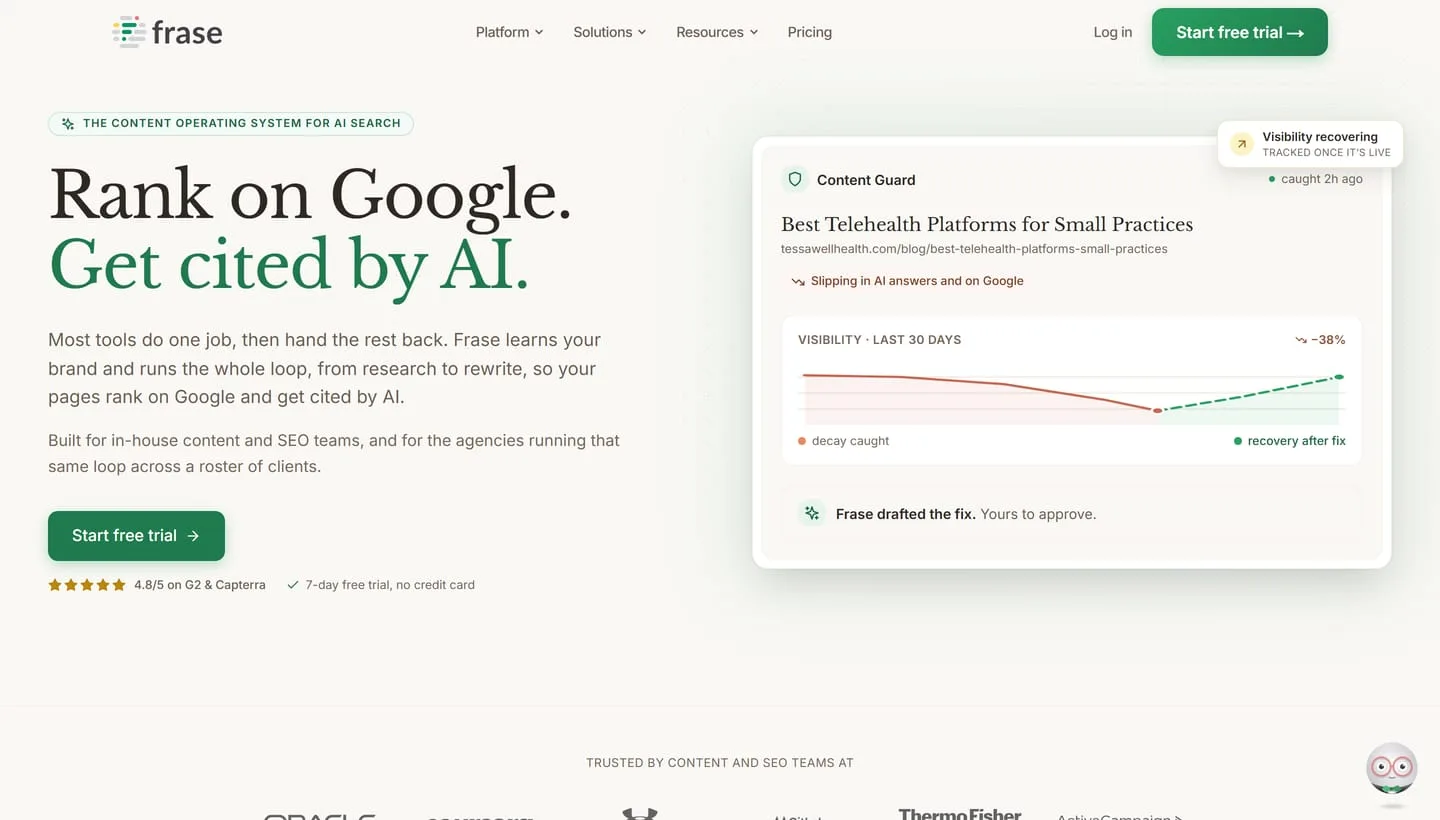
Briefs and optimization, with AI visibility tracking bolted on — the cheapest way to get both.
Strengths: $39/mo billed yearly; briefs, optimization and AI-engine tracking together. Limitations: Lighter than dedicated trackers on competitor depth; on-page focus. Best for: Small content teams covering two jobs on one budget.
17. BuzzSumo — best for ideation and who covers what
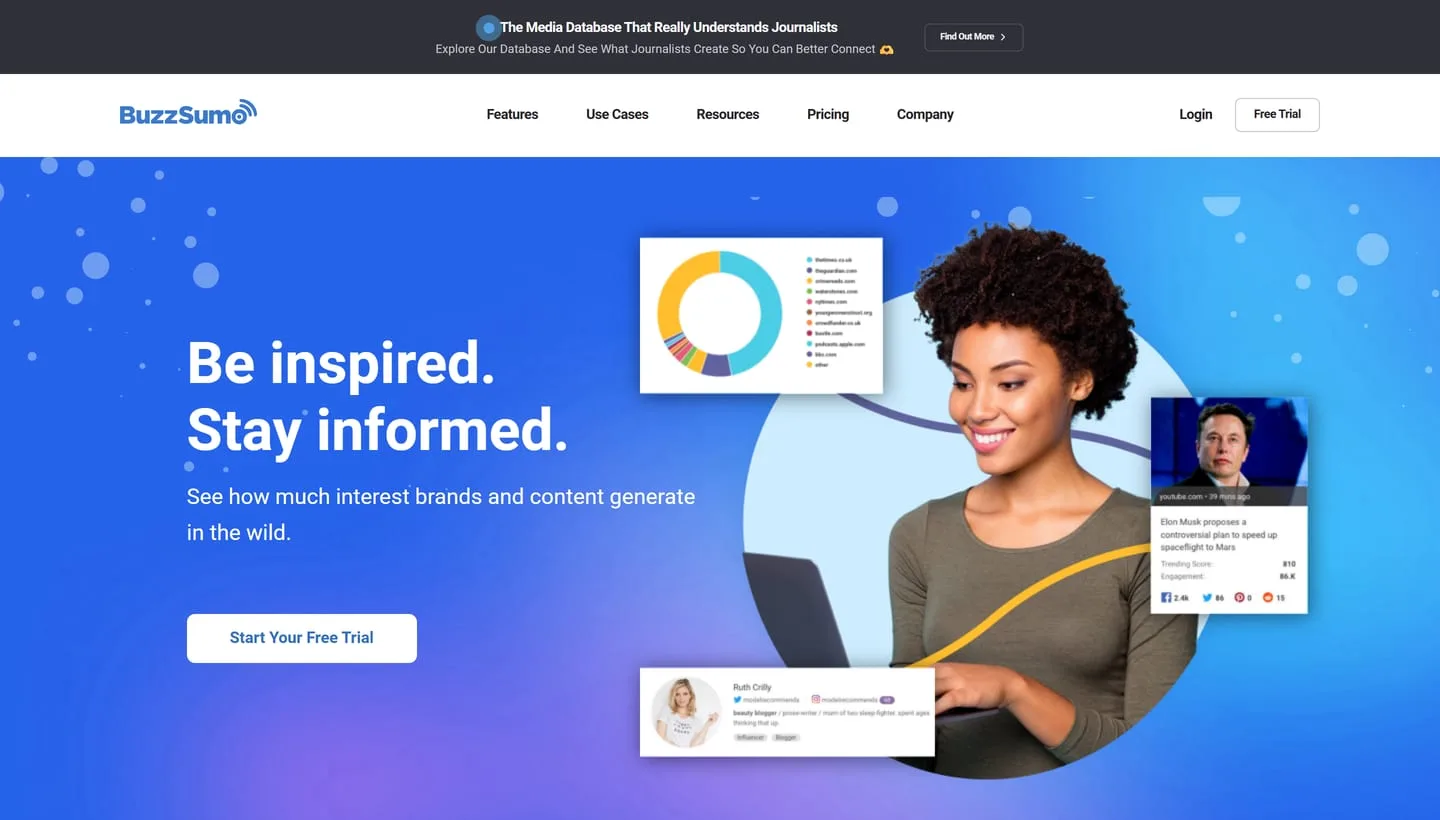
Content ideation and the journalists and creators behind it.
Strengths: Best-in-class for finding what gets shared and who covers a topic; useful for digital PR. Limitations: Not an SEO suite; pricing climbs quickly. Pricing: Content Creation $199/mo, PR & Comms $299/mo (annual; monthly is about 20% more). Best for: Content and PR teams looking for angles and people.
18. ChatGPT and Claude — best generalist assistant for SEO work
Not SEO tools, but every SEO team now uses one, so it is dishonest to leave them off. What they are actually good for: turning a keyword list into intent clusters, drafting briefs and outlines from a SERP you paste in, writing regex for Search Console filters, explaining a Screaming Frog export, first-drafting FAQ answers you then verify, and — the underused one — acting as a test subject: ask the assistant your category's buying questions and read who it names.
Strengths: Fast at the glue work between tools; free tiers are enough for most of it; web-search modes give current answers. Limitations: Volumes, rankings and backlink counts they quote are invented unless they browsed — never take a metric from a chat; content written end-to-end by an assistant is exactly what search systems are learning to discount. Pricing: Free; paid tiers around $20/mo. Best for: The work between the tools, and for checking whether an assistant recommends you.
Technical
19. Screaming Frog SEO Spider — best for crawls and audits
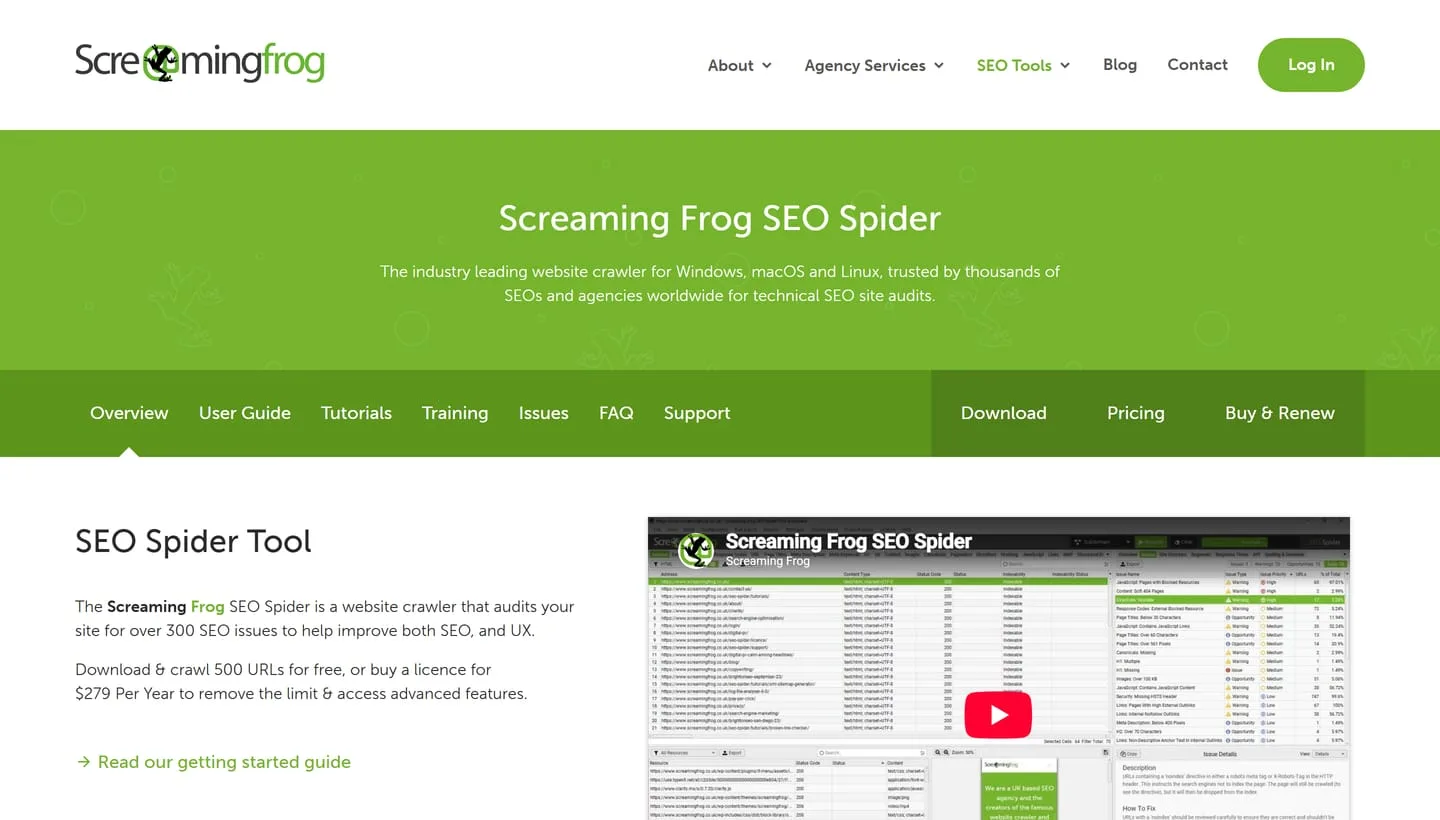
The desktop crawler every technical SEO owns.
Strengths: Free to 500 URLs; exhaustive crawl data; the fastest route to broken links, redirect chains and outbound-link audits; renders JavaScript; can extract anything with XPath. Limitations: Desktop app with a learning curve; no ongoing monitoring on the free tier. Best for: Technical audits, and broken link building.
20. Rank Math and Yoast — best for on-page hygiene on WordPress
If your site is on WordPress, one of these two is doing your titles, meta descriptions, canonicals, schema, sitemaps and redirects, and that is most of technical SEO for a small site. Both free versions are enough. Rank Math's free tier is more generous (schema types, redirects, basic rank tracking); Yoast is the older, more conservative choice with better documentation and a readability check writers like.
Strengths: Handle 80% of on-page and technical hygiene inside the CMS; both free tiers are complete for a small site. Limitations: WordPress only; the paid tiers add convenience, not capability; neither tells you anything about other sites. Pricing: Rank Math PRO about €8/mo billed annually; Yoast SEO Premium $118.80/yr per site. Best for: Any WordPress site — pick one, install it, move on.
Rank Tracking
21. AccuRanker — best when ranking accuracy is contractual
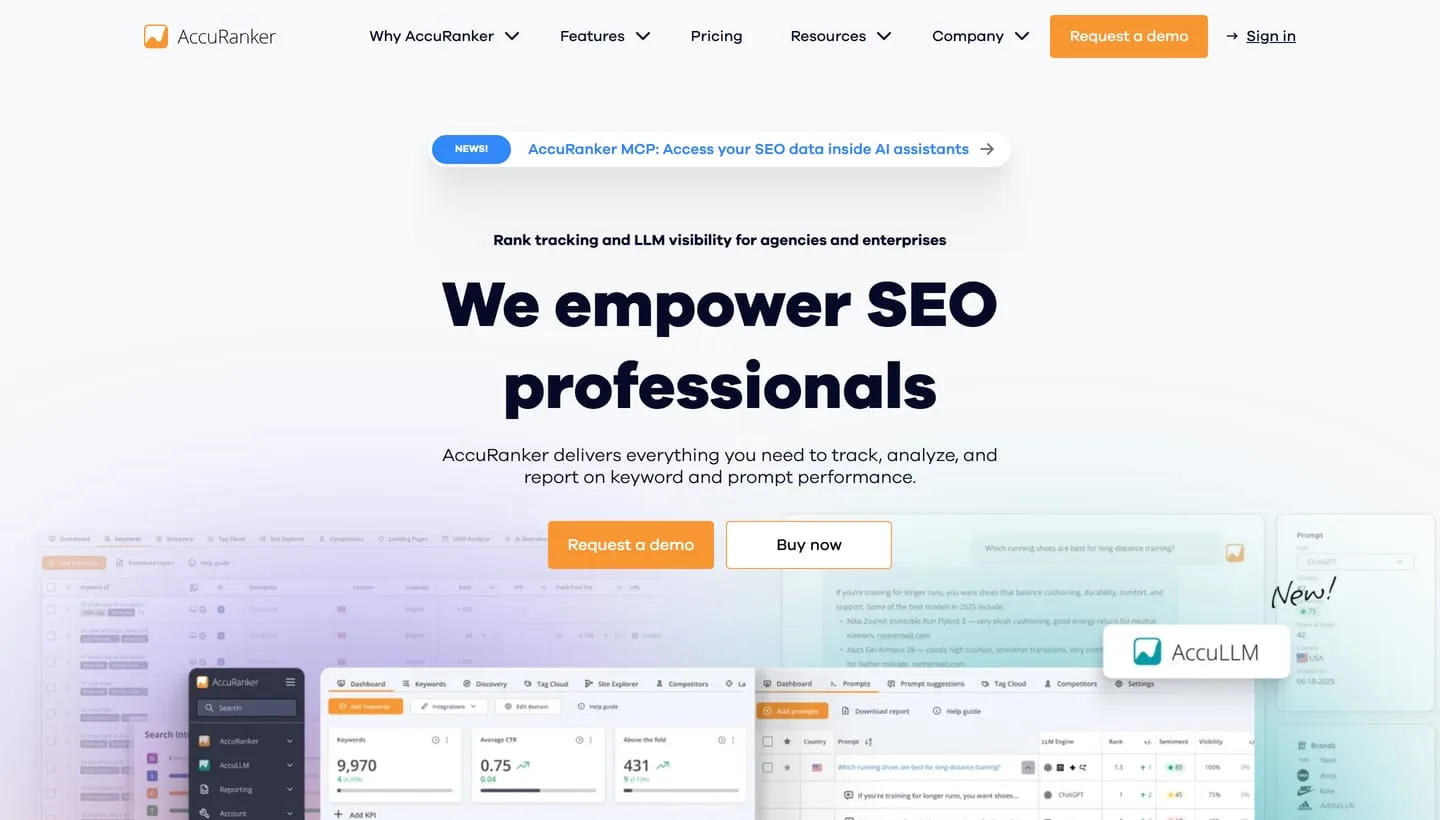
A specialist for teams whose suite's rank tracking isn't accurate or fast enough.
Strengths: On-demand refreshes; strong accuracy reputation; clean reporting for clients; SERP-feature tracking including AI Overviews. Limitations: Single job; priced for agencies; most teams are adequately served by their suite until they aren't. Pricing: Professional $224/mo (2,000 keywords), Expert $764/mo. Best for: Agencies and teams where ranking accuracy is contractual.
Competitive Intelligence
22. Similarweb — best for market-level traffic estimates
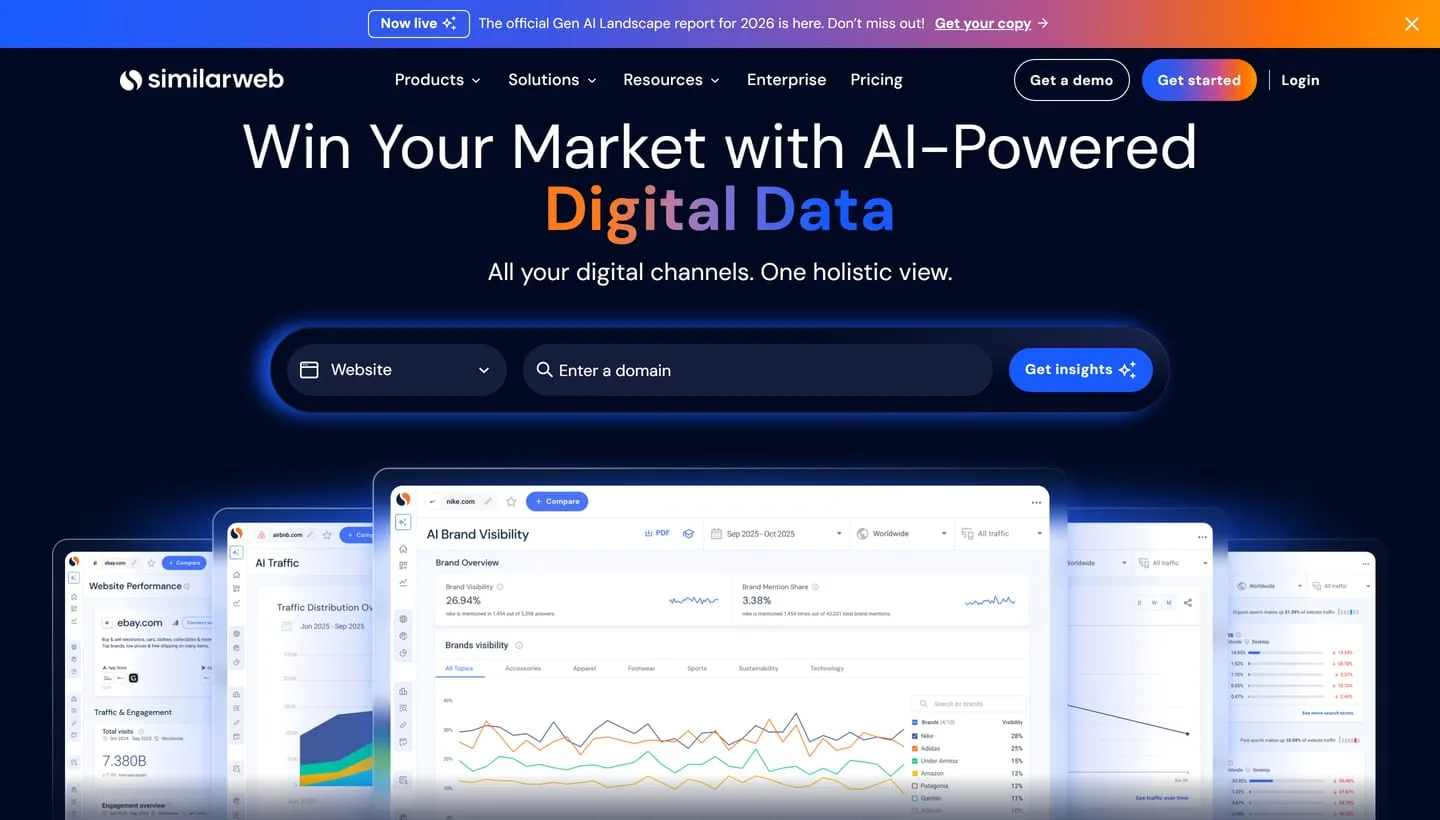
Traffic, channel mix and audience estimates for domains you don't own — the "how big are they really, and where does it come from" tool. It has added AI-visibility reporting to the SEO product, and its free tools answer the quick version of the question.
Strengths: The best publicly available traffic estimates; channel breakdown (organic, paid, referral, direct); market and category views agencies use for pitches. Limitations: Estimates, not measurements — wide error bars on small sites; priced for larger teams; the SEO module is not a substitute for Ahrefs or Semrush. Pricing: Starter around $199/mo; enterprise tiers quoted (vendor page hides figures behind a trial). Best for: Agencies and strategy teams sizing markets and competitors.
Off-Page and AI Visibility
Our tool
23. Sightivo — best for earning the mentions that move rankings and AI answers
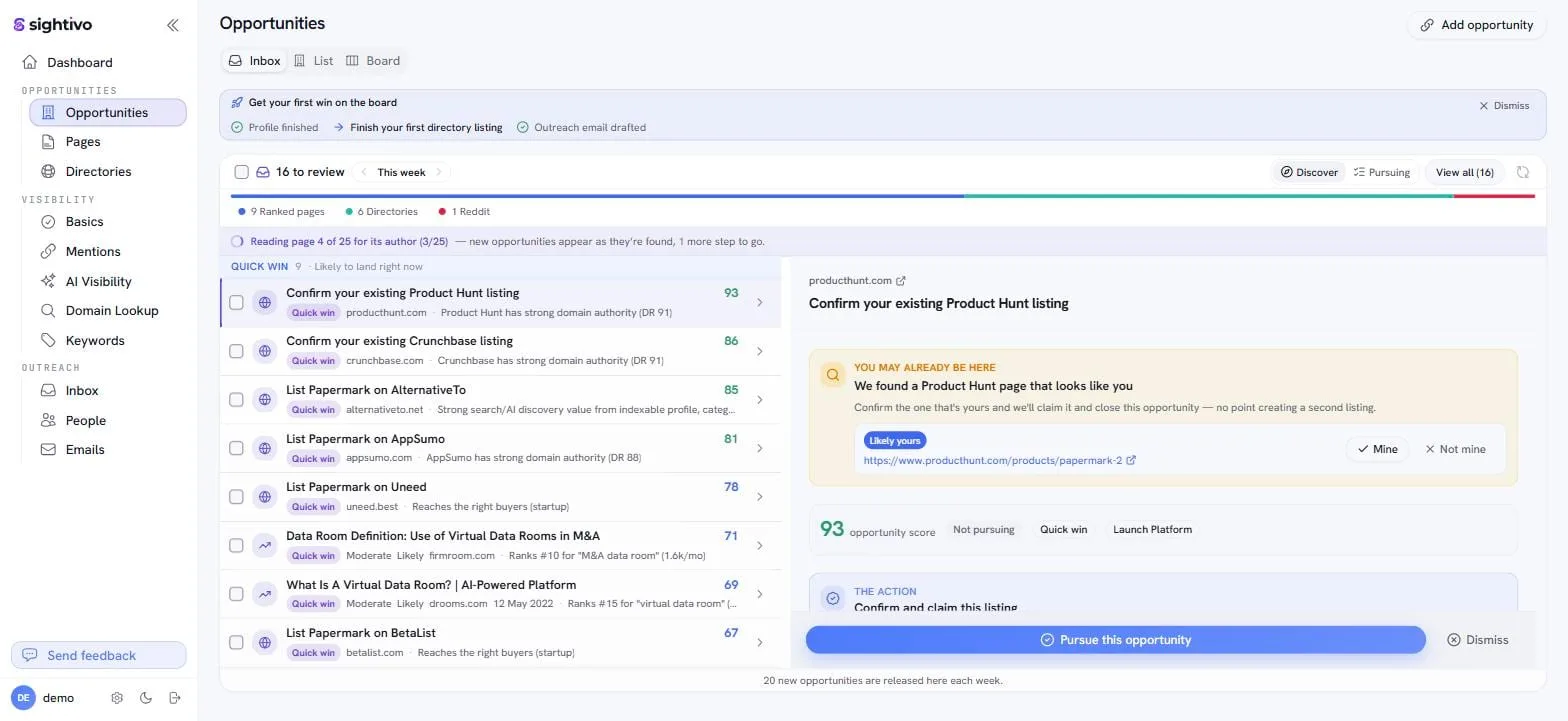
Every tool above measures your site, your rankings, or your content. None of them tell you which third-party page to appear on, who runs it, or what to say to them — and that's the work driving both rankings and AI citations.
Strengths:
- Scored opportunities: the roundups, comparisons, directories and ranked pages worth pursuing in your category
- Author discovery with contact enrichment, plus drafted outreach and follow-up tracking
- AI visibility tracking across ChatGPT, Perplexity, Gemini and Claude in the same workspace, on a fixed prompt set re-run over time
- Backlink and rank tracking alongside, so SEO and GEO stop being two subscriptions
- Free plan, no credit card — and three free tools that need no account at all: the AI visibility checker, the backlink checker and the keyword research tool
Limitations:
- Not an Ahrefs-scale backlink index — pair it with free webmaster tools or a suite for deep research
- Built for startups and small teams rather than enterprise
- Newer, with a smaller community than the incumbents
Pricing: Free, Starter $79/mo, Growth $169/mo.
Best for: Teams whose bottleneck is earning mentions, not measuring the gap
24. Profound, Peec AI and Otterly — best dedicated AI visibility trackers
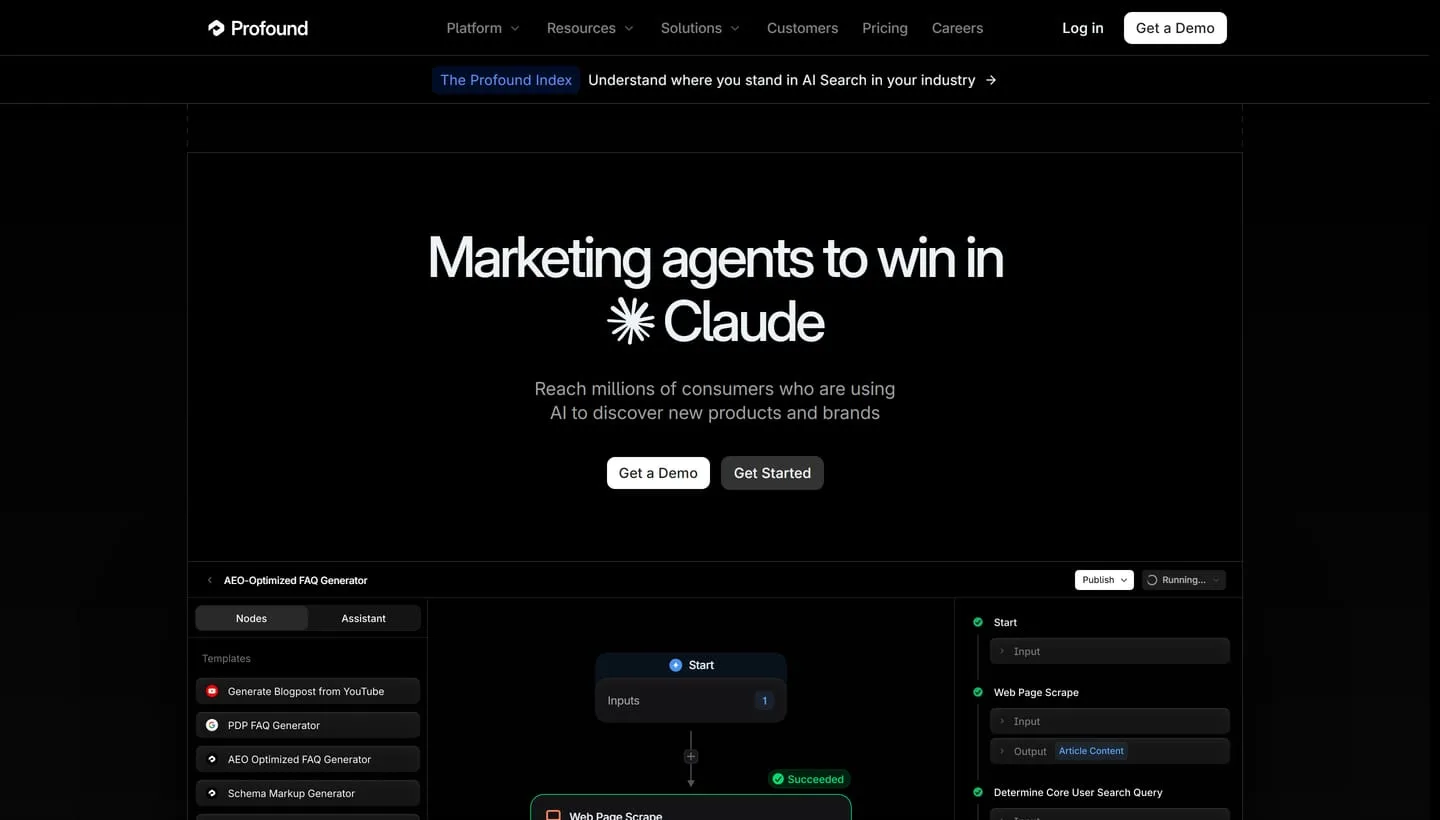
If you want AI-answer tracking as its own product rather than a module or a workflow tool, this is the current field. Otterly is the cheapest real starting point; Peec is the cleanest daily tracker for marketing teams; Profound is the enterprise choice with executive reporting and the deepest engine coverage above its entry tier.
Strengths: Purpose-built prompt sets, share-of-voice and citation reports across engines; better competitor views than the suites' modules. Limitations: Measurement, not action — none tells you where to get mentioned or who to ask; engine coverage varies by tier; the field changes monthly. Pricing: Otterly Lite $29/mo; Profound Starter $99/mo (annual), Growth $399/mo; Peec Starter around €85/mo (page renders prices client-side; figure from current listings). Best for: Teams who already have an off-page motion and want a dedicated scoreboard. We compared ten of them, with a disclosure, in the best AI visibility tools.
Four Stacks That Work
Free ($0). Search Console + Bing Webmaster Tools + GA4 + Ahrefs Webmaster Tools + Screaming Frog free + Rank Math or Yoast free (WordPress) + Sightivo free. Covers measurement, your own backlinks, technical audits and a weekly shortlist of places to pitch. Add our free backlink checker and keyword tool for one-off lookups.
Solo founder (~$80–130/mo). The free layer plus either one research tool (Ahrefs Starter at $29, or Mangools annual) or one workflow tool covering off-page. Keywords Everywhere at $7/mo-equivalent is the cheapest useful add. Don't buy both a suite and a workflow tool yet.
Small team (~$260/mo). Ahrefs Lite ($129) or SE Ranking Core ($129) for research, Surfer Discovery ($49) for content, Sightivo Starter ($79) for off-page and AI visibility. Three jobs, no overlap.
Agency (~$400+/mo). Semrush or Ahrefs on an agency tier, a dedicated rank tracker, a content optimizer, Similarweb for pitches, and a multi-client off-page tool — plus a white-label reporting layer.
The mistake is stack four's spend on stack two's workload. Every tool generates work; only some reduce it.
Tools That Didn't Make the List
Not bad tools — just not on the shortlist for the jobs above, or covered elsewhere on this site:
- HubSpot SEO / Marketing Hub — content home with SEO recommendations and an AEO beta; you don't buy it for SEO.
- Majestic — the deepest historic backlink index, but Ahrefs covers the job for almost everyone. It's in our backlink monitoring roundup.
- SpyFu, Serpstat, SEO PowerSuite — capable suites with loyal users; none beat the value of SE Ranking or the data of Ahrefs in our tests.
- PageSpeed Insights, Lighthouse, GTmetrix — essential and free, but performance tools rather than SEO tools; covered in best free SEO tools.
- Yext, BrightLocal, Whitespark — local SEO specialists, out of scope for this list.
- Pitchbox, Respona, BuzzStream — outreach CRMs without the discovery and AI-visibility layer; compared in link building tools.
- Jasper, Writesonic, Copy.ai — writing assistants; the generalist assistants above do the same job for less.
What Almost No SEO Tool Does
Look at the recommendation features across this list. Surfer and Clearscope recommend on-page changes. Semrush's audit recommends technical fixes. Moz's Page Optimization is on-page. Rank Math and Yoast score the page you are editing. Screaming Frog reports technical problems. Ahrefs shows you data and lets you decide.
Every one of those recommendations concerns a page you already control — and that's the minority of what determines whether you rank or get cited. Ahrefs' study of 75,000 brands found brand web mentions correlate with AI Overview visibility at 0.664 against 0.218 for backlinks, with the top three factors all off-site. Muck Rack found 84% of AI citations come from earned media.
The category optimizes what's computable and leaves the rest to you. We wrote about why in the SEO/GEO tool gap.
Common Questions
What is the best SEO tool overall?
For data, Ahrefs. For breadth, Semrush. For value, SE Ranking. For beginners, Mangools. For free, Search Console. There's no single winner because they do different jobs — buy for your bottleneck.
What are SEO tools, and what do they actually do?
Software that helps you measure how a site performs in search, research what people search for and who ranks for it, optimise pages, find technical problems, track rankings, and — the newer category — measure and improve how AI assistants describe and recommend you. No single tool does all of it, which is why this list is grouped by job.
What is the cheapest way to do SEO properly?
Search Console, Bing Webmaster Tools, GA4, Ahrefs Webmaster Tools and Screaming Frog's free tier cover measurement, your own backlinks and technical audits at zero cost. Add one paid tool for whichever job is actually slowing you down.
Do I need Ahrefs and Semrush?
Almost never. They overlap heavily. Pick one for research and spend the difference on a job neither covers — content optimization or off-page outreach.
Which SEO tool is best for beginners?
Mangools for the interface, Moz Pro if you'll be reporting Domain Authority to someone, and Search Console before either. Avoid starting with an all-in-one suite on its top tier; the learning curve is the price you don't see.
Which SEO tools are best for small business?
Search Console and GA4 free, one of Mangools/SE Ranking/Ahrefs Starter for research, and a WordPress SEO plugin if you're on WordPress. We went deeper in best SEO tools for small business.
Are free SEO tools good enough?
For a small site, largely yes. We listed the genuinely useful ones in best free link building tools and best free SEO tools — and we run three of our own that need no account: a backlink checker, a keyword research tool and an AI visibility checker.
Which SEO tools handle AI search?
Semrush, Ahrefs Brand Radar, SE Ranking, Similarweb, Surfer and Frase have all added it; dedicated trackers (Profound, Peec, Otterly) go deeper; Sightivo pairs the tracking with the off-site work that changes the number. We compared the field in the 10 best AI visibility tools.
What SEO tools does Google offer for free?
Search Console, Analytics 4, Keyword Planner (inside Google Ads), Trends, PageSpeed Insights, Lighthouse, the Rich Results Test and Looker Studio. Together they cover measurement, basic keyword research and technical checks for your own site; what they don't do is show you competitors.
How much should a small business spend on SEO tools?
Under $150/mo covers a small business well in 2026. Above that, you're usually buying data volume or seats rather than capability.
Key Takeaways
- Buy by job, not by brand — most stacks duplicate research and skip off-page entirely
- Search Console, Bing Webmaster Tools and GA4 are free and better than any paid approximation of your own data
- Ahrefs' $29 Starter tier changed the entry economics; Lite at $129 is still the real working tier, and SE Ranking now bundles AI tracking at that price
- Content optimizers only ever improve pages you already control
- The uncovered job — earning mentions on other people's pages — is the one that moves both rankings and AI citations
If your stack measures everything and never names the next action, see how Sightivo turns gaps into named actions or start free.
Topics covered
Related articles
Written by
Product leader who's launched 8 B2B SaaS products over the past 6 years. Experienced in taking products from 0 to 1 and scaling them. Built Sightivo out of frustration while doing backlink outreach for another startup—spent hours juggling spreadsheets and tools just to send a few emails. Decided to build something better and share it with others facing the same pain.
Ready to grow your search & AI visibility?
Sign up for Sightivo to track rankings, backlinks, and how often AI engines cite your brand.
Start free