The SEO/GEO Tool Gap: Why Your Tools Measure Everything and Recommend Almost Nothing
Sightivo
The SEO/GEO Tool Gap: Why Your Tools Measure Everything and Recommend Almost Nothing
Your SEO stack and your AI visibility stack don't talk to each other, and neither tells you what to actually do. When they do recommend something, it's on-page. Here's why, and what the missing half looks like.

Open any SEO tool and you'll find a recommendations tab. Open any AI visibility tool and you'll find a dashboard. Now try to answer a simple question with either one: what should I do this week to get mentioned more?
Neither will tell you. And the reason is the same in both cases — a reason worth understanding before you buy anything else.
Two Stacks That Don't Talk
The tooling market has split cleanly in two, and most teams now pay for both halves.
The SEO stack — Ahrefs, Semrush, Moz, SE Ranking — measures rankings, backlinks, technical health and keywords. Mature, accurate, and built on a decade of crawl infrastructure.
The GEO stack — Profound, Peec AI, Otterly, ZipTie, and a dozen more — measures how often ChatGPT, Perplexity, Gemini and AI Overviews mention your brand. New, fast-moving, and largely priced as a second subscription.
They rarely share a workspace. Your backlink data lives in one, your mention rate lives in another, and the connection between them — that the same earned mentions drive both — exists only in your head.
That connection is not speculative. Ahrefs studied 75,000 brands and found brand web mentions correlate with AI Overview visibility at 0.664, well ahead of backlinks at 0.218, with the top three factors all off-site. Muck Rack's analysis of more than 25 million cited links found earned media accounts for 84% of AI citations against 0.3% for paid and advertorial content.
One activity — getting credible sources to write about you — moves both numbers. Two separate stacks bill you to watch it happen from different angles.
The Recommendation Gap
Here's the part that costs you more than the duplicate subscriptions.
Almost every tool in both stacks stops at measurement. And the handful that do make recommendations recommend the same narrow thing: changes to pages you already control.
| What the tool recommends | Typical examples | What it can't tell you |
|---|---|---|
| On-page optimization | Add these terms, adjust headings, improve title tags | Which third-party page you should appear on |
| Technical fixes | Fix crawl errors, redirects, page speed, schema | Who writes or maintains that page |
| Content briefs | Cover these subtopics at this length | What to say to that person to earn the mention |
| Keyword targets | Chase these queries at this difficulty | Whether they'd plausibly say yes |
| AI visibility scores | You're in 12% of answers, a rival is in 40% | Which five sources to pursue to close that gap |
Moz is the clearest illustration. Its recommendation features — Page Optimization and Site Crawl — are genuinely useful, and they are entirely on-page and technical. Its link tools, Link Explorer and Link Intersect, are research: they show you what exists. They don't hand you an action. That split runs through the whole category. Surfer and Clearscope recommend on-page content changes. Semrush's site audit recommends technical fixes. The AI visibility tools mostly recommend nothing at all — they report.
So the recommendation coverage looks like this: comprehensive for the 20% of ranking and citation influence you control on your own domain, and close to absent for the 80% that depends on other people's pages.
Why On-Page Is Where Every Tool Stops
This isn't laziness. On-page recommendations are simply the only kind that are cheap to compute.
Your own site is a closed system. A crawler can read every page you own, compare them against pages that rank, and produce a diff. No judgment required, no humans involved, no risk of being wrong in an embarrassing way.
Off-page requires judgment at every step. Which of the ten thousand pages mentioning your category is worth pursuing? Is this roundup actually updated, or abandoned in 2023? Who maintains it — the byline, the editor, or a freelancer who left? What would make them say yes? Every one of those is a call, not a calculation.
Off-page recommendations can be wrong in public. An on-page suggestion that misses costs you nothing. Tell someone to email a journalist with a bad angle and you've burned a contact they can't get back.
The data is harder to hold. Author identity, contact details, publication cadence and relationship history don't fall out of a crawl. They have to be assembled and kept current.
All of which is why the category converged on the safe half. It's also why the expensive half — deciding where to show up and getting someone to put you there — is still done in spreadsheets.
What the Missing Half Actually Looks Like
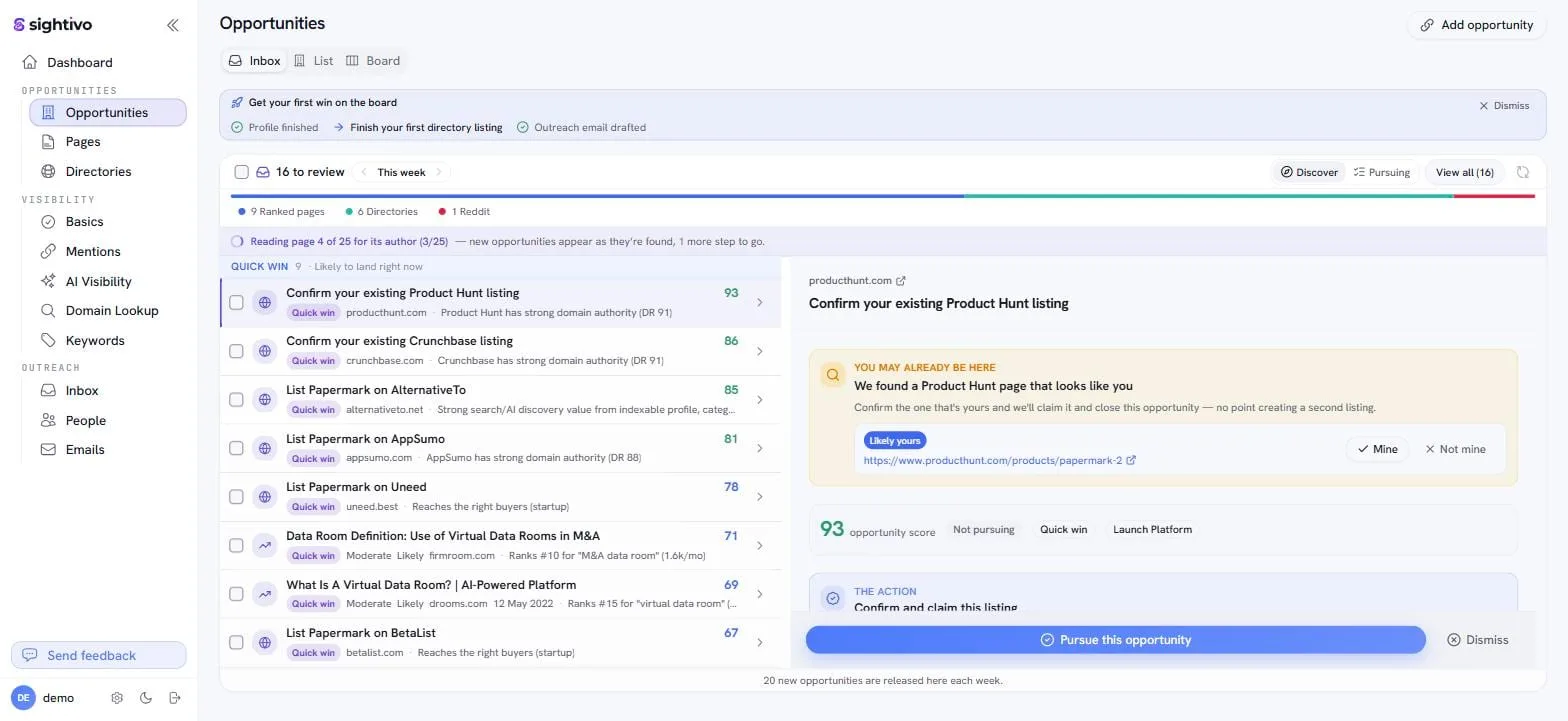
A genuine off-page recommendation is more specific than anything a rank tracker produces. It names:
- The page. Not "build links" — this comparison post, ranking fourth for your category term and cited by ChatGPT in two of your tracked prompts, which lists four competitors and not you.
- Why it's worth it. What it's ranked for, whether AI engines cite it, how relevant its audience is to your buyers.
- The person. The author or editor who actually maintains it, with a verified contact, not a generic form.
- The angle. A reason they'd care, grounded in what the piece already says.
- The follow-up. Diarized, because most positive replies come after the second touch — Backlinko's 12-million-email dataset puts the lift at 65.8% more replies from a single follow-up.
That is a recommendation you can act on before lunch. It's also the thing neither stack sells you.
How to Audit Your Own Stack
Run each tool you pay for through three questions:
What does it measure, and does something else already measure that? Duplicate rank tracking across three subscriptions is common and invisible until you look.
When it finds a gap, what does it hand me? A number, a chart, an export, or an action? Be strict — "here are 400 prospects" is an export, not an action.
If it's an action, is it on my site or someone else's? If everything in the column is on your own domain, you have no coverage of the thing that drives most of both rankings and AI citations.
Most teams discover they're paying two to four subscriptions to be told, in increasing detail, that they're not mentioned enough — and nothing about how to fix it.
Where Sightivo Sits
We built Sightivo because we kept running that audit on our own stack and getting the same answer.
It tracks both surfaces in one place — rankings and backlinks alongside how often ChatGPT, Perplexity, Gemini and AI Overviews mention you — so the two halves stop being separate subscriptions. Then it does the part the rest of the category skips: it scores the specific pages, directories and roundups worth pursuing in your category, finds the authors behind them with contact details, drafts the outreach, and tracks the follow-ups.
It is not an Ahrefs-scale index and doesn't try to be. The bet is different: that the bottleneck for most teams isn't more data about the gap, it's the twenty hours of research between knowing the gap exists and sending a pitch that earns a reply.
Common Questions
Do I still need an SEO suite?
If systematic competitor backlink research is a real part of your job, yes. Ahrefs and Semrush are excellent at what they do. The question is whether you need them and a separate GEO subscription and a contact finder and a sending tool, or whether one workflow covers the work while free webmaster tools cover the data.
Aren't on-page recommendations still worth it?
Absolutely — they're just finite. You can fix your title tags once. You cannot fix "nobody in your category mentions you" once; that's ongoing work with other people.
Why don't the big suites just add off-page recommendations?
Some are edging toward it. It's a different product, though: contact data, relationship state and outreach are a CRM problem, not a crawl problem, and the incumbents are built around crawls.
Is GEO really a separate discipline from SEO?
Less than the marketing suggests. The measurement differs; the underlying work — earning credible mentions in relevant places — overlaps heavily. We compared them properly in GEO vs. SEO.
What should I buy first if I'm starting fresh?
Free webmaster tools for data, and one workflow tool that turns gaps into named actions. Add a full suite when link research itself becomes your bottleneck, not before.
Key Takeaways
- The SEO and GEO stacks measure two surfaces that one activity — earned mentions — drives
- Recommendation features across both stacks are overwhelmingly on-page and technical
- On-page dominates because your own site is computable; off-page needs judgment, identity data and relationship state
- A real off-page recommendation names the page, the person, the angle and the follow-up
- Audit your stack by asking what each tool hands you when it finds a gap — a number, an export, or an action
If your tools keep telling you about the gap and never about the next step, see how Sightivo turns visibility gaps into named actions or start free.
Topics covered
Related articles
Written by
Product leader who's launched 8 B2B SaaS products over the past 6 years. Experienced in taking products from 0 to 1 and scaling them. Built Sightivo out of frustration while doing backlink outreach for another startup—spent hours juggling spreadsheets and tools just to send a few emails. Decided to build something better and share it with others facing the same pain.
Ready to grow your search & AI visibility?
Sign up for Sightivo to track rankings, backlinks, and how often AI engines cite your brand.
Start free