The 12 Best AEO Tools in 2026 (Answer Engine Optimization)
Sightivo
The 12 Best AEO Tools in 2026 (Answer Engine Optimization)
12 answer engine optimization tools compared on engines, prompts, what they do with a gap and price — verified August 2026 — with free and startup picks.

Answer engine optimization (AEO) is the work of getting your brand named, cited and recommended when someone asks ChatGPT, Perplexity, Gemini or Google's AI Overviews a question — and, in the older sense of the term, of being the direct answer in a featured snippet or a voice result. AEO tools are the software that tells you whether that is happening, for which prompts, against which competitors, and (in a few cases) what to do about it.
The category is eighteen months old and already has more than thirty products in it. This guide compares twelve of them on the things that actually differ: which engines they watch, how many prompts you get at the entry price, what lands in your lap when a gap is found, and whether there is a free way in. It is written for a founder or a small marketing team deciding what to pay for, so the entry tier gets more attention than the enterprise one.
One framing note before the list. AEO and generative engine optimization (GEO) are overlapping names for the same practice; AEO also covers featured snippets and voice answers. Every tool below calls itself something slightly different — AEO platform, GEO tool, AI visibility tracker, LLM monitor — and the label mostly tells you which term the vendor's marketing team bet on. We keep a separate list of the best AI visibility tools and the best GEO tools; the overlap between all three lists is large, and deliberate.
The Best AEO Tools at a Glance
| Tool | Best for | Engines tracked | Starting price | Free tier / trial | Acts on the data? |
|---|---|---|---|---|---|
| Sightivo | Turning AEO gaps into pages and mentions | ChatGPT, Claude, Google AI Overviews | $99/mo | 3-day trial (card) + free checker | Yes — pages, sources, outreach |
| HubSpot AEO | HubSpot customers who want the cheapest entry | ChatGPT, Gemini, Perplexity | $50/mo add-on | Free AI Search Grader | Partly — recommendations |
| Profound | Enterprise teams with prompt-volume research needs | ChatGPT (Starter); +Perplexity, AI Overviews (Growth); up to 9 | $99/mo | Trial via signup | Partly — content workflows |
| Peec AI | Clean daily tracking for mid-market brands | 3 of 6 per plan (ChatGPT, AI Mode, AI Overviews, Copilot, Perplexity, Gemini) | $80/mo (annual) | 7-day trial, no card | No |
| Otterly.AI | The cheapest paid monitor | ChatGPT, AI Overviews, Perplexity, Copilot (+ paid add-ons) | $29/mo | Free trial | No |
| Scrunch AI | Persona-based prompt sets at enterprise scale | ChatGPT, Claude, Gemini, Perplexity, AI Mode/Overviews, Meta | $250/mo (annual) | 7-day trial, no card | Partly — page audits |
| Athena HQ | Free tier with real engine coverage | ChatGPT, Perplexity, AI Overviews, Gemini, Claude (free); 9 on Starter | Free → $295/mo | Free tier (~300 credits) | Partly — recommendations |
| SE Ranking AI Visibility / SE Visible | Teams already on SE Ranking | ChatGPT, AI Overviews, AI Mode, Gemini, Perplexity | $89/mo add-on; SE Visible from $79/mo | 14-day trial | Partly — content suggestions |
| Semrush AI Visibility Toolkit | Semrush customers | ChatGPT, Gemini, Perplexity, AI Overviews | $99/mo per domain | Free checker | Partly |
| Ahrefs Brand Radar | Prompt-volume research on a huge index | AI Overviews/AI Mode, ChatGPT, Perplexity, Copilot, Gemini, Grok | $199/mo per platform (+ Ahrefs plan) | Free AI visibility checker | No |
| Rankscale | Broad engine coverage at a low price | ChatGPT, Perplexity, AI Mode, AI Overviews, Gemini, Claude, Copilot, Grok, DeepSeek, Mistral | From $20/mo | 7-day trial on Pro | Partly — page audits |
| AirOps | Content teams that want insights plus production | ChatGPT (free/Solo); +Google, Perplexity on Pro | Free (ChatGPT only) | Free tier + 14-day trial | Partly — content refresh |
Prices verified August 2026 against each vendor's published plans; annual-billing prices are marked. Where a vendor only quotes on a call, the table says so.
How We Chose
Twelve criteria would be too many; four decide almost every purchase in this category.
Engine coverage relative to your buyers, not the vendor's logo wall. Two engines your customers use, tracked daily, beat nine engines tracked weekly. Semrush's study of 10 million keywords found AI Overviews appeared on 6.49% of queries in January 2025, rose to roughly 25% by July and settled at 15.69% in November — the surface that matters most changes month to month, so coverage of the engines you actually care about matters more than the count.
What lands in your lap after the gap is found. A number, an export, an on-page suggestion, or an off-page action. This is the single biggest difference between tools and it is weighted heaviest here, because the gap is rarely on your site. Surfer's analysis found 67.82% of AI Overview citations go to pages that do not rank in Google's top ten — the citations are being earned somewhere other than the page you would optimise.
Prompt control. Whether you write the prompts or accept a templated set, how many you get at the entry price, and whether the tool shows you the fan-out queries the engine actually searched.
Entry price, not headline price. What it costs the team most likely to be reading this, including the base plan a toolkit sits on and the per-engine add-ons that starting prices hide.
Method, honestly stated: this comparison is based on each vendor's published plans, documentation and user reviews as of August 2026, plus hands-on use of the free tiers and trials we had access to. We have not run a controlled accuracy bake-off across all twelve — AI answers are non-deterministic and vary by session, region and model version, and anyone publishing a precise "accuracy ranking" should be asked how they controlled for that.
The 12 Best AEO Tools
Our tool
1. Sightivo
Disclosure: Sightivo is our product. The facts below are the same ones we hold competitors to.
Sightivo tracks how ChatGPT, Claude and Google AI Overviews answer the buyer prompts in your category, records which brands get named and which sources get cited, and then does the part most of this list stops at: it turns the gap into work. It drafts the comparison, list and answer pages your site is missing, finds the third-party pages the engines already cite and are open to adding you, surfaces the authors and contacts behind them, and drafts the outreach.
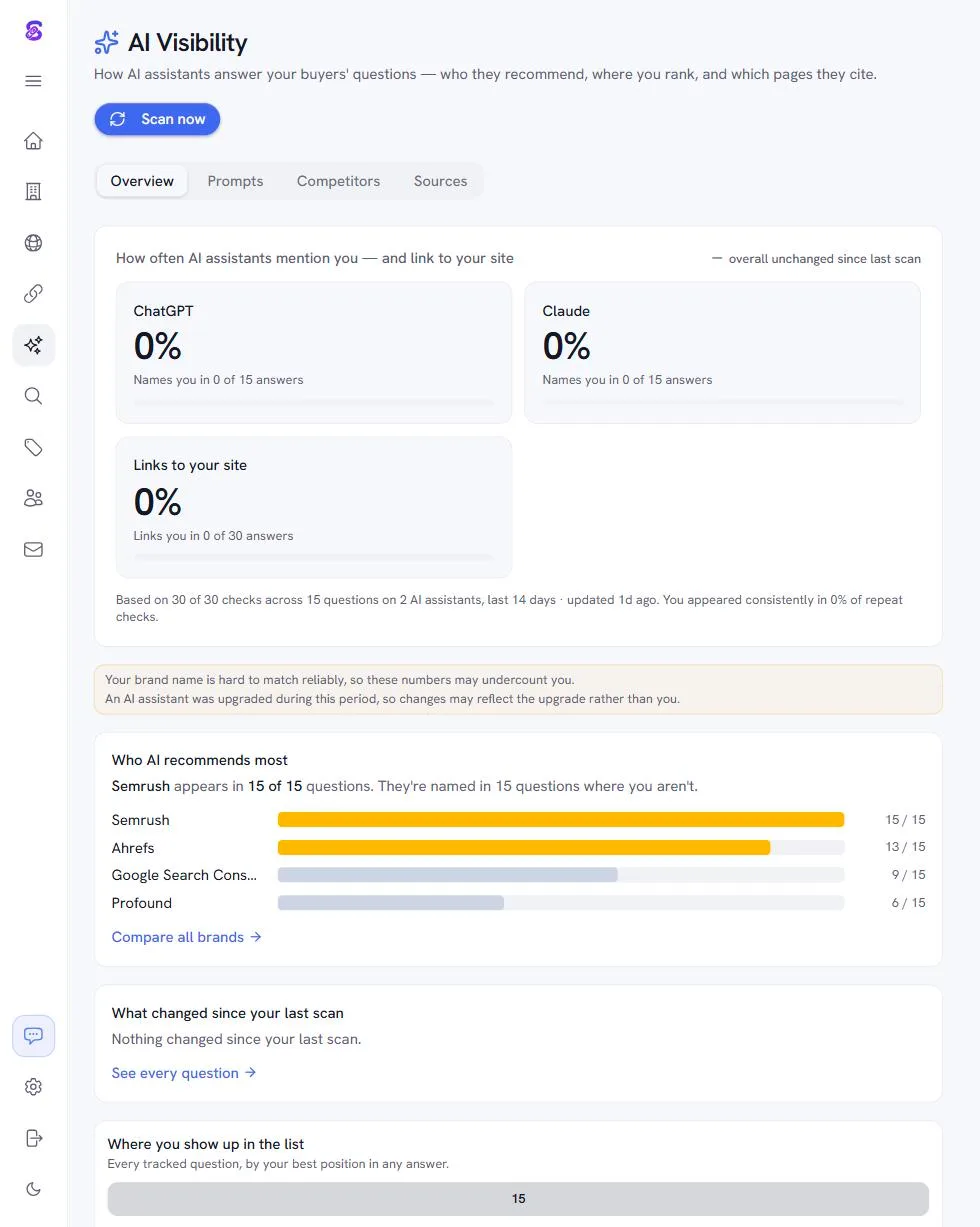
Engines: ChatGPT, Claude, Google AI Overviews.
Pricing: Solo $99/mo (2 projects), Indie $199/mo (4 projects), Studio $399/mo (10 projects). Unlimited seats on every plan. 3-day trial with a card, sized to run the whole loop once. No long-term free plan — the free AI visibility checker (ChatGPT, five prompts, no signup for the first run) is the free part.
Best for: Startups and small teams that want the next action, not the next dashboard.
One honest con: Three engines, not nine; prompt volumes are sized for one brand at a time; no white-label reporting. Agencies running many clients will outgrow the Solo tier fast.
2. HubSpot AEO
The cheapest paid entry in the category and the one most likely to be sitting in a tool you already pay for. HubSpot AEO is a $50/month add-on ($45 on annual billing) that tracks brand visibility and sentiment across ChatGPT, Gemini and Perplexity, reports competitor share of voice and citations, and produces prioritised recommendations. 25 prompts are included; more can be bought.
Engines: ChatGPT, Gemini, Perplexity.
Pricing: $50/mo add-on. The free AI Search Grader gives a one-off snapshot with competitive positioning — the closest thing in the category to a free AEO audit.
Best for: HubSpot customers, and anyone who wants a credible baseline for the price of a lunch.
One honest con: 25 prompts is thin for a category with more than five buyer questions, and the recommendations are mostly on-page — HubSpot's own published case ("1,850% growth in leads from AI") is a vendor claim, not an independent study.
3. Profound
The enterprise reference point. Profound's Conversation Explorer reports real prompt volumes from a dataset it puts at 1.9 billion prompts, its citation analysis shows which pages engines lean on, and Agent Analytics tracks AI crawler traffic on your site. The Workflows feature drafts a few articles a month. It is the tool the rest of the category is measured against, and it is priced like it.
Engines: ChatGPT only on Starter; ChatGPT, Perplexity and AI Overviews on Growth; up to nine on Enterprise.
Pricing: Starter $99/mo (annual) — ChatGPT only, 50 prompts, one seat. Growth $399/mo — three engines, 100 prompts, three seats. Enterprise custom.
Best for: Enterprise teams that need prompt-volume research and multi-company reporting.
One honest con: The $99 tier is one engine; three engines start at $399. Reviews consistently mention "too much data, not enough direction".
4. Peec AI
Peec is the clean, daily-tracking option for mid-market brands: source and citation views, competitor benchmarking, and an interface that agencies like putting in front of clients. Every self-serve plan lets you choose three of six engines; everything beyond that is Enterprise.
Engines: Three per plan from ChatGPT, AI Mode, AI Overviews, Copilot, Perplexity and Gemini; up to eleven on Enterprise.
Pricing: Starter $80/mo billed annually (about $95 monthly) — 50 prompts, three models, one project. Pro $205/mo — 150 prompts. Advanced $420/mo — 350 prompts, multi-country, Looker Studio. 7-day trial, no card.
Best for: Brands that want daily tracking they can trust and nothing they do not need.
One honest con: Monitoring only — no content, audit or outreach layer. The three-engine cap applies to every tier you can buy without a sales call.
5. Otterly.AI
The cheapest paid monitor on the list, and a sensible first tool for a founder who wants to know whether the problem exists before spending real money. Otterly converts your existing keywords and URLs into prompts, tracks them across the base engines, and adds GEO page audits and, on higher tiers, API and MCP access.
Engines: ChatGPT, Google AI Overviews, Perplexity, Copilot on the base; Claude, Gemini and AI Mode are paid add-ons.
Pricing: Lite $29/mo — 15 prompts. Standard $189/mo — 100 prompts, API. Premium $489/mo — 400 prompts. Annual billing takes 15% off. Free trial.
Best for: A first look at the problem for under $30.
One honest con: 15 prompts on Lite is genuinely too few, and the engine add-ons erode the price advantage once you want Claude or Gemini.
6. Scrunch AI
Scrunch is built around personas: you define who your buyers are, it generates prompt sets per persona from an industry library, tracks how each engine answers, and audits your pages for AI readability. All engines come on every plan, which is unusual.
Engines: ChatGPT, Claude, Gemini, Perplexity, AI Mode/AI Overviews, Meta — all plans.
Pricing: Starter $250/mo annual ($300 monthly) — three seats, 350 custom + 1,000 industry prompts, five page audits. Growth $417/$500. Enterprise custom. 7-day trial, no card.
Best for: Enterprise teams that think in personas and want every engine from day one.
One honest con: No small plan; multi-brand is Enterprise-only; the action layer is on-page audits only.
7. Athena HQ
Athena has the most generous free tier in the category — five engines and roughly 300 credits at no cost — and a Starter plan that jumps straight to $295. The platform pairs prompt and response analysis with competitor insights, content recommendations and an "Athena agent" that proposes on-page and off-page actions.
Engines: ChatGPT, Perplexity, AI Overviews, Gemini, Claude on the free tier; nine models on Starter (adds AI Mode, Copilot, Grok).
Pricing: Essential free (about 300 credits, one credit per AI response, unlimited members). Starter $295/mo (annual −17%) — 3,600 credits, CSV export. Enterprise custom.
Best for: Getting a real multi-engine baseline for free.
One honest con: The free-to-$295 cliff, and credit billing that is hard to forecast when prompts multiply across engines.
8. SE Ranking AI Visibility (and SE Visible)
If you already run rank tracking in SE Ranking, its AI Visibility add-on is the obvious extension: 200 prompts across the major engines, source and citation reporting, and content suggestions in the same interface as your classic SEO data. SE Visible is the same engine sold standalone.
Engines: ChatGPT, AI Overviews, AI Mode, Gemini, Perplexity.
Pricing: $89/mo add-on ($71 annual) on top of the $129 Core plan, 200 prompts. SE Visible standalone from $79–99/mo, 200 prompts, three projects. 14-day trial.
Best for: Teams that want AI answers next to their rankings without a second tool.
One honest con: The add-on maths — Core plus AI Visibility is $218/mo before you have any AI-specific action layer.
9. Semrush AI Visibility Toolkit
Semrush's answer to the category is a $99/month per-domain add-on with 25 prompts included and roughly $60 per additional 50. It reports mentions, sentiment and share of voice across four engines and plugs into the rest of the Semrush suite, which is the point.
Engines: ChatGPT, Gemini, Perplexity, AI Overviews.
Pricing: $99/mo per domain on top of a Semrush plan; free AI Search Visibility Checker.
Best for: Semrush customers who want one login.
One honest con: 25 prompts at $99 is the least generous entry allocation on this list, and it assumes a Semrush plan underneath.
10. Ahrefs Brand Radar
Brand Radar is less a monitor than a research index: a prompt pool Ahrefs puts at 414 million-plus, from which you can see how often a brand or topic appears in AI answers across platforms. Ahrefs' own 75,000-brand study found branded web mentions correlate with AI visibility at 0.664 versus 0.218 for backlinks — a finding Brand Radar is built to exploit.
Engines: AI Overviews and AI Mode, ChatGPT, Perplexity, Copilot, Gemini, Grok.
Pricing: $199/mo per AI platform or $699/mo for all, plus an Ahrefs base plan — realistically around $828/mo all-in. Free AI visibility checker.
Best for: Prompt-volume and share-of-voice research at scale.
One honest con: The all-in price, and no action layer at all.
11. Rankscale
Rankscale covers more engines than anything else on the list — ten named, plus more — at the lowest starting price, with answer-credit billing rather than prompt caps. Pro adds page audits and ten brand dashboards.
Engines: ChatGPT, Perplexity, Google AI Mode, AI Overviews, Gemini, Claude, Copilot, Grok, DeepSeek, Mistral and others.
Pricing: Essentials from $20/mo. Pro $99/mo — up to 4,800 AI answers, ten dashboards, 50 page audits, 7-day trial. Growth $385/mo. Enterprise $780/mo.
Best for: Breadth of engine coverage on a small budget.
One honest con: Credit-based billing means "how many prompts do I get" has no simple answer, and the action layer is on-page audits.
12. AirOps
AirOps started as a content-operations platform and added AI search insights on top; the result is the only tool here with a free tier that tracks 100 prompts (ChatGPT only) and a paid tier that connects the gaps it finds to content refresh and creation workflows.
Engines: ChatGPT on the free and Solo tiers; ChatGPT, Google, Perplexity and more on Pro.
Pricing: Insights free (1,000 tasks, ChatGPT only). Solo free to start — 100 prompts, ChatGPT only. Pro and above custom pricing, 250 tracked prompts, multi-engine. 14-day trial.
Best for: Content teams that want insight and production in one place.
One honest con: Multi-engine tracking is behind a sales conversation, and the tool is fundamentally about content, not about the third-party sources that supply most citations.
Picks by Situation
No budget. Athena HQ's free tier for a multi-engine baseline, HubSpot's AI Search Grader for a one-off snapshot, our free AI visibility checker for five ChatGPT prompts in a minute. The fuller list is in free AI visibility tools.
Startup, under $100/mo. Otterly Lite ($29) to confirm the problem exists; HubSpot AEO ($50) if you are on HubSpot; Rankscale Essentials ($20) for engine breadth; Sightivo Solo ($99) once you want the gaps turned into pages and mentions. More on what matters at this stage in AI visibility tools for startups.
Agency. Peec for the client-facing interface, Scrunch for persona prompt sets, SE Ranking for AI answers beside rankings. We compare the multi-client specifics in AI visibility tools for agencies.
What an AEO Tool Should Be Measuring
Whatever the vendor calls the dashboard, four numbers matter:
- Mention rate — the share of tracked prompts where your brand is named at all. Most brands start near zero; that is normal, not a verdict.
- Citation rate — the share where a page on your domain is cited as a source. Different from being mentioned: a brand can be recommended from memory and never linked.
- Share of voice — your mentions as a share of all brands named for the prompt set, against named competitors.
- Cited sources — the third-party pages the engines lean on for your category. This is the list that tells you where to get mentioned. Evertune's review of 40,000 heavily cited URLs found 50% of ChatGPT citations are listicles and the median cited page runs 941 words with four H2s and ten images — the shape of page to be on, and to write.
Two more numbers explain why any of this is worth paying for. Seer Interactive's client case measured ChatGPT referral traffic converting at 15.9% against 1.76% for Google organic. And Otterly's report on more than a million citations found 73% of sites had a technical barrier blocking at least one AI crawler — a lot of brands are invisible for reasons that take an afternoon to fix.
Common Questions
What is the best AEO tool?
For a startup that wants the gap turned into work, Sightivo — with the disclosure that it is ours. For the cheapest credible baseline, HubSpot AEO at $50 or Otterly at $29. For enterprise research depth, Profound. There is no best tool independent of budget and team size; the table above is organised so you can pick for yours.
What is AEO vs SEO?
SEO is the practice of ranking pages in a list of links; AEO is the practice of being named, cited or quoted inside a single generated answer. The signals overlap heavily — Search Engine Land's analysis found 72% of ChatGPT-cited pages open with a short, direct "answer capsule", which is also good featured-snippet practice — but AEO leans much harder on third-party mentions, and its unit of success is a mention rather than a position. We go deeper in the answer engine optimization guide.
Is AEO replacing SEO?
No. Most AI answers are still assembled from pages that rank; Google's own guidance says optimising for its generative features is "still SEO". AEO adds measurement (are we in the answer?) and a set of off-site tactics on top of SEO; it does not replace the crawlable, well-structured, well-linked site underneath.
What are AEO tools used for?
Three jobs: measuring whether and how your brand appears in AI answers for a defined prompt set; identifying which competitors and which third-party sources the engines favour; and, in the better tools, turning that into content to publish and mentions to earn. Most of the category does the first two.
Are there free AEO tools?
Yes. Athena HQ's Essential tier tracks five engines with about 300 credits at no cost; HubSpot's AI Search Grader, Semrush's AI Search Visibility Checker, Ahrefs' AI Visibility Checker and our AI visibility checker give one-off snapshots; AirOps tracks 100 ChatGPT prompts free. None of the free options include an action layer.
How much do AEO tools cost?
Entry tiers run from $20 (Rankscale) and $29 (Otterly) through $50 (HubSpot add-on), $80–99 (Peec, Profound, Semrush add-on, Sightivo) to $250–295 (Scrunch, Athena Starter). Enterprise platforms are quoted on a call. Add-ons hide the real number: SE Ranking's $89 sits on a $129 plan, Ahrefs Brand Radar realistically lands near $828 all-in.
Which are the best rated answer engine optimization tools?
By G2 review volume, Profound leads the category with more than a thousand reviews at around 4.5–4.6 stars; HubSpot's AEO benefits from HubSpot's overall rating; Peec and Scrunch are the best-reviewed of the mid-market monitors. For the top rated answer engine optimization for AI products specifically — software brands trying to get recommended — the tools with an action layer (Sightivo, Athena, AirOps) rate higher on outcome than the pure monitors, because a software buyer's prompts are exactly the "best X for Y" questions engines answer with listicles.
Key Takeaways
- Every tool measures; only a few act. Weight the "acts on the data" column heaviest.
- Entry price is not the price: check the base plan and per-engine add-ons.
- Three engines your buyers use, tracked daily, beat nine tracked weekly.
- Free options exist for the baseline (Athena, HubSpot Grader, our checker); pay when you want the gap worked.
- AEO and GEO are the same practice under two names; pick the tool for the job, not the label.
If you'd rather your AEO tool named the next action than the next number, read how answer engine optimization works or start free.
Topics covered
Related articles
Written by
Product leader who's launched 8 B2B SaaS products over the past 6 years. Experienced in taking products from 0 to 1 and scaling them. Built Sightivo out of frustration while doing backlink outreach for another startup—spent hours juggling spreadsheets and tools just to send a few emails. Decided to build something better and share it with others facing the same pain.
Ready to grow your search & AI visibility?
Sign up for Sightivo to track rankings, backlinks, and how often AI engines cite your brand.
Start free