
Athena HQ Review (2026): Pricing, Credits, Pros and Cons
Sightivo
Athena HQ Review (2026): Pricing, Credits, Pros and Cons
Athena HQ review: a free tier, then $295/mo for 3,600 credits across nine engines. What the credit model really buys, what the agent does, and who it suits.

Athena HQ is the AI visibility tool most people try first, because trying it costs nothing. It is one of the few products in the category with a genuinely usable free tier — real data, your own brand, no card — and one of the fewer still that recommends actions rather than only reporting scores. It is also the tool people most often ask us about the pricing of, because the step from free to paid is $295 a month, and what that $295 buys is measured in credits rather than prompts.
This review covers what Athena does, what the credit model actually gets you (prices checked August 2026), what its agent does and does not do, and who should buy it. Disclosure: we build a competing product, and the comparison section says so. Everything else comes from Athena's published plans and documentation, its funding announcements and public user reviews — we have not run it on a paid plan.
TL;DR: Athena HQ is the best free way to see where you stand across nine AI engines, with the most complete engine list in the category and an agent that tells you what to change. The paid step is steep and metered: $295/mo buys 3,600 credits, and one credit is one AI response, so nine engines and daily refreshes burn through it fast. The recommendations are real, but the off-site half — getting mentioned on pages you do not own — is still hands. Start on the free tier; think hard before the $295.
What Athena HQ Is
Athena HQ (athenahq.ai) is a generative engine optimisation platform: it runs your prompts against AI assistants, records whether and how your brand appears, benchmarks you against competitors, and runs an agent that recommends changes. It covers a wider engine list than almost anything else in the category — ChatGPT, Google AI Overviews, Google AI Mode, Perplexity, Gemini, Microsoft Copilot, Claude, Grok and DeepSeek — with the free tier limited to five of them.
The core surfaces are:
- Prompt and response analysis — mention rate, position and the full answer text, per engine.
- Source insights — which domains and URLs the engines cited when they answered.
- Competitor benchmarking — share of voice against the brands you name.
- The Athena agent — recommendations for on-page and off-page changes, plus a content optimisation agent on paid plans.
Athena came through Y Combinator's Winter 2025 batch and raised a $2.2M seed round in mid-2025 with Y Combinator among its investors. It was founded by Andrew Yan, previously on information acquisition at Google Search, and Alan Yao, who built AI tooling at ServiceNow. That pedigree shows in the product: the retrieval and source analysis are noticeably sharper than the average dashboard.
Athena HQ Pricing (Checked August 2026)
Athena publishes a free tier, one self-serve paid plan and a custom Enterprise tier on athenahq.ai/pricing.
| Plan | Price | Credits / month | Engines | Seats |
|---|---|---|---|---|
| Essential | Free | 300 (about $25 of credit) | 5 | Unlimited |
| Starter | $295/mo (about $245/mo annual) | 3,600 | 9 | Unlimited |
| Enterprise | Custom | Custom | 9 | Unlimited |
Annual billing takes roughly 17% off Starter. Extra credits are sold at about $100 per 1,250. Starter adds API access, CSV export, integrations, on-page and off-page actions and the content optimisation agent. Enterprise adds the knowledge base, discrepancy detection, the Athena Citation Engine, SAML and OIDC SSO, audit logs, multi-region and multilingual support, persona targeting and BI integrations.
Unlimited seats on every plan, including the free one, is genuinely unusual and worth noting — most competitors charge per seat or cap you at three.
What a Credit Actually Buys
This is the part worth doing the arithmetic on, because the plan page does not.
One credit is one AI response. Not one prompt — one prompt, on one engine, on one run. So the number of prompts you can actually track is:
credits ÷ engines ÷ refreshes per month
On Starter that is 3,600 credits. Track across all nine engines and refresh daily: 3,600 ÷ 9 ÷ 30 ≈ 13 prompts. Drop to eight engines and it is about 15. Refresh weekly instead of daily and the same budget carries roughly 55 prompts across nine engines.
Thirteen prompts is a narrow window on a category. For comparison, Scrunch's $250/mo Starter includes 350 custom prompts plus a 1,000-prompt industry library, and Peec's ~$80/mo plan includes 50 — both on flat billing across a smaller engine list. Athena's trade is breadth of engines against depth of prompts, and the credit meter is what makes that trade for you.
The free tier's 300 credits work the same way: enough for a real first look — one prompt set, five engines, a handful of runs — and not enough to monitor anything continuously. That is a fair design for a free tier, and it is the single best way to get an honest baseline for your brand without spending anything.
What Athena HQ Does Well
The free tier is the best in the category. Real data, your own brand, unlimited team members, no card. Nothing else lets you answer "are we even in the answers?" at zero cost with this much fidelity.
Nine engines, including the ones others charge extra for. Claude, Gemini, Grok and DeepSeek are add-ons or Enterprise-only almost everywhere else. Here they are on the $295 plan.
It recommends, it does not only report. The agent produces on-page and off-page suggestions rather than a score and a shrug. In a category where most tools stop at the dashboard, that is a real differentiator.
Onboarding and time-to-data are fast. The recurring note in user reviews is how quickly you get from signup to tracked prompts — one reviewer contrasted a week with Athena against two demos and a security review elsewhere.
Users rate it highly. G2 lists 34 reviews at about 4.9 out of 5, praising the automation, the quality of the insights, the interface and the speed of support.
Where Athena HQ Stops
Free, then $295, with nothing in between. The ladder has one rung and it is a tall one. A founder who likes the free tier faces a tenfold jump to continue, with no $79 or $99 option in the middle.
Credits are hard to budget. Adding an engine, a market or a daily refresh multiplies the responses you pay for without changing the plan. Teams consistently report not knowing what next month will cost — the exact complaint that flat-priced tools like Scrunch, Peec and Sightivo do not generate.
No trial of the paid tier. The free plan is a taste of a five-engine product; there is no way to try the nine-engine paid feature set before committing $295. Reviewers name this as the main friction for smaller teams.
Recommendations still need hands. Athena will tell you a page needs restructuring, or that a source ought to mention you. Finding the author of that source, getting a verified contact, writing the pitch and sending it are outside the product. That last mile is where the results are: Ahrefs' study of 75,000 brands found branded web mentions correlate about three times more strongly with AI visibility than backlinks do, and roughly 44% of ChatGPT citations go to "best of" list pages you do not control.
Its best features are Enterprise. Discrepancy detection, the Citation Engine, persona targeting and the knowledge base are the parts that most differentiate Athena, and none of them are on the $295 plan.
Attribution is directional, not accounting-grade. Worth saying about every tool in this category, Athena included: AI visibility numbers are a useful trend line, not a ledger. Treat a 4-point move as a signal, not a result.
What Users Say
The praise is consistent: fast onboarding, auditable data, an interface with almost no learning curve, and support that ships fixes. Several reviewers describe the action layer as a genuine step beyond pure monitoring — the thing they were looking for when they left a dashboard-only tool.
The criticism is equally consistent and it is nearly all about money: premium pricing for the volume you get, the absence of a paid trial, and credit spend that is hard to forecast. Nobody seems to dislike the product; plenty of people cannot justify the plan.
Athena HQ vs Sightivo
We make Sightivo, so weigh this section accordingly.
| Athena HQ | Sightivo | |
|---|---|---|
| Free option | Free tier, 300 credits, 5 engines | Free AI visibility checker, no signup |
| Entry paid price | $295/mo | $99/mo |
| Billing | Credits (1 credit = 1 AI response) | Flat monthly |
| Engines | 9 | ChatGPT, Claude, Google AI Overviews |
| Prompts at entry paid tier | ~13/day across 9 engines at daily refresh | Prompt sets sized for one brand |
| Seats | Unlimited | Unlimited |
| Recommendations | On-page and off-page suggestions | Drafts the missing page, lists the sources AI cites, finds the authors and contacts, drafts the outreach, sends it from a built-in inbox |
| Projects | Per workspace | Solo 2, Indie 4, Studio 10 |
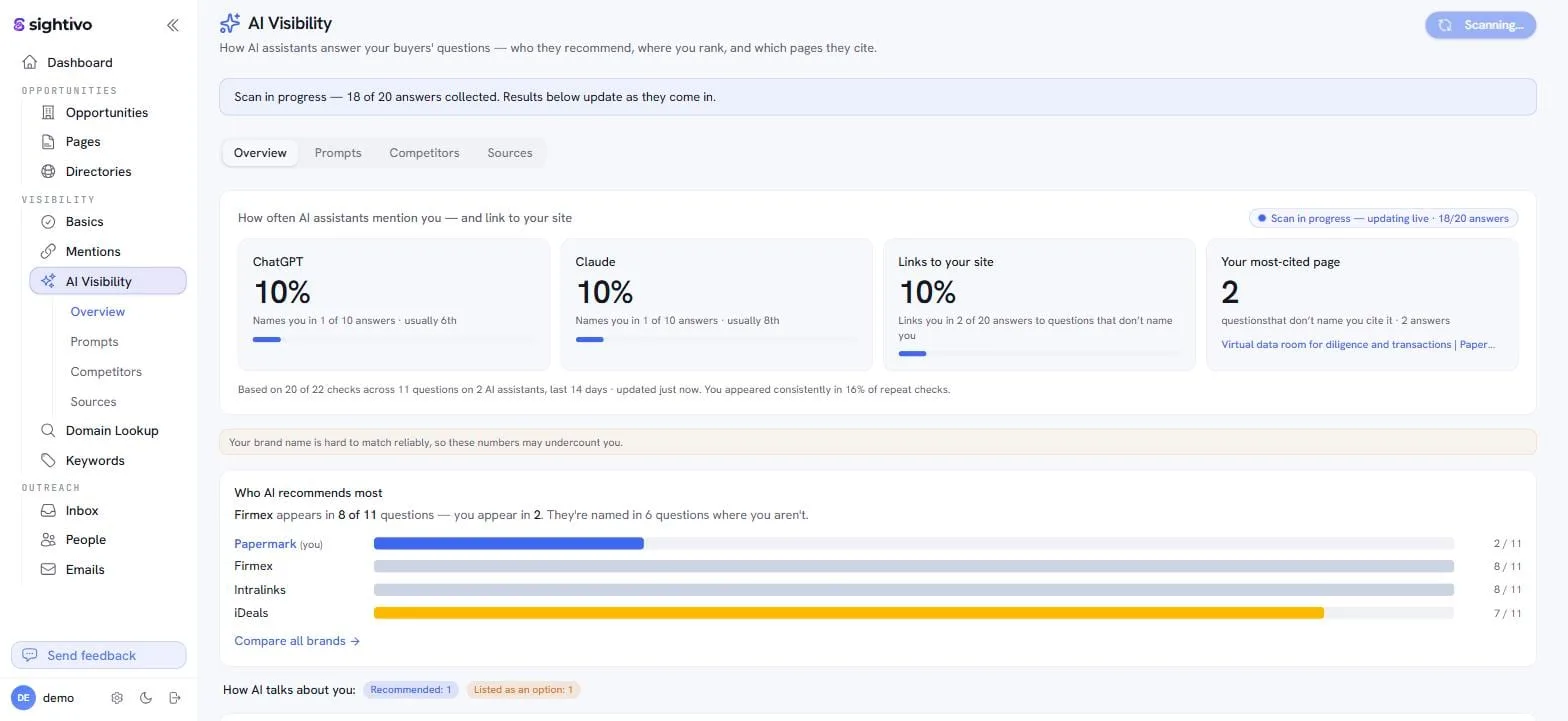
The honest summary: Athena covers three times the engines and will tell you what to change. Sightivo covers the three engines that drive most AI referral traffic and then does the changing — including the off-site part Athena hands back to you. If engine breadth is the requirement, Athena wins it outright. If the bottleneck is that nobody on your team has time to chase the citation once you know it is missing, breadth is not the constraint.
Athena HQ Alternatives
The short version: Peec AI at about $80/mo for flat-priced reporting in the gap between Athena's free and $295 tiers; Otterly AI at $29/mo if you only need the numbers; Scrunch AI for a similar budget with flat billing and far more prompts — see our Scrunch AI review; Profound if you want the deepest measurement and budget is not the constraint; SE Ranking if you want SEO and AI reporting in one suite; Sightivo if you want the recommendations carried through to sent outreach. All seven compared by price, coverage and action in best Athena HQ alternatives, and in the wider best AEO tools roundup.
When Athena HQ Is the Right Choice
- You need the widest engine coverage available — Claude, Gemini, Grok and DeepSeek included — without an enterprise contract.
- You want to start free with real data on your own brand before spending anything. Nothing else in the category does this as well.
- You have writers and a PR function ready to act on recommendations, and you want a tool that produces them rather than only scores.
- Unlimited seats matter — a whole team, or a client, needs to see the dashboard.
- You track a focused prompt set rather than a broad one, so 3,600 credits a month is enough headroom.
- You are heading for the enterprise track anyway, where the knowledge base, Citation Engine and persona targeting live.
When to Look Elsewhere
- You need to track more than a couple of dozen prompts and $295 is your ceiling — flat-priced tools give you far more volume for the money.
- You need a predictable invoice. Credits and finance departments do not get along.
- You want to try the paid product before buying it.
- You want the off-site work done, not recommended.
- You need only two or three engines, in which case you are paying for breadth you will not read.
Common Questions
How much does Athena HQ cost?
Athena HQ has a free Essential tier with 300 credits (about $25 of credit) across five engines, a Starter plan at $295/mo — about $245/mo on annual billing — with 3,600 credits and nine engines, and custom Enterprise pricing. Extra credits are around $100 per 1,250. One credit equals one AI response. Unlimited seats on every plan. Prices checked August 2026.
Does Athena HQ have a free plan?
Yes. The Essential tier is free and gives you 300 credits across five engines with unlimited team members and no card required. It is the most usable free tier in the category — enough for a real baseline, not enough for continuous monitoring.
How many prompts can I track on Athena HQ Starter?
It depends on engines and refresh frequency, because credits are spent per response. 3,600 credits across nine engines refreshed daily is about 13 prompts (3,600 ÷ 9 ÷ 30). Refresh weekly instead and the same budget covers roughly 55 prompts. Cut to three engines and daily refresh gives you about 40.
What engines does Athena HQ track?
ChatGPT, Google AI Overviews, Google AI Mode, Perplexity, Gemini, Microsoft Copilot, Claude, Grok and DeepSeek on paid plans. The free Essential tier covers five of them.
Is Athena HQ worth it?
The free tier is worth it to everyone — it costs nothing and gives you a real baseline. The $295 plan is worth it if you need nine-engine coverage and will act on the recommendations, and hard to justify if you mostly need volume, since flat-priced tools give you several hundred prompts for similar money.
Does Athena HQ help you get cited, or only recommend?
It recommends. The agent suggests on-page and off-page actions, and the content optimisation agent helps with your own pages. Finding the author of a citing page, getting their contact, writing the pitch and sending it are outside the product.
Athena HQ vs Profound: which is better?
Athena has a free tier, more engines on its entry paid plan, unlimited seats and an action layer. Profound has deeper citation analysis, a far larger prompt-research dataset and enterprise security, but its $99 plan tracks ChatGPT only and three engines cost $399/mo. Athena suits teams that want breadth and recommendations; Profound suits enterprise teams that want measurement depth. See our Profound review.
Key Takeaways
- Athena HQ has the best free tier in AI visibility — 300 credits, five engines, unlimited seats, no card — and the widest engine list on a self-serve plan: nine, including Claude, Gemini, Grok and DeepSeek.
- Paid means $295/mo for 3,600 credits, with nothing between free and that. Annual billing brings it to about $245/mo.
- One credit is one AI response, so 3,600 credits across nine engines at daily refresh works out at roughly 13 prompts — breadth of engines bought with depth of prompts.
- G2 lists about 34 reviews at 4.9/5; the praise is for onboarding, insight quality and support, and nearly all the criticism is about price and credit predictability.
- The agent recommends on-page and off-page actions, but the off-site last mile — the author, the contact, the pitch — is still yours.
If you would rather your AI visibility tool handed you the next page to write and the next person to email, see how Sightivo works — or check what ChatGPT says about your brand for free first.
Topics covered
Related articles
Written by
Product leader who's launched 8 B2B SaaS products over the past 6 years. Experienced in taking products from 0 to 1 and scaling them. Built Sightivo out of frustration while doing backlink outreach for another startup—spent hours juggling spreadsheets and tools just to send a few emails. Decided to build something better and share it with others facing the same pain.
Ready to grow your search & AI visibility?
Sign up for Sightivo to track rankings, backlinks, and how often AI engines cite your brand.
Start free