

Key takeaways
- AEO is about being the answer, not a result. The unit of competition is a slot in one response, and there are usually one to five of them.
- Answer engines retrieve from the web, so SEO still gates entry — but what they say about you comes mostly from third-party pages, not your own.
- AEO, GEO and "AI SEO" describe the same work. GEO is the generative-engine subset; AEO also covers snippets and voice.
- The tactics split in two: make your pages easy to quote, and be present and accurately described in the sources engines already cite.
- Measure with a fixed prompt set run repeatedly: mention rate, citation rate, share of voice, description accuracy. Single runs are noise.
What is Answer Engine Optimization (AEO)?
Answer engine optimization (AEO) is the practice of getting your brand, pages and claims chosen as the answer by systems that reply with a direct response instead of a list of links: AI assistants such as ChatGPT, Perplexity, Gemini, Claude and Copilot; Google AI Overviews and AI Mode; featured snippets; and voice assistants like Alexa and Siri.
It overlaps heavily with SEO — the same relevance and authority still matter — but it changes the unit of competition. SEO competes for a position on a page of results. AEO competes to be quoted, cited or named inside a single answer, where there are usually one to five slots and no page two.
AEO and generative engine optimization (GEO) are used almost interchangeably. The useful distinction: GEO refers specifically to generative AI engines that write a fresh answer each time; AEO is a slightly wider term that also covers non-generative answer surfaces such as featured snippets and spoken voice results. The signals that win one win the others.
The term is a decade old — it started with featured snippets and voice — but it became urgent when assistants started answering buying questions. If a founder asks ChatGPT for the best tool in your category and it names three products, either you are one of the three or you were never in the conversation. There is no page two to climb from.
How answer engines choose their answers
Every answer engine does some version of the same three steps: retrieve candidate pages (from a search index, live), read them, and synthesize or lift an answer with some of them as sources. What differs is which index they retrieve from, how many sources they show, and how much they lean on model memory versus live pages. That difference is why the same question gets different answers — and why one tactic never covers every engine.
| Engine | How it answers | What it cites | What that means for you |
|---|---|---|---|
| ChatGPT (search on) | Retrieves live pages through Bing's index via OAI-SearchBot, then writes an answer; without search it answers from training data. | A handful of inline sources — often roundups, comparison pages, docs, Reddit and vendor pages. | Be indexed by Bing, allow OAI-SearchBot, and be present in the roundups it reaches for. Training-data answers lag months. |
| Perplexity | Search-first: runs its own retrieval for every question and cites heavily. | Five to ten numbered sources; favours recent, well-structured pages and community threads. | Freshness and extractable structure pay off fastest here; changes show within days of a re-crawl. |
| Google AI Overviews / AI Mode | Fans a query out into sub-queries against Google's index and synthesizes; AI Mode does the same conversationally. | Sources drawn largely from pages that already rank in the top results for the sub-queries. | Rankings still matter; question-led headings and direct answers make your page the one that gets lifted. |
| Gemini | Grounds on Google Search when it decides grounding is needed; otherwise answers from the model. | Fewer visible sources; grounded answers link out, ungrounded ones do not. | Same levers as AI Overviews, plus entity consistency so the model's own knowledge of you is right. |
| Microsoft Copilot | Bing retrieval plus a GPT model; Bing Webmaster Tools reports which URLs it cites. | Bing-indexed pages; overlaps heavily with ChatGPT search. | Bing indexation is the shared dependency for two engines — worth checking once. |
| Featured snippets | Google lifts a passage from a top-ranking page into an answer box. | One page, quoted. | A 40–60-word direct answer under a question heading, on a page that already ranks in the top ten. |
| Voice (Alexa, Siri, Assistant) | Reads a single answer aloud, usually sourced from a snippet, a knowledge panel or a partner index. | One answer, no list. | Snippet-style answers plus complete, consistent business and product entity data. |
Two consequences fall out of the table. First, being retrievable is the entry fee: a page that does not rank for the sub-queries, is not in Bing, or blocks the crawler is not a candidate. Second, once retrieved, what the engine says about a brand is a consensus of the pages it read — and for a buying question those pages are mostly not yours. We go deeper on the ChatGPT specifics in how to get cited by ChatGPT.
AEO vs SEO vs GEO
The short version: SEO gets you retrieved, AEO gets you quoted, and GEO is AEO on the generative engines. They share most of their signals and differ in what they optimise for.
| SEO | AEO | GEO | |
|---|---|---|---|
| Goal | Rank a page in a list of results | Be the answer, or a cited source of it | Be named or cited in a generated answer |
| Surfaces | Search results pages | AI assistants, AI Overviews, snippets, voice | ChatGPT, Perplexity, Gemini, Claude, AI Mode |
| Slots | Ten organic, plus features | One to five | One to five |
| Decided mostly by | Your pages + links to them | What third-party sources say about you + how quotable your pages are | Same as AEO |
| Unit of content | The page | The passage, the definition, the table row | The passage and the entity |
| Key signals | Relevance, links, technical health, intent match | Extractability, entity consistency, third-party mentions, freshness, E-E-A-T | Same, plus citation-worthy sources and prompt coverage |
| Measured by | Rankings, impressions, clicks | Mention rate, citation rate, share of voice, accuracy, snippet wins | Mention/citation rate per engine and prompt |
| Feedback loop | Weeks to months | Days (live retrieval) to months (model knowledge) | Days to months |
Is AEO replacing SEO? No — it sits on top of it. Answer engines retrieve from search indexes, so crawlability, indexation and authority still decide whether you are a candidate. What AEO changes is where the marginal hour goes: less toward one more page, more toward making existing pages quotable and toward the third-party footprint. For the generative-engine specifics — levers per engine and the improve-and-remeasure loop — see our generative engine optimization guide.
Why AEO matters now
Three shifts, each documented by the people running the systems:
- 01Answers are the default surface. Google said at I/O 2025 that AI Overviews reach more than 1.5 billion people a month, and AI Mode has since rolled out as a full conversational tab. OpenAI reported ChatGPT passing 800 million weekly users in late 2025. A large share of research now happens where there is no list of links.
- 02Clicks fall when a summary appears. Pew Research Center's 2025 analysis of real browsing data found users clicked a result on about 8% of visits with an AI summary versus 15% without one, and rarely clicked the summary's own citations. Being cited is not the same as being visited — being named is what carries the brand across.
- 03The slots are few and sticky. A results page has ten organic positions and a scroll; an assistant's recommendation has three to five names and no scroll. Whoever occupies them in the sources the engine reads keeps occupying them until the sources change.
For an early-stage company this cuts both ways. Ranking for a head term against incumbents is a multi-year job; being one of three names an assistant gives for "best X for small teams" depends on a handful of roundups and directories, which is a weeks-long job. Our own baseline when we started measuring was 0 of 15 buying prompts — the screenshot below is that dashboard, not a mock-up.
How to do answer engine optimization: eight tactics
Half of these are on your site and half are not. Teams that only do the first half publish a great deal and move nothing, because the answers were being decided elsewhere.
- 01
Answer first, then explain
Open every section — and the page — with a direct answer of one or two sentences, then support it. Engines that lift passages take the passage that answers the question cleanly; a 300-word preamble before the point is a passage that never gets lifted. Question-led H2s ("How is AEO different from SEO?") make the match explicit.
For definitions, write the sentence you would want quoted verbatim: "X is Y that does Z," under thirty words, before any nuance. This page opens that way on purpose.
- 02
Structure for extraction: definitions, tables, steps, FAQs
Comparison tables, numbered steps and FAQ blocks are the formats answer engines reproduce most faithfully, because they carry their structure with them. A "vs" question is best answered with a table row; a "how do I" with a numbered list; a "what is" with a definition block. Use real HTML tables and lists, not images of them.
Add FAQPage and Article markup where it is honest. Schema is housekeeping rather than a ranking lever, but it removes ambiguity about which text is the question and which is the answer.
- 03
Get the entity right, everywhere
An assistant's description of your brand is a consensus of what it has read. If your directory listings say "visual analytics," your homepage says "SEO platform" and a two-year-old press release says something else, the consensus is mush — and mush does not get recommended. Decide the one-line answer to "what is X, who is it for, what does it cost" and make every surface agree: site, G2, Product Hunt, LinkedIn, Crunchbase, founder bios, press boilerplate.
This is the cheapest AEO work there is and the most commonly skipped. It is also the one item you can finish in a week.
- 04
Be present in the sources engines already cite
Ask the engines the questions your buyers ask and read the citations. For most B2B categories they resolve to a small set of pages: category roundups ("best X tools"), comparison and alternatives pages, directories, a few editorial guides and Reddit or community threads. If you are not in those pages, no amount of on-site work puts you in the answer — the engine is not reading you, it is reading them.
So the core off-site motion is: list the cited pages, prioritise the ones that are attainable and relevant, and earn an accurate mention there — a listing, an inclusion, a quote, a review. This is the same work as digital PR and link building, aimed at mentions rather than links, and it is what Sightivo automates.
- 05
Show your work: authors, dates, first-hand evidence
Engines and the search systems beneath them weight experience and expertise signals: a named author with a real profile, a visible published and updated date, and content that could only have been written by someone who did the thing — screenshots, numbers, named examples, a methodology. Anonymous, undated, generic pages are exactly the ones a synthesizer can safely ignore, because it can get the same text anywhere.
- 06
Keep it fresh — genuinely
Perplexity and ChatGPT search favour recent pages, and Google shows updated dates. But "updated" means the content changed, not the date. Re-check prices, replace stale screenshots, add what changed since last quarter, and only then bump the date. Cosmetic freshness is noticed and discounted.
- 07
Make sure engines can read you at all
Check that your important pages return full HTML without JavaScript, that robots.txt does not block OAI-SearchBot, PerplexityBot, Claude-SearchBot or Google-Extended by accident, and that the site is in Bing's index (Bing Webmaster Tools) as well as Google's — ChatGPT search and Copilot depend on it. Bing's AI Performance report shows which of your URLs Microsoft's AI surfaces cite, which is one of the few first-party citation reports that exist.
- 08
Cover the questions, not just the keywords
Keyword research finds phrases people type; prompt research finds the questions they ask an assistant, which are longer, more specific and more comparative ("best X for a five-person team under $100 a month"). Build a prompt set from those — several paraphrases per intent, buying and informational — and use it both to decide what to publish and to measure whether it worked. If a page does not map to a question someone actually asks, it will not be the answer to one.
How to measure AEO
There is no Search Console for assistants, so measurement is something you build: a fixed set of questions, asked the same way, on a schedule, across engines. Several paraphrases per intent, buying questions and informational ones, category questions rather than brand questions. Then track:
- Mention rate
- Share of prompts in your set where the answer names your brand.
- Citation rate
- Share of prompts where one of your URLs is listed as a source.
- Share of voice
- Your mentions as a share of all brand mentions across the set — the competitor view.
- Description accuracy
- Whether what the engine says about you (category, audience, price) is right. Wrong-but-mentioned is a real failure mode.
- Cited third-party sources
- Which external pages the engines cite for your category — the input to the off-site work.
- AI referral sessions
- GA4 sessions from chatgpt.com, perplexity.ai, gemini.google.com, copilot.microsoft.com and similar.
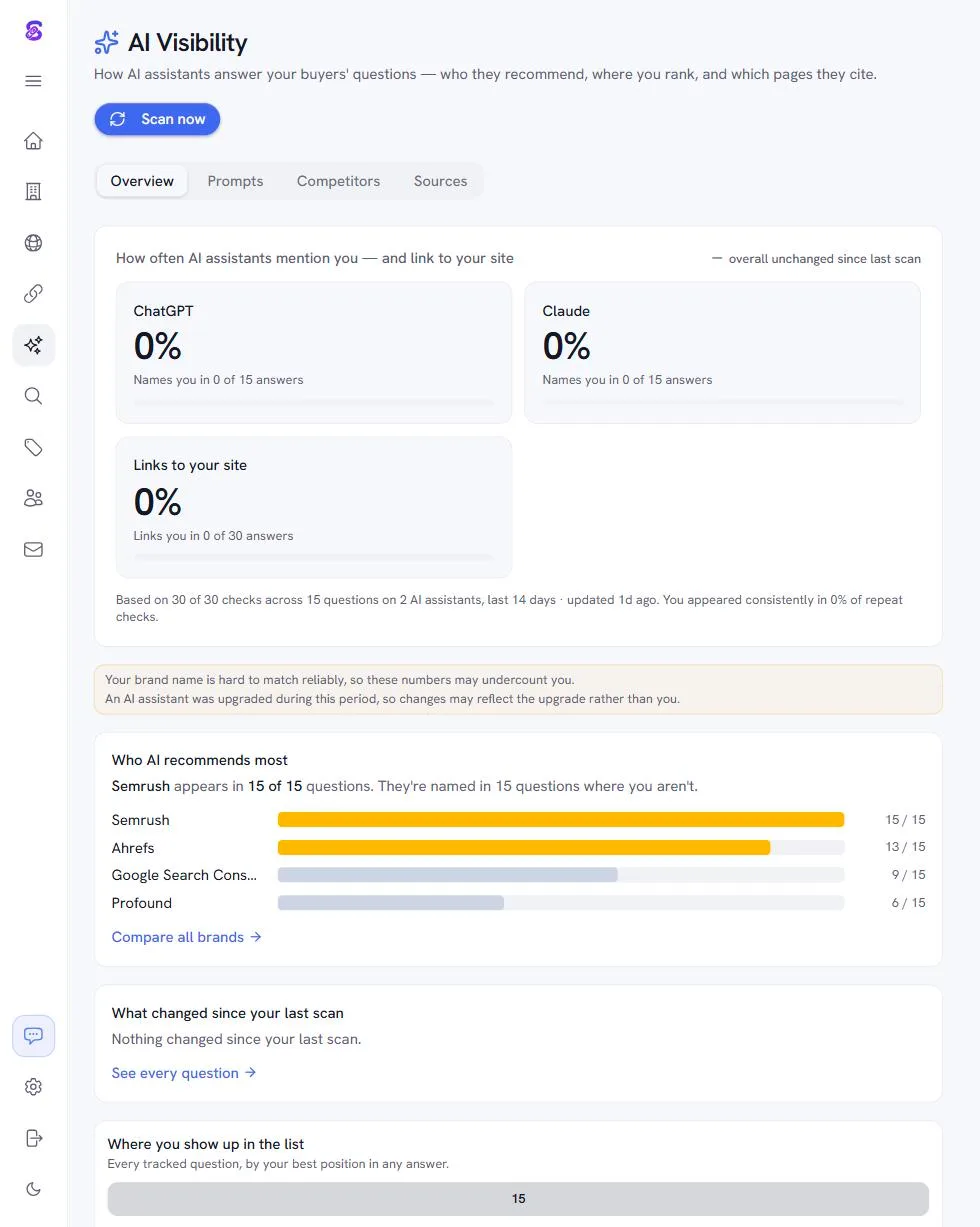
Two rules keep the numbers honest. Runs vary, so compare trends over repeated runs rather than reading a single result as truth. And re-run the set after each batch of work — a new listing, a fixed directory profile, an updated page — so you learn which changes moved which engine.
Common AEO mistakes
Treating it as a content-volume problem
Publishing forty more pages does not change which roundups an engine reads. Most of the answer is decided off your site.
Optimising for one engine, once
Answers vary between engines and between runs of the same engine. A single ChatGPT check is a spot check, not a measurement.
Asking the assistant about your own brand
"What is Acme?" proves nothing — the test is whether it reaches for you unprompted when asked about the category.
Inconsistent entity data
Different descriptions on different directories teach the model a blurry entity. Blurry entities do not get recommended.
Schema as a substitute for substance
FAQ markup on thin answers marks up thin answers. Structure helps extraction; it does not create authority.
Blocking the crawlers you want
Sites block GPTBot to keep content out of training and take OAI-SearchBot with it — removing themselves from ChatGPT search answers entirely.
Chasing links instead of mentions
A nofollow mention in a page an engine cites is worth more for AEO than a followed link from a page it never reads.
AEO tools
The category is young and moves monthly. Roughly, the options are:
- Semrush AI Visibility Toolkit, Ahrefs Brand Radar, SE Ranking — AI-visibility modules inside the big suites; broad engine coverage, enterprise pricing tiers.
- Profound, Peec, Otterly — Dedicated trackers: prompt sets, share of voice and citation reports across engines.
- Sightivo — Tracking across ChatGPT, Claude and Google AI Overviews, plus the part the others stop at — a ranked list of where to get mentioned, with the author, contact and drafted pitch. From $89/mo, unlimited seats.
- Free checkers — Ours asks ChatGPT your category's buying questions and reports who got named; Semrush and SE Ranking have their own. Good for a first look, not for tracking.
We tested ten of them side by side in the best AI visibility tools, with pricing and a disclosure that we make one of them. For a first look without any account, the free AI visibility checker asks ChatGPT your category's buying questions and tells you who got named.
Where Sightivo fits
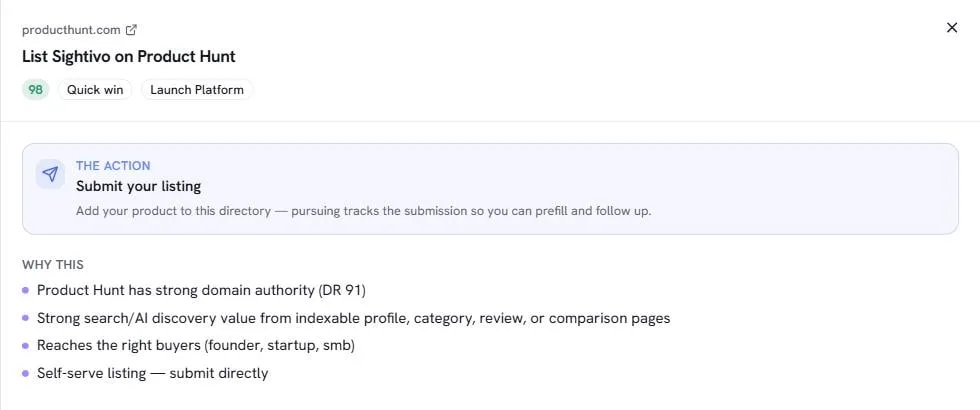
Sightivo is an SEO and AI visibility platform for startups. On the AEO side it does the measurement loop above — a prompt set across ChatGPT, Claude and Google AI Overviews, tracked over time — and then the part most tools stop at: it reads the sources behind the answers you are missing from and turns them into a ranked list of places to get mentioned, each with the author, their contact details and a drafted pitch. You approve what goes out. Plans start at $89/mo with unlimited seats; details and honest limits are on the AI search visibility page.
Answer engine optimization FAQ
What is answer engine optimization?
Answer engine optimization (AEO) is the practice of making your brand and content the answer that AI assistants (ChatGPT, Perplexity, Gemini, Claude, Copilot), Google AI Overviews, featured snippets and voice assistants return to a question — rather than one of many links a person might click. It combines on-page structure that is easy to quote with the off-site mentions and citations that make an engine trust you enough to name you.
How is AEO different from SEO?
SEO competes for a position in a list of results; AEO competes to be quoted, cited or named inside a single answer. SEO signals — relevance, authority, technical health — still underpin AEO, but AEO adds two things: content structured so it can be lifted cleanly (direct answers, definitions, tables, FAQs) and a footprint of third-party mentions in the sources answer engines read, because most of what an assistant says about a brand comes from other people's pages, not the brand's own.
Is AEO the same as GEO?
Nearly. Generative engine optimization (GEO) refers specifically to generative AI engines that synthesize a new answer each time — ChatGPT, Perplexity, Gemini, Claude, Google AI Mode. AEO is a slightly broader term that also covers non-generative answer surfaces such as featured snippets and voice results. In practice teams use the words interchangeably, and the work is the same: be present, accurate and easy to quote in the sources those systems draw on.
Is AEO replacing SEO?
No. Answer engines retrieve from the web, so pages still need to be crawlable, indexed and authoritative to be candidates — ChatGPT search, for example, runs on Bing's index, and AI Overviews on Google's. AEO sits on top of SEO and shifts effort toward extractable structure and third-party mentions. What is shrinking is the share of questions that end in a click at all.
How do I optimize content for answer engines?
Open each section with a direct one- or two-sentence answer, then support it. Use question-led headings, definitions, comparison tables and FAQ blocks. Keep entities (your product name, category, price) consistent everywhere. Add author bylines and update dates. Make sure the page renders without JavaScript. Then do the half that isn't on your site: get accurately mentioned in the roundups, comparisons, directories and communities the engines cite for your category.
How do you measure AEO success?
Fix a set of buying and informational questions in your category, ask them repeatedly across engines, and track four numbers: mention rate (how often you are named), citation rate (how often your pages are cited as sources), share of voice against competitors, and description accuracy (whether what the engine says about you is right). Add AI-referral sessions in GA4 (chatgpt.com, perplexity.ai and similar referrers) as the traffic-side signal. Single runs vary; measure trends over repeated runs.
How long does AEO take to work?
On-page changes can show up in engines that retrieve live (Perplexity, ChatGPT with search, AI Overviews) within days of being re-crawled. Changing what an assistant believes about your brand — which sources it reaches for and how it describes you — depends on earning new mentions and typically takes one to three months to move measurably. Answers that come from model training rather than live retrieval lag by months.
What is the difference between a mention and a citation?
A mention is your brand being named in the answer text ("tools like Acme and Beta"). A citation is your URL being listed as a source the answer drew from. You can be mentioned without being cited (the engine learned about you from a third-party roundup it cited instead), and cited without being mentioned (your page supported a claim about something else). Both matter; mentions are what put you in the buyer's consideration set.
Do backlinks matter for AEO?
Indirectly and directly. Indirectly, links still drive the search rankings that determine which pages an engine retrieves in the first place. Directly, the pages that link to you are usually the pages that mention you — and it is the mention text, not the link, that teaches an assistant what you are. A brand mention on a page an engine cites is worth more for AEO than a bare link from a page it never reads.
What are the best AEO tools?
The suites have added AI-visibility modules (Semrush AI Visibility Toolkit, Ahrefs Brand Radar, SE Ranking), and there are dedicated trackers (Profound, Peec, Otterly, and Sightivo, which pairs the tracking with a prioritized list of where to get mentioned). Free checkers exist for a spot check. We compared the field in our best AI visibility tools roundup; the honest summary is that they differ mostly on which engines they cover, how many prompts you can track, and whether they tell you what to do next.
Does AEO apply to small businesses and startups?
It applies more, not less. An early-stage company rarely outranks incumbents for head terms, but an assistant answering "best X for small teams" has three to five slots and fills them from a handful of roundups and directories. Being present and accurately described in those few sources is achievable for a small team in weeks, which is not true of ranking for the head term.
How does Sightivo help with AEO?
Sightivo runs the measurement loop (a fixed prompt set across ChatGPT, Claude and Google AI Overviews, tracked over time), reads the sources behind the answers you are missing from, and turns them into a ranked list of places to get mentioned — each with the author, their contact details and a drafted pitch. Plans start at $89/mo with unlimited seats; the free AI visibility checker needs no account at all.
Go deeper
Find out which answers you are missing from
Run the free checker to see whether ChatGPT names you for your category, then let Sightivo show you the sources shaping those answers and where to get mentioned next.
Or run the free checker first
Product leader who's launched 8 B2B SaaS products over the past 6 years. Experienced in taking products from 0 to 1 and scaling them. Built Sightivo out of frustration while doing backlink outreach for another startup—spent hours juggling spreadsheets and tools just to send a few emails. Decided to build something better and share it with others facing the same pain.